
Бесплатный фрагмент - Английские времена на практике
Грамматика и повседневные фразы
Предисловие
Изучение английского языка — процесс многогранный и требующий системного подхода, особенно когда речь идёт о временах, которые формируют каркас любого устного или письменного высказывания. Эта книга была создана с целью предоставить изучающим английский комплексный инструмент для освоения всех времен английского языка в практическом контексте, соединяя грамматическую теорию с повседневной речью и полезными упражнениями.
Каждая глава посвящена одному временному аспекту, начиная с простых утверждений и отрицаний, переходя к вопросам и сравнениям, и завершая наиболее сложными формами будущего совершенного и продолженного времени. Особое внимание уделено грамматическим пояснениям и ключевым конструкциям, что позволяет читателю не только правильно строить предложения, но и понимать, в каких ситуациях они употребляются.
Истории, включённые в книгу, созданы с учётом принципов доступного восприятия для изучающих английский: сюжет прост, но интересен, а лексика — актуальна для повседневного общения. Каждая глава сопровождается набором упражнений, позволяющих закрепить материал через сопоставление, заполнение пропусков и ответы на вопросы, что способствует формированию устойчивых навыков.
Надеюсь, что данная книга станет надёжным путеводителем в мире английской грамматики и вдохновит читателя на уверенное и осознанное использование времён языка в повседневной жизни. Моя цель — помочь каждому изучающему не только понимать грамматику, но и чувствовать её естественное применение в реальных ситуациях.
Желаю успехов!
Present Simple — Affirmative (Утверждения)
1. Грамматическое объяснение
Present Simple используется для:
Регулярных действий и привычек:
I wake up at 7 a.m. every day. – Я просыпаюсь в 7 утра каждый день.
Общих истин и фактов:
Water boils at 100 degrees Celsius. – Вода закипает при 100 градусах.
Расписаний и программ:
The train leaves at 9 p.m. – Поезд отправляется в 9 вечера.
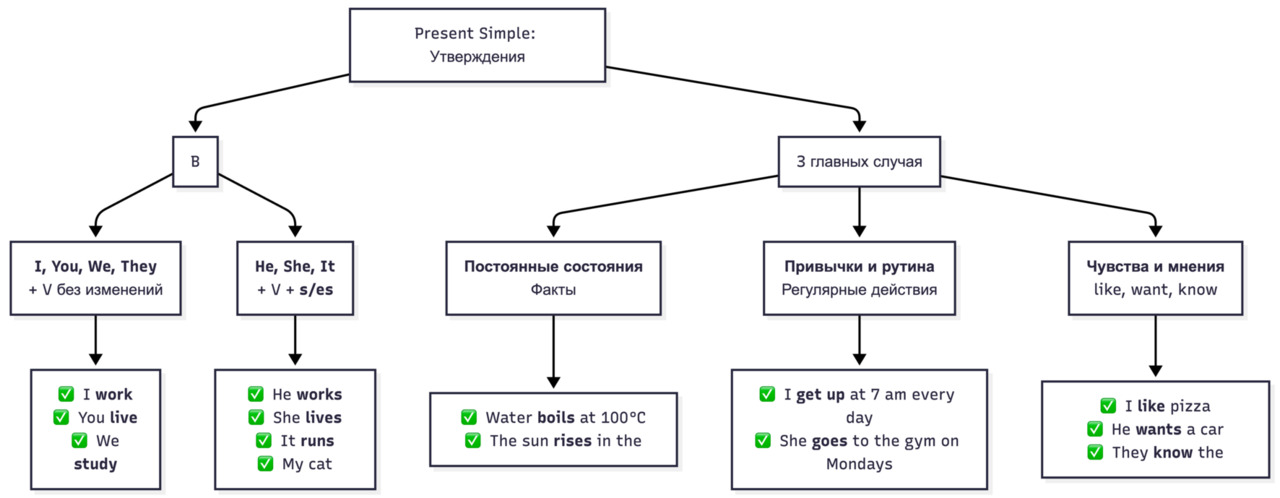
Формула утверждения:
Для I / You / We / They:
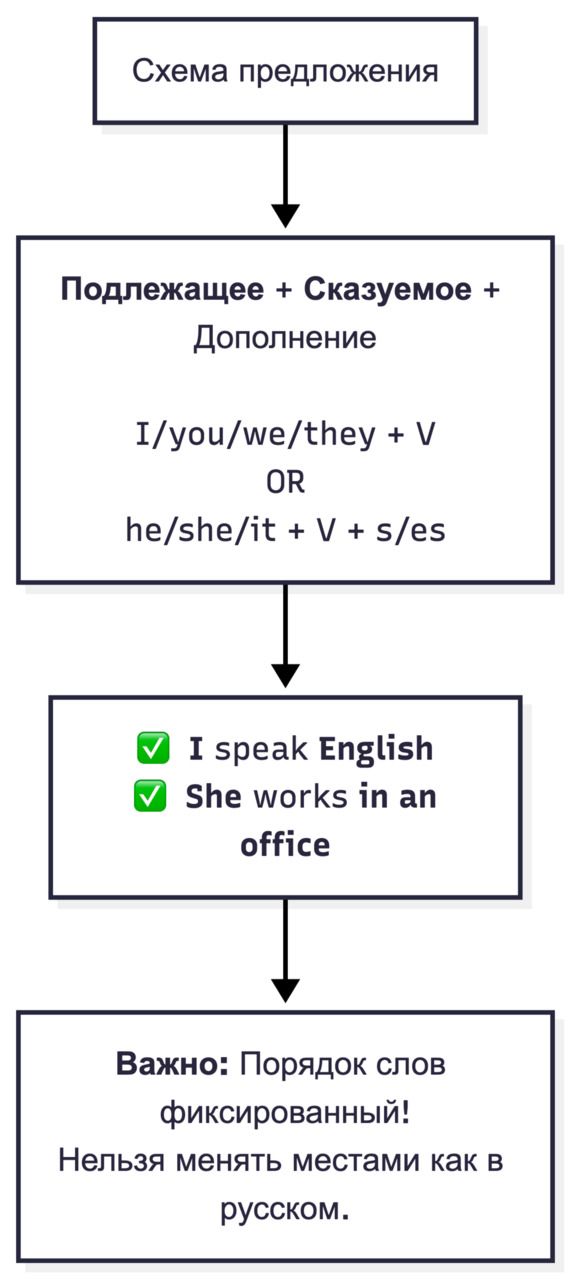
Subject + base verb + object
I work from home.
Для He / She / It:
Subject + verb+s/es + object
She works from home.
Особенности:
К третьему лицу (he, she, it) к глаголу добавляем -s или -es.
Для глаголов, оканчивающихся на -y после согласной, -y меняется на -ies: study → studies.

2. История на английском
Простая история для повседневной жизни, где активно используется Present Simple – утверждения.
Emma wakes up at 7 a.m. every morning. She brushes her teeth and takes a shower. Then she eats breakfast and reads the news on her phone.
She works in a small office in the city. Every day she sends emails, makes phone calls, and meets her colleagues. Emma likes her job because she helps people and learns new things.
In the evening, she cooks dinner, watches her favorite TV show, and goes to bed at 11 p.m. Emma enjoys her daily routine because it gives her energy and happiness.
3. Полезные фразы и выражения
Каждая фраза с переводом:
wake up – просыпаться
brush your teeth – чистить зубы
take a shower – принимать душ
eat breakfast – завтракать
read the news – читать новости
work in an office – работать в офисе
send emails – отправлять письма
make phone calls – звонить по телефону
meet colleagues – встречаться с коллегами
like your job – любить работу
help people – помогать людям
learn new things – учиться новому
cook dinner – готовить ужин
watch TV – смотреть телевизор
go to bed – ложиться спать
enjoy your routine – наслаждаться распорядком
give energy – давать энергию
brush hair – расчесывать волосы
drink coffee – пить кофе
read a book – читать книгу
4. Упражнения
Exercise 1: Matching (сопоставление фраз с переводами)
wake up
send emails
cook dinner
watch TV
go to bed
a) смотреть телевизор
b) готовить ужин
c) ложиться спать
d) просыпаться
e) отправлять письма
Exercise 2: Fill in the blanks (заполнение пропусков)
Используй глаголы в Present Simple: (wakes up, works, reads, cooks, enjoys)
Emma _______ at 7 a.m. every day.
She _______ in a small office in the city.
Every morning she _______ the news on her phone.
In the evening, she _______ dinner.
Emma _______ her daily routine.
Exercise 3: Answer the questions (ответь на вопросы по тексту)
What time does Emma wake up?
Where does she work?
What does she read every morning?
What does she do in the evening?
Why does Emma enjoy her routine?
5. Ответы
Exercise 1: Matching
1 – d
2 – e
3 – b
4 – a
5 – c
Exercise 2: Fill in the blanks
wakes up
works
reads
cooks
enjoys
Exercise 3: Answer the questions
At 7 a.m.
In a small office in the city
She reads the news on her phone
She cooks dinner and watches TV
Because it gives her energy and happiness
Present Simple — Negative (Отрицания)
1. Грамматическое объяснение
Present Simple – отрицания используются, когда мы хотим сказать, что что-то не происходит регулярно или не является фактом.
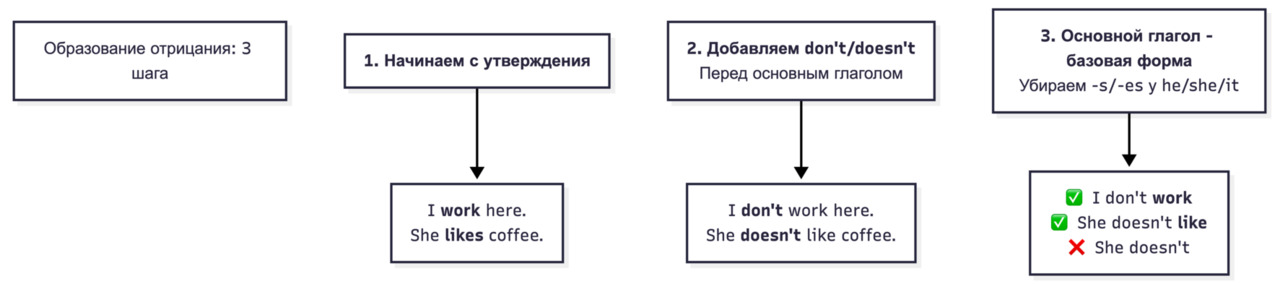
Формула отрицания:
Для I / You / We / They:
Subject + do not (don’t) + base verb + object
I don’t like coffee. – Я не люблю кофе.
Для He / She / It:
Subject + does not (doesn’t) + base verb + object
She doesn’t watch TV. – Она не смотрит телевизор.
Особенности:
После don’t / doesn’t глагол всегда в начальной форме (без -s/-es).
Сокращения: do not → don’t, does not → doesn’t.
Примеры:
I don’t play football. – Я не играю в футбол.
He doesn’t go to the gym. – Он не ходит в спортзал.
They don’t eat meat. – Они не едят мясо.
2. История на английском
Простая повседневная история с использованием отрицаний в Present Simple.
Emma doesn’t wake up at 6 a.m. She doesn’t drink coffee in the morning. She doesn’t watch the news before breakfast.
She doesn’t work on weekends. On Saturdays and Sundays, she doesn’t go to the office. Emma doesn’t like loud places, so she doesn’t go to crowded markets.
Her friend Tom doesn’t eat meat. He doesn’t drink soda. But he likes tea and fruit. They often meet in the park because Emma doesn’t like crowded cafés.
In the evening, Emma doesn’t watch TV for a long time. She doesn’t play video games either. Instead, she reads a book or writes in her diary.
3. Полезные фразы и выражения
don’t wake up – не просыпаться
don’t drink coffee – не пить кофе
don’t watch TV – не смотреть телевизор
don’t work – не работать
don’t go to the office – не ходить в офис
don’t like loud places – не любить шумные места
don’t go to crowded markets – не ходить на переполненные рынки
doesn’t eat meat – не есть мясо
doesn’t drink soda – не пить газировку
doesn’t play video games – не играть в видеоигры
doesn’t watch the news – не смотреть новости
read a book – читать книгу
write in a diary – писать в дневник
like tea – любить чай
meet in the park – встречаться в парке
spend weekends at home – проводить выходные дома
4. Упражнения
Exercise 1: Matching (сопоставление фраз с переводами)
don’t wake up
doesn’t drink soda
don’t go to crowded markets
doesn’t play video games
write in a diary
a) не играть в видеоигры
b) писать в дневник
c) не просыпаться
d) не пить газировку
e) не ходить на переполненные рынки
Exercise 2: Fill in the blanks (заполнение пропусков)
Используй don’t / doesn’t + глагол: (don’t wake up, doesn’t eat, don’t watch, doesn’t go, don’t like)
Emma _______ at 6 a.m.
She _______ meat.
She _______ TV in the morning.
On weekends, she _______ to the office.
Emma _______ crowded cafés.
Exercise 3: Answer the questions (ответь на вопросы по тексту)
Does Emma wake up at 6 a.m.?
Does Emma drink coffee in the morning?
Does Emma go to the office on weekends?
What does Emma do in the evening instead of watching TV?
What doesn’t Tom drink?
5. Ответы
Exercise 1: Matching
1 – c
2 – d
3 – e
4 – a
5 – b
Exercise 2: Fill in the blanks
doesn’t wake up
doesn’t eat
don’t watch
doesn’t go
don’t like
Exercise 3: Answer the questions
No, she doesn’t.
No, she doesn’t.
No, she doesn’t.
She reads a book or writes in her diary.
Soda.
Present Simple — Yes/No Questions (Общие вопросы)
1. Грамматическое объяснение
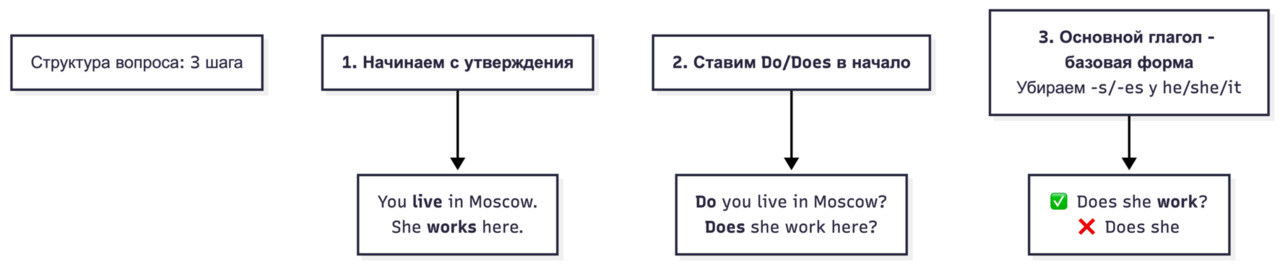
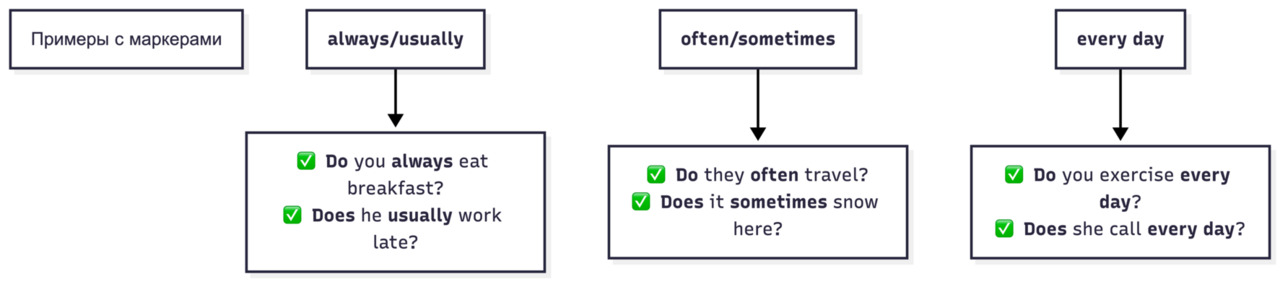
Yes/No вопросы в Present Simple используются, когда мы хотим задать общий вопрос, на который можно ответить «да» или «нет».
Формула:
Для I / You / We / They:
Do + subject + base verb + object?
Do you like coffee? – Ты любишь кофе?
Для He / She / It:
Does + subject + base verb + object?
Does she work in an office? – Она работает в офисе?
Особенности:
После do / does глагол всегда в начальной форме.
Ответы часто короткие:
Yes, I do. / No, I don’t.
Yes, he does. / No, she doesn’t.
Примеры:
Do you read books every day? – Ты читаешь книги каждый день?
Does Tom play football? – Том играет в футбол?
Do they go to school on Saturdays? – Они ходят в школу по субботам?
2. История на английском
Простая повседневная история с Yes/No вопросами.
Emma likes her daily routine. She wakes up at 7 a.m. and eats breakfast. Her friend Tom often calls her in the morning.
Tom asks Emma:
Do you drink coffee?
Do you read the news every day?
Do you go to work on weekends?
Emma answers:
No, I don’t drink coffee.
Yes, I read the news every day.
No, I don’t go to work on weekends.
Later, Emma asks Tom:
Do you like tea?
Do you eat meat?
Tom answers:
Yes, I like tea.
No, I don’t eat meat.
They enjoy asking and answering questions because it helps them learn more about each other.
3. Полезные фразы и выражения
Do you drink coffee? – Ты пьёшь кофе?
Do you read the news? – Ты читаешь новости?
Do you go to work on weekends? – Ты ходишь на работу по выходным?
Do you like tea? – Тебе нравится чай?
Do you eat meat? – Ты ешь мясо?
Does she work in an office? – Она работает в офисе?
Does he play football? – Он играет в футбол?
Yes, I do. – Да, я (так делаю).
No, I don’t. – Нет, я (так не делаю).
Yes, he does. – Да, он (так делает).
No, she doesn’t. – Нет, она (так не делает).
Call in the morning – звонить утром
Answer questions – отвечать на вопросы
Learn more about someone – узнавать больше о ком-то
4. Упражнения
Exercise 1: Matching (сопоставление вопросов и переводов)
Do you like tea?
Does she work in an office?
Do they eat meat?
Does he play football?
Do you read the news every day?
a) Ты читаешь новости каждый день?
b) Ты любишь чай?
c) Они едят мясо?
d) Она работает в офисе?
e) Он играет в футбол?
Exercise 2: Fill in the blanks (заполнение пропусков)
Используй Do / Does + глагол: (Do, Does, eat, like, go)
______ you drink coffee in the morning?
______ she go to work on weekends?
Do they ______ meat?
Does he ______ football every weekend?
Do you ______ tea or coffee?
Exercise 3: Answer the questions (ответь на вопросы по истории)
Does Emma drink coffee?
Does Emma go to work on weekends?
Does Tom eat meat?
Does Emma read the news every day?
Why do they enjoy asking questions?
5. Ответы
Exercise 1: Matching
1 – b
2 – d
3 – c
4 – e
5 – a
Exercise 2: Fill in the blanks
Do
Does
eat
play
like
Exercise 3: Answer the questions
No, she doesn’t.
No, she doesn’t.
No, he doesn’t.
Yes, she does.
Because it helps them learn more about each other.
Present Simple — Wh-questions (Специальные вопросы)
1. Грамматическое объяснение
Wh-questions используются, когда мы хотим узнать детали о действии, а не просто «да» или «нет».
Wh-words (вопросительные слова):
What – что / какой
Where – где / куда
When – когда
Who – кто
Why – почему
How – как
Формула:
Для I / You / We / They:
Wh-word + do + subject + base verb + object?
What do you eat for breakfast? – Что ты ешь на завтрак?
Для He / She / It:
Wh-word + does + subject + base verb + object?
Where does she work? – Где она работает?

Особенности:
После do / does глагол всегда в начальной форме.
Ответ на вопрос может быть коротким:
I eat eggs. – Я ем яйца.
She works in a small office. – Она работает в небольшом офисе.
Примеры:
What do you do every morning? – Что ты делаешь каждое утро?
Where does Tom live? – Где живет Том?
When do they go to school? – Когда они ходят в школу?
Who works in this office? – Кто работает в этом офисе?
Why do you like tea? – Почему тебе нравится чай?
2. История на английском
Emma wakes up at 7 a.m. every morning. She eats breakfast and reads the news on her phone. Her friend Tom calls her.
Tom asks Emma some Wh-questions:
What do you eat for breakfast?
Where do you go on weekends?
When do you usually go to bed?
Who do you meet in the park?
Why do you like reading books?
Emma answers:
I eat eggs and toast.
I go to the park on weekends.
I usually go to bed at 11 p.m.
I meet my friend Tom in the park.
I like reading books because it relaxes me.
Later, Emma asks Tom:
What does he drink in the morning?
Where does he work?
Tom answers:
He drinks tea.
He works in a small office in the city.
3. Полезные фразы и выражения
What do you eat for breakfast? – Что ты ешь на завтрак?
Where do you go on weekends? – Куда ты ходишь по выходным?
When do you usually go to bed? – Когда ты обычно ложишься спать?
Who do you meet in the park? – С кем ты встречаешься в парке?
Why do you like reading books? – Почему тебе нравится читать книги?
What does he drink in the morning? – Что он пьет утром?
Where does he work? – Где он работает?
wake up at 7 a.m. – просыпаться в 7 утра
eat eggs and toast – есть яйца и тост
read the news – читать новости
go to the park – идти в парк
go to bed – ложиться спать
meet a friend – встречаться с другом
relax – расслабляться
drinks tea – пить чай
works in a small office – работать в небольшом офисе
4. Упражнения
Exercise 1: Matching (сопоставление вопросов и переводов)
What do you eat for breakfast?
Where do you go on weekends?
When do you usually go to bed?
Who do you meet in the park?
Why do you like reading books?
a) Когда ты обычно ложишься спать?
b) С кем ты встречаешься в парке?
c) Почему тебе нравится читать книги?
d) Что ты ешь на завтрак?
e) Куда ты ходишь по выходным?
Exercise 2: Fill in the blanks (заполнение пропусков)
Используй Wh-word + do / does + subject + verb: (What, Where, When, Who, Why)
______ do you eat in the morning?
______ does she work?
______ do you meet on weekends?
______ do you usually wake up?
______ do you like reading books?
Exercise 3: Answer the questions (ответь на вопросы по истории)
What does Emma eat for breakfast?
Where does Emma go on weekends?
When does Emma usually go to bed?
Who does she meet in the park?
Why does Emma like reading books?
5. Ответы
Exercise 1: Matching
1 – d
2 – e
3 – a
4 – b
5 — c
Exercise 2: Fill in the blanks
What
Where
Who
When
Why
Exercise 3: Answer the questions
She eats eggs and toast.
She goes to the park.
She usually goes to bed at 11 p.m.
She meets her friend Tom.
Because it relaxes her.
Present Continuous — Affirmative (Утверждения)
1. Грамматическое объяснение
Present Continuous (настоящее продолженное время) используется, когда мы говорим о:
Действиях, происходящих сейчас в момент речи:
I am reading a book now. – Я сейчас читаю книгу.
Временных действиях, которые происходят в текущий период, но не обязательно прямо сейчас:
She is working on a new project this week. – Она работает над новым проектом на этой неделе.
Планах на ближайшее будущее:
We are meeting Tom tomorrow. – Мы встречаемся с Томом завтра.
Формула утверждения:
Subject + am/is/are + verb+ing + object
Примеры:
I am reading a book. – Я читаю книгу.
She is cooking dinner. – Она готовит ужин.
They are playing football. – Они играют в футбол.
Особенности:
Для I → am, He/She/It → is, We/You/They → are
К глаголу добавляется -ing
Если глагол оканчивается на e, его обычно убирают перед -ing: make → making
Для односложных глаголов с согласной в конце, после краткого гласного звук удваивается: run → running
2. История на английском
It is Saturday morning. Emma is cooking breakfast in the kitchen. Her friend Tom is reading the news on his phone.
The children are playing in the garden. Emma is talking to her mother on the phone. Her dog Max is sleeping on the sofa.
Later, Emma and Tom are going for a walk in the park. They are enjoying the sunny weather and are watching the birds in the trees.
At home, Emma is listening to music while she is writing in her diary. Today, everyone is having a calm and happy morning.
3. Полезные фразы и выражения
am cooking – готовлю (сейчас)
is reading – читает (сейчас)
are playing – играют (сейчас)
is talking – разговаривает (сейчас)
is sleeping – спит
are going for a walk – идут гулять
are enjoying – наслаждаются
are watching – наблюдают
is listening – слушает
is writing – пишет
having a calm morning – проводить спокойное утро
sunny weather – солнечная погода
in the garden – в саду
on the phone – по телефону
at home – дома
now – сейчас
this week – на этой неделе
tomorrow – завтра
diary – дневник
children – дети
4. Упражнения
Exercise 1: Matching (сопоставление фраз с переводами)
is cooking
are playing
is reading
is talking
are going for a walk
a) разговаривает
b) готовит
c) читают
d) идут гулять
e) играют
Exercise 2: Fill in the blanks (заполнение пропусков)
Используй форму am/is/are + verb+ing: (am cooking, is reading, are playing, is talking, are enjoying)
Emma ______ breakfast in the kitchen.
Tom ______ the news on his phone.
The children ______ in the garden.
Emma ______ to her mother on the phone.
They ______ the sunny weather in the park.
Exercise 3: Answer the questions (ответь на вопросы по истории)
What is Emma cooking?
Who is reading the news?
Where are the children playing?
Who is Emma talking to?
What are Emma and Tom doing in the park?
5. Ответы
Exercise 1: Matching
1 – b
2 – e
3 — c
4 – a
5 – d
Exercise 2: Fill in the blanks
is cooking
is reading
are playing
is talking
are enjoying
Exercise 3: Answer the questions
Breakfast
Tom
In the garden
Her mother
They are going for a walk and enjoying the sunny weather
Present Continuous — Negative (Отрицания)
1. Грамматическое объяснение
Present Continuous – отрицания используются, когда мы хотим сказать, что действие не происходит сейчас или не происходит в этот период времени.
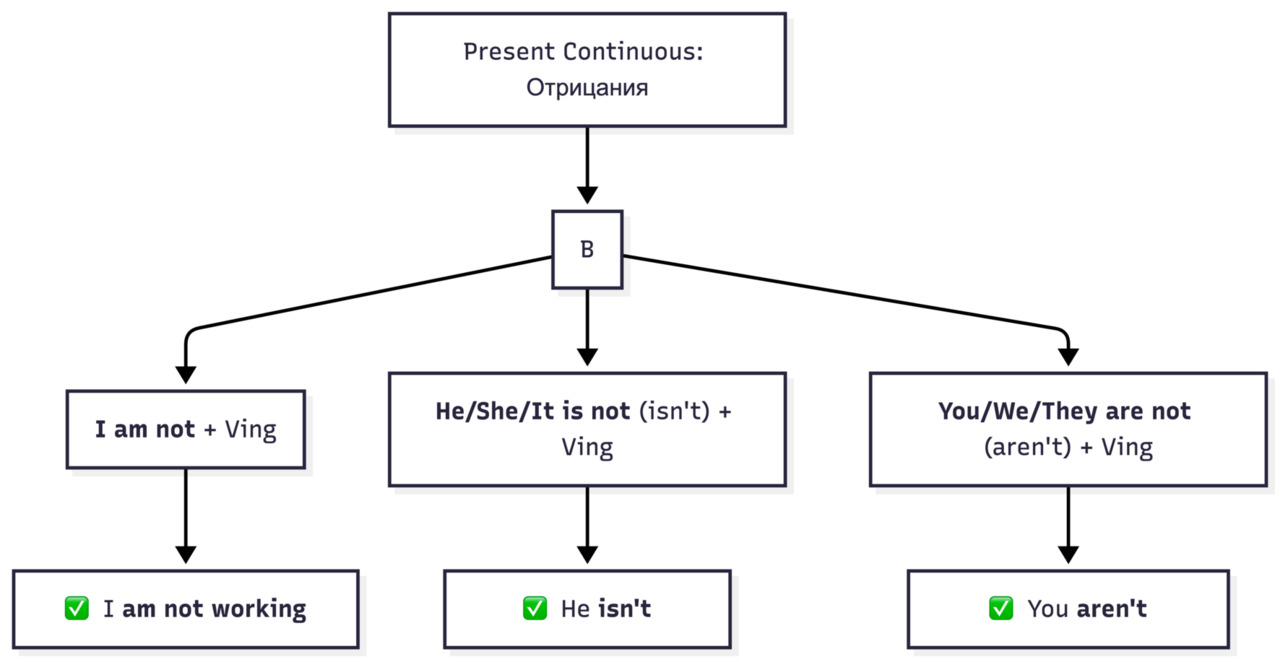
Формула отрицания:
Subject + am/is/are + not + verb+ing + object
Примеры:
I am not reading a book. – Я не читаю книгу.
She isn’t cooking dinner. – Она не готовит ужин.
They aren’t playing football. – Они не играют в футбол.
Сокращения:
am not → am not
is not → isn’t
are not → aren’t

Особенности:
Отрицание ставится между глаголом to be и основным глаголом с -ing
Используется, чтобы подчеркнуть, что действие не происходит прямо сейчас или временно не выполняется
2. История на английском
It is Sunday morning. Emma isn’t cooking breakfast today. She isn’t reading the news on her phone. Her friend Tom isn’t playing video games.
The children aren’t watching TV. Emma isn’t talking to anyone on the phone. Her dog Max isn’t sleeping in the garden – he is running around.
Later, Emma and Tom aren’t going to the park because it is raining. They aren’t enjoying the weather outside. Instead, they are sitting at home and are drinking hot tea.
Today, everyone is not having a normal sunny morning, but they are still relaxing at home.
3. Полезные фразы и выражения
am not cooking – не готовлю
isn’t reading – не читает
aren’t playing – не играют
isn’t talking – не разговаривает
isn’t sleeping – не спит
aren’t going to the park – не идут в парк
aren’t enjoying – не наслаждаются
are sitting – сидят
are drinking – пьют
is not having – не проводят
raining – идет дождь
at home – дома
in the garden – в саду
video games – видеоигры
hot tea – горячий чай
relaxing – расслабляются
4. Упражнения
Exercise 1: Matching (сопоставление фраз с переводами)
isn’t reading
aren’t playing
isn’t cooking
aren’t enjoying
are drinking
a) не готовят
b) не читают
c) не наслаждаются
d) пьют
e) не играют
Exercise 2: Fill in the blanks (заполнение пропусков)
Используй am not / isn’t / aren’t + verb+ing: (am not cooking, isn’t reading, aren’t playing, aren’t going, aren’t enjoying)
Emma ______ breakfast today.
She ______ the news on her phone.
The children ______ video games.
Emma and Tom ______ to the park.
They ______ the rainy weather outside.
Exercise 3: Answer the questions (ответь на вопросы по истории)
Is Emma cooking breakfast today?
Are the children watching TV?
Is Max sleeping in the garden?
Are Emma and Tom going to the park?
What are they doing instead of going outside?
5. Ответы
Exercise 1: Matching
1 – b
2 – e
3 – a
4 – c
5 – d
Exercise 2: Fill in the blanks
am not cooking
isn’t reading
aren’t playing
aren’t going
aren’t enjoying
Exercise 3: Answer the questions
No, she isn’t.
No, they aren’t.
No, he isn’t.
No, they aren’t.
They are sitting at home and drinking hot tea.
Present Continuous — Yes/No Questions (Общие вопросы)
1. Грамматическое объяснение
Yes/No вопросы в Present Continuous используются, чтобы спросить, происходит ли действие прямо сейчас или в текущий период времени.
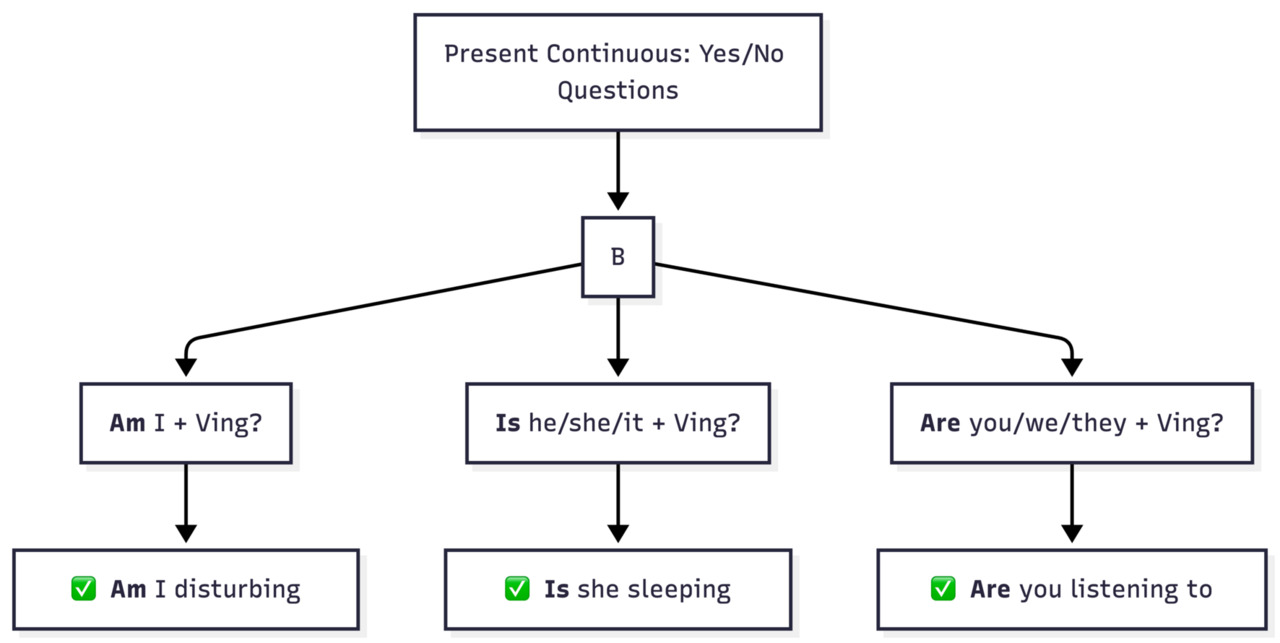
Формула:
Am / Is / Are + subject + verb+ing + object?
Примеры:
Am I reading the book correctly? – Я правильно читаю книгу?
Is she cooking dinner now? – Она сейчас готовит ужин?
Are they playing football in the garden? – Они играют в футбол в саду?
Особенности:
Ответы короткие:
Yes, I am. / No, I’m not.
Yes, she is. / No, she isn’t.
Yes, they are. / No, they aren’t

2. История на английском
It is Monday morning. Emma is cooking breakfast. Her friend Tom is reading a book. The children are playing outside.
Tom asks Emma:
Are you cooking breakfast?
Is she reading the news?
Are the children playing in the garden?
Emma answers:
Yes, I am.
No, she isn’t.
Yes, they are.
Later, Emma asks Tom:
Are you drinking tea?
Are you going to the park?
Tom answers:
Yes, I am.
No, I’m not.
They enjoy asking questions because it helps them know what everyone is doing.
3. Полезные фразы и выражения
Are you cooking breakfast? – Ты готовишь завтрак?
Is she reading the news? – Она читает новости?
Are the children playing in the garden? – Дети играют в саду?
Are you drinking tea? – Ты пьешь чай?
Are you going to the park? – Ты идешь в парк?
Yes, I am. – Да, я (так делаю)
No, I’m not. – Нет, я (так не делаю)
Yes, she is. – Да, она (так делает)
No, she isn’t. – Нет, она (так не делает)
Yes, they are. – Да, они (так делают)
No, they aren’t. – Нет, они (так не делают)
enjoy asking questions – нравится задавать вопросы
know what everyone is doing – знать, что делает каждый
4. Упражнения
Exercise 1: Matching (сопоставление вопросов и переводов)
Are you cooking breakfast?
Is she reading the news?
Are the children playing in the garden?
Are you drinking tea?
Are you going to the park?
a) Ты идешь в парк?
b) Ты готовишь завтрак?
c) Дети играют в саду?
d) Ты пьешь чай?
e) Она читает новости?
Exercise 2: Fill in the blanks (заполнение пропусков)
Используй Am / Is / Are + subject + verb+ing: (Are, Is, Am, Are, Is)
______ you cooking breakfast now?
______ she reading a book?
______ I speaking correctly?
______ the children playing outside?
______ Tom going to the park?
Exercise 3: Answer the questions (ответь на вопросы по истории)
Is Emma cooking breakfast?
Is she reading the news?
Are the children playing outside?
Is Tom drinking tea?
Are they going to the park?
5. Ответы
Exercise 1: Matching
1 – b
2 – e
3 — c
4 – d
5 – a
Exercise 2: Fill in the blanks
Are
Is
Am
Are
Is
Exercise 3: Answer the questions
Yes, she is.
No, she isn’t.
Yes, they are.
Yes, he is.
No, they aren’t.
Present Simple vs Present Continuous — Comparison (Сравнение)
1. Грамматическое объяснение
Когда использовать Present Simple:
Регулярные действия / привычки:
I drink coffee every morning. – Я пью кофе каждое утро.
Постоянные факты / истины:
Water boils at 100°C. – Вода закипает при 100°C.
Расписание / программы:
The train leaves at 8 p.m. – Поезд отправляется в 8 вечера.
Когда использовать Present Continuous:
Действие, происходящее сейчас, в момент речи:
I am drinking coffee now. – Я сейчас пью кофе.
Временные действия (не обязательно прямо сейчас):
She is working on a new project this week. – Она работает над новым проектом на этой неделе.
Ближайшие планы:
We are meeting Tom tomorrow. – Мы встречаемся с Томом завтра.
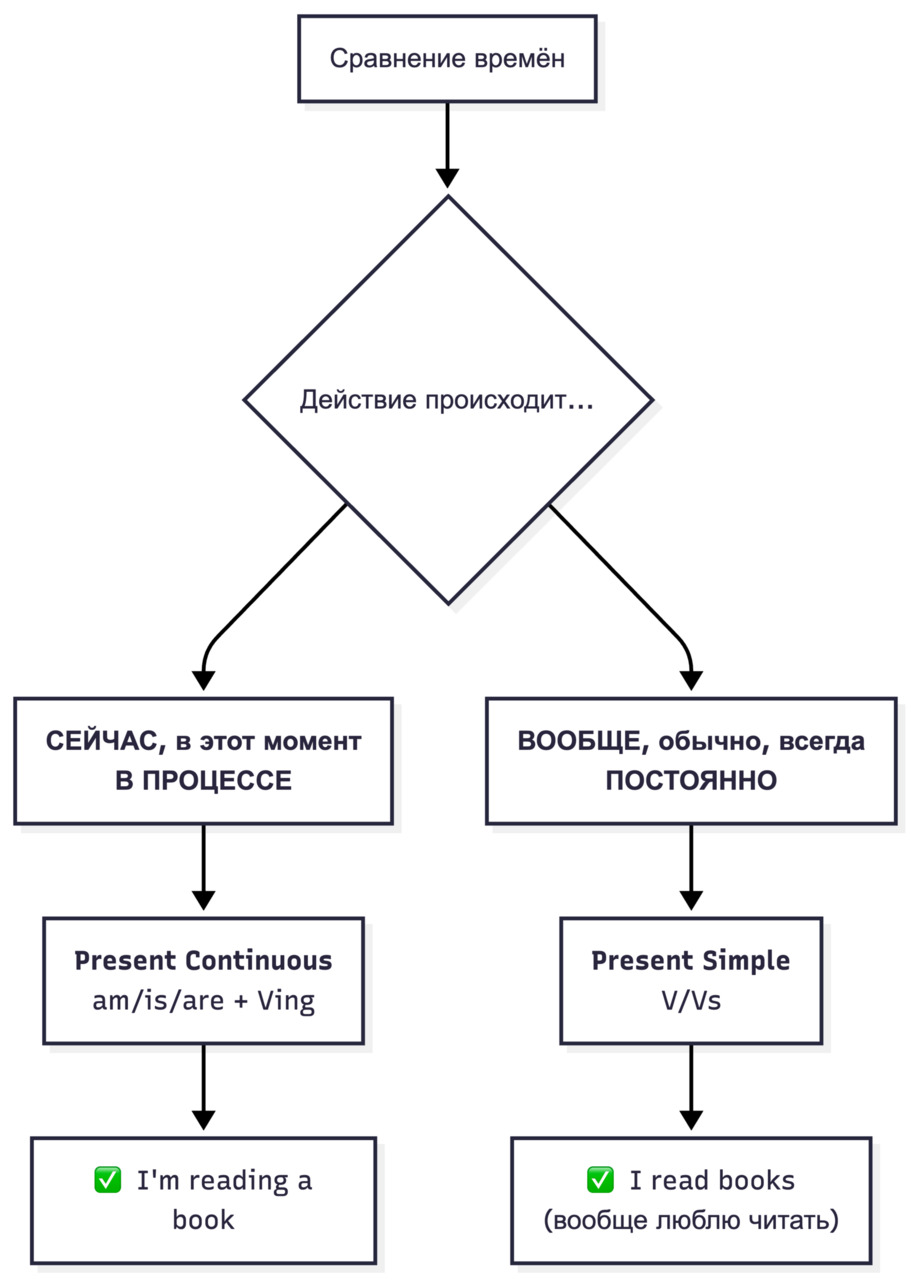
Ключевые отличия:
Present Simple = привычка / факт / расписание
Present Continuous = прямо сейчас / временно / ближайшее будущее
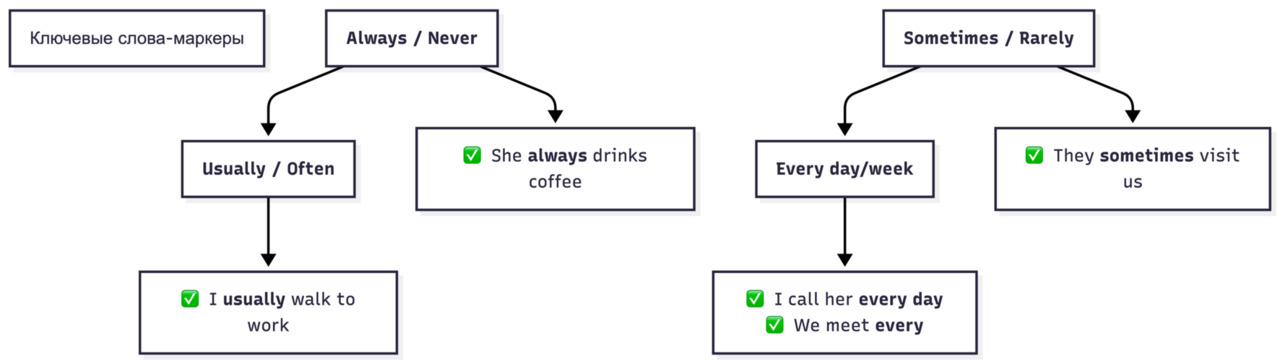
Present Simple часто сопровождается наречиями частоты: always, usually, often, sometimes
Present Continuous сопровождается наречиями времени: now, at the moment, today, this week
2. История на английском
Emma has a busy life. She drinks coffee every morning. She usually reads the news before breakfast.
But today is special. She is drinking tea instead of coffee. She is reading a magazine now because her favorite newspaper isn’t available online.
Her friend Tom usually plays football on Saturdays. Today, he is playing video games because it is raining outside.
Emma and Tom meet every weekend in the park, but this week they are meeting at home. Life is a mix of habits and temporary changes!
3. Полезные фразы и выражения
drink coffee – пить кофе
read the news – читать новости
read a magazine – читать журнал
isn’t available – недоступно
usually plays football – обычно играет в футбол
is playing video games – играет в видеоигры (сейчас)
meet every weekend – встречаются каждые выходные
are meeting at home – встречаются дома (временно)
every morning – каждое утро
today – сегодня
now – сейчас
this week – на этой неделе
habits – привычки
temporary changes – временные изменения
busy life – занятая жизнь
4. Упражнения
Exercise 1: Choose the correct tense (Выбери правильное время)
I usually ______ (drink / am drinking) coffee in the morning.
She ______ (is reading / reads) a book now.
Tom usually ______ (plays / is playing) football on Saturdays.
Today he ______ (plays / is playing) video games.
We ______ (meet / are meeting) every weekend.
This week we ______ (meet / are meeting) at home.
Exercise 2: Fill in the blanks with Present Simple or Present Continuous
Emma ______ (read) the news every morning, but today she ______ (read) a magazine.
I usually ______ (drink) coffee, but right now I ______ (drink) tea.
They ______ (go) to school every day, but today they ______ (stay) at home.
He usually ______ (work) in an office, but this week he ______ (work) from home.
My friends ______ (play) football every weekend, but today they ______ (play) video games.
Exercise 3: Answer the questions
What does Emma usually drink in the morning?
What is she drinking today?
What does Tom usually do on Saturdays?
What is Tom doing today?
Where are Emma and Tom meeting this week?
5. Ответы
Exercise 1: Choose the correct tense
drink
is reading
plays
is playing
meet
are meeting
Exercise 2: Fill in the blanks
reads, is reading
drink, am drinking
go, are staying
works, is working
play, are playing
Exercise 3: Answer the questions
She usually drinks coffee.
She is drinking tea.
He usually plays football.
He is playing video games.
They are meeting at home.
Past Simple — Affirmative (Утверждения)
1. Грамматическое объяснение
Past Simple используется, чтобы говорить о действиях, которые произошли и закончились в прошлом.
Формула:
Для правильных глаголов: Subject + verb + -ed + object
I watched a movie yesterday. – Я посмотрел фильм вчера.
Для неправильных глаголов: Subject + 2-я форма неправильного глагола + object
She went to the park last Sunday. – Она ходила в парк в прошлое воскресенье.
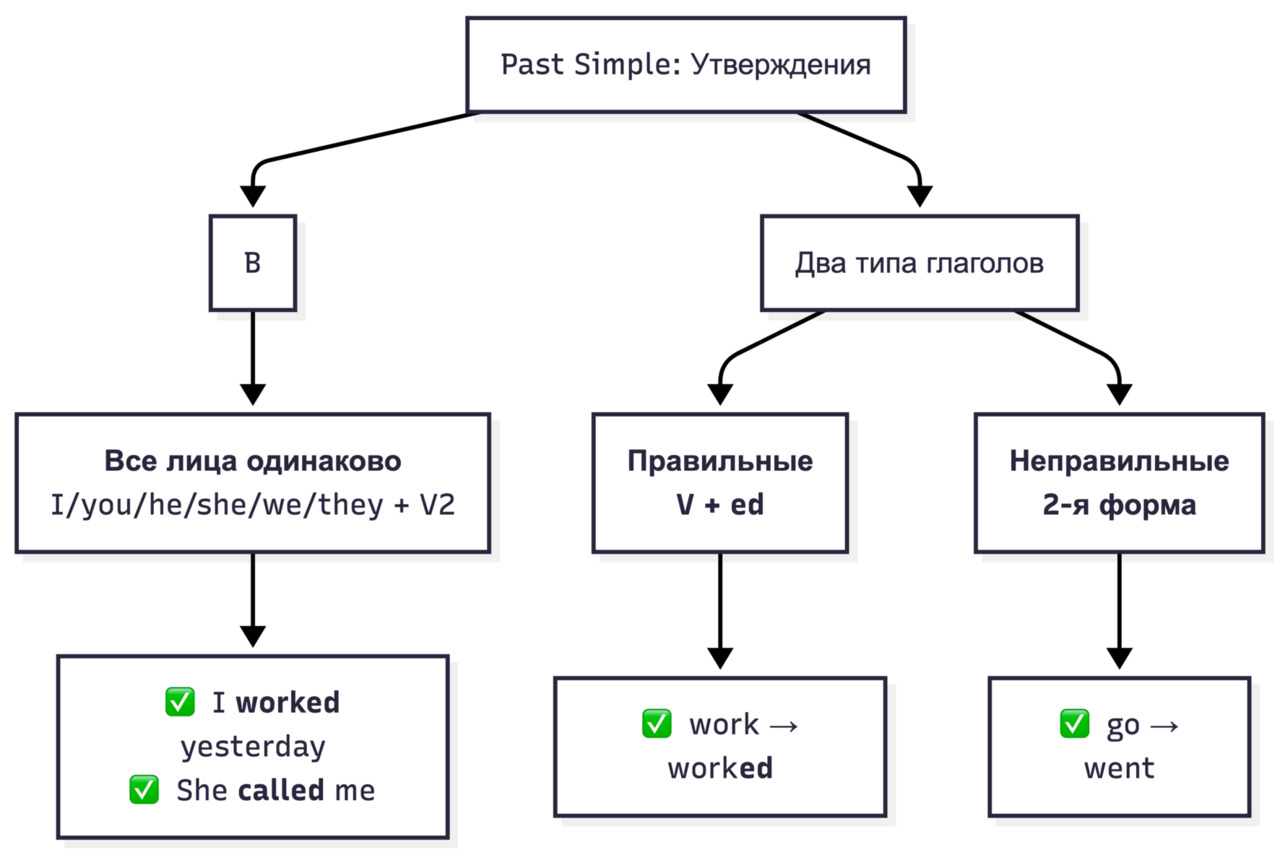
Особенности:
В предложении обычно указываем время (yesterday, last week, two days ago, in 2020)
Глагол всегда в прошедшей форме
Для неправильных глаголов необходимо запоминать 2-ю форму (went, saw, did, had, ate и т.д.)
Примеры:
Бесплатный фрагмент закончился.
Купите книгу, чтобы продолжить чтение.