
Бесплатный фрагмент - Базовый курс английского языка для средней школы
Полный учебник грамматики и лексики с упражнениями и историями
Предисловие
Дорогие читатели,
Изучение английского языка открывает множество возможностей для общения, учебы и личного развития. Эта книга создана специально для школьников средней школы, чтобы помочь им систематизировать знания, освоить базовую грамматику и лексику, а также научиться применять их в повседневной жизни. Материал представлен постепенно: от простых конструкций к более сложным, с акцентом на ясность объяснений и практическую пользу.
Каждая глава построена с учетом особенностей восприятия информации подростками. Грамматические темы объясняются понятно и сопровождаются примерами, краткими историями и упражнениями, которые помогают закрепить материал и развивают навыки чтения, письма и говорения. Особое внимание уделено повседневной лексике и устойчивым выражениям, чтобы обучение оставалось практичным и интересным.
В конце книги собраны материалы, которые служат удобным справочником: наиболее употребляемые неправильные глаголы, полезные советы по запоминанию слов и грамматических конструкций. Такой подход позволяет не только учить правила, но и использовать язык естественно и уверенно.
Надеюсь, что эта книга станет надежным инструментом для школьников средней школы в освоении английского языка. Пусть каждый раздел мотивирует к практике, стимулирует любопытство и делает процесс обучения увлекательным и эффективным.
Subject Pronouns and the Verb to be
Grammar Focus
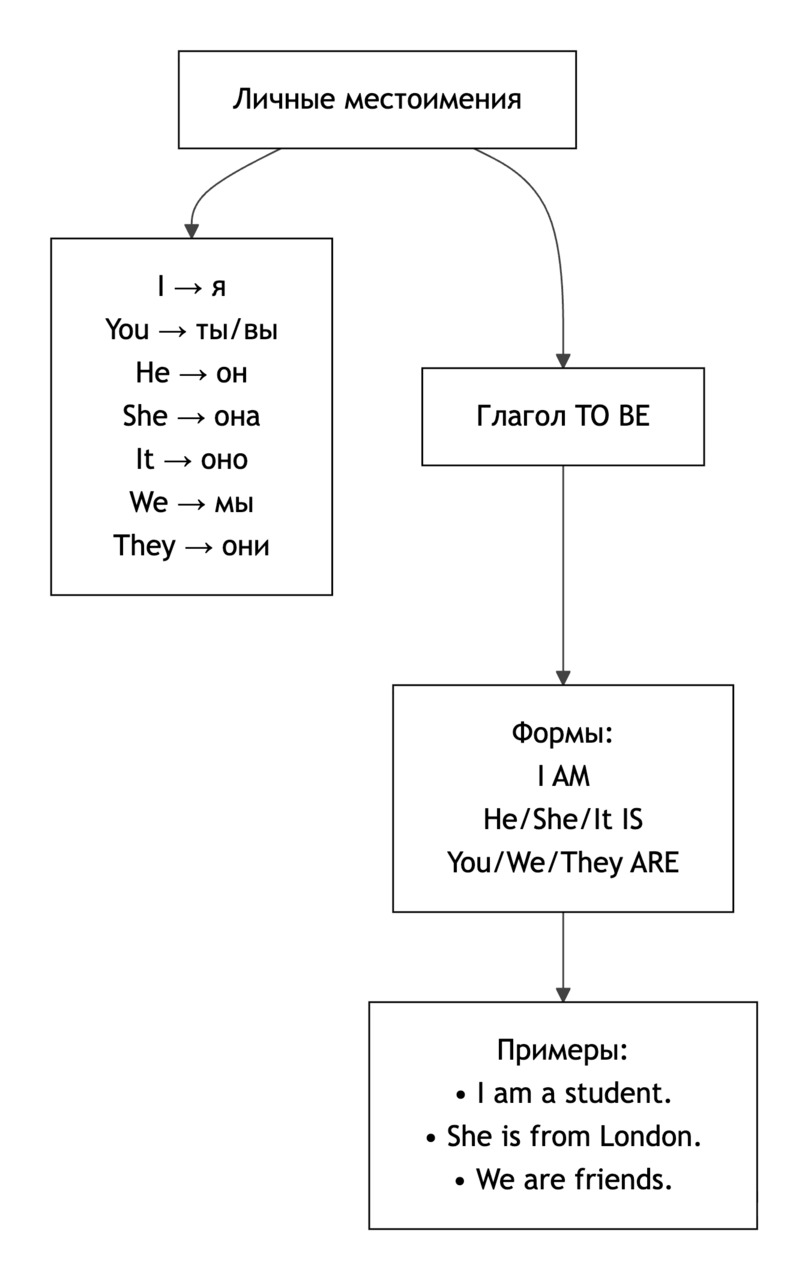
Subject pronouns — это местоимения, которые показывают, кто выполняет действие:
I, you, he, she, it, we, they.
Глагол to be в настоящем времени имеет три формы:
am — используется только с I
is — используется с he, she, it
are — используется с you, we, they
Утверждение:
I am a student. — Я студент.
She is my friend. — Она моя подруга.
They are at school. — Они в школе.
Отрицание:
Отрицание образуется с помощью not:
He is not (isn’t) ready. — Он не готов.
We are not (aren’t) late. — Мы не опаздываем.
Вопрос:
Глагол to be ставится перед подлежащим:
Are you happy? — Ты счастлив?
Is she at home? — Она дома?
Советы для школьников:
В английском предложении всегда есть подлежащее.
После местоимения сразу идёт форма to be.
Не переводите слово to be в настоящем времени на русский — его часто нет в переводе.
Story
My name is Alex, and I am fourteen years old. I am a student at a small school in my town. My school is not very big, but it is friendly and comfortable. My best friend is Mark. He is very kind and always ready to help. We are in the same class, and we are good at English.
Our teacher is Mrs Brown. She is strict, but she is fair. She says that English is important for our future. The classroom is bright, and it is always clean. The desks are near the windows, and they are new.
After school, we are usually tired, but we are happy. My parents are at home in the evening. My mother is a doctor, and my father is an engineer. They are proud of me. At night, I am calm and relaxed. I am ready for a new day.
Useful Words and Expressions
student — ученик
friendly — дружелюбный
comfortable — удобный
best friend — лучший друг
kind — добрый
ready — готовый
teacher — учитель
strict — строгий
fair — справедливый
future — будущее
classroom — класс
bright — светлый
clean — чистый
usually — обычно
proud — гордый
calm — спокойный
relaxed — расслабленный
Exercises
Exercise 1. Fill in the blanks
I ___ a student.
She ___ my teacher.
We ___ in the same class.
He ___ not tired.
They ___ ready.
Exercise 2. Choose the correct answer
My parents (is / are) at home.
I (am / is) fourteen years old.
The classroom (are / is) bright.
You (is / are) my friend.
Exercise 3. Answer the questions
Who are you and how old are you?
Where are you now?
Who is your English teacher?
Are your friends kind and friendly?
How are you in the evening?
Answer Key
Exercise 1:
am
is
are
is
are
Exercise 2:
are
am
is
are
Exercise 3 (sample answers):
I am a student and I am fifteen years old. I am interested in learning English.
I am at home now. I am calm and ready to study.
My English teacher is Mrs Smith. She is experienced and helpful.
Yes, my friends are kind and friendly. They are always ready to help me.
In the evening, I am usually tired but relaxed. I am happy to rest and read.
Mini Tips
Запоминай местоимения сразу с формой to be: I am, she is, they are.
Проговаривай примеры вслух — это помогает автоматизировать структуру.
Possessive Adjectives and the Verb to be
Grammar Focus
Possessive adjectives показывают, кому что принадлежит. Они всегда стоят перед существительным и не используются отдельно.
Основные притяжательные прилагательные:
my — мой, моя
your — твой, ваш
his — его
her — её
its — его, её (для предметов и животных)
our — наш
their — их
Важно помнить: притяжательное прилагательное зависит от владельца, а не от предмета.
My book is new. — Моя книга новая.
Her bag is on the desk. — Её сумка на парте.
Their house is big. — Их дом большой.
Глагол to be используется так же, как и в предыдущей главе:
am — с I
is — с he, she, it
are — с you, we, they
This is my friend. — Это мой друг.
Her name is Anna. — Её имя Анна.
Our teachers are kind. — Наши учителя добрые.
Советы для школьников:
Не путай his и her: his — для мужчин, her — для женщин.
После my, your, his и других всегда должно быть существительное.
В английском языке нельзя сказать просто This book is my.
Story
My name is Emma, and I am a new student at this school. My class is small, but it is friendly. Our classroom is on the second floor, and it is very bright. My desk is near the window, and my books are always there.
My best friend is Lucy. Her smile is warm, and her ideas are interesting. Her favourite subject is English. Our teacher is Mr Green. His lessons are clear and useful. His voice is calm, and his explanations are simple.
After school, we are usually at home. My family is important to me. My mother is busy, but her work is interesting. My father is kind, and his advice is helpful. In the evening, our house is quiet. Our time together is special, and it is my favourite part of the day.
Useful Words and Expressions
new student — новый ученик
class — класс
second floor — второй этаж
desk — парта
window — окно
best friend — лучший друг
smile — улыбка
favourite subject — любимый предмет
lesson — урок
clear — понятный
useful — полезный
explanation — объяснение
family — семья
advice — совет
busy — занятый
quiet — тихий
together — вместе
Exercises
Exercise 1. Fill in the blanks
This is ___ book. (я)
Her brother ___ very kind.
We are in ___ classroom.
His name ___ Tom.
They are with ___ parents.
Exercise 2. Choose the correct answer
This is (my / mine) bag.
Her teachers (is / are) friendly.
Our classroom (is / are) bright.
His ideas (is / are) interesting.
Exercise 3. Answer the questions
What is your name and where are you from?
Who is your best friend and what is his or her name?
What is your favourite subject and why is it important for you?
Who are your family members?
What is your favourite place at home?
Answer Key
Exercise 1:
my
is
our
is
their
Exercise 2:
my
are
is
are
Exercise 3 (sample answers):
My name is Anna, and I am from a small town. I am a student at a local school.
My best friend is Kate. Her name is easy to remember, and she is very kind.
My favourite subject is English because it is useful. It is important for my future.
My family members are my parents and my sister. Our family is friendly and close.
My favourite place at home is my room. It is quiet and comfortable.
Mini Tips
Учите притяжательные прилагательные парами с местоимениями: I — my, she — her.
Повторяйте словосочетания, а не отдельные слова: my family, her name, our class.
There is / There are
Grammar Focus
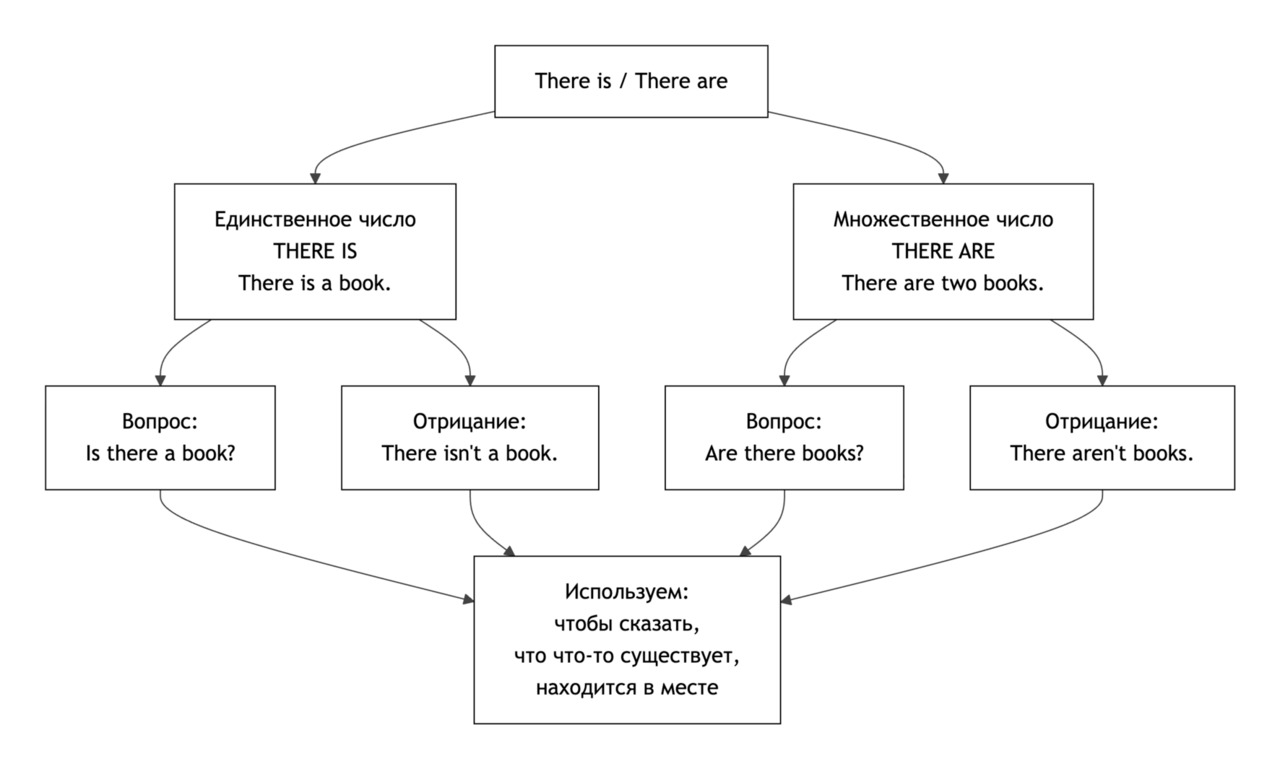
Конструкция there is / there are используется, чтобы сказать, что что-то существует или находится где-то. Она часто переводится на русский словами «есть», «находится», «имеется».
There is используется с единственным числом и с неисчисляемыми существительными.
There is a book on the desk. — На парте есть книга.
There is milk in the fridge. — В холодильнике есть молоко.
There are используется с множественным числом.
There are two windows in the room. — В комнате есть два окна.
Отрицание:
There is not (isn’t) a computer in the class. — В классе нет компьютера.
There are not (aren’t) any students here. — Здесь нет учеников.
Вопрос:
Is there a park near your house? — Есть ли парк рядом с твоим домом?
Are there any books on the table? — Есть ли книги на столе?
Советы для школьников:
После there is / there are всегда идёт существительное.
Выбор is или are зависит от слова после, а не от there.
Вопрос начинается с Is there или Are there.
Story
There is a small park near my school, and it is my favourite place after lessons. There are many trees, and there is a long path in the centre of the park. In the morning, there are students there, but in the evening, there is more space and quiet.
Near the entrance, there is a bench where I usually sit. There are birds in the trees, and there is fresh air all around. Sometimes there are children with their parents, and there is a friendly atmosphere.
In the middle of the park, there is a small playground. There are swings and a football field. After school, there are often games there, and there is a lot of energy. On the other side, there is a small café. There is hot tea and simple food.
When I am tired, there is nothing better than this place. There are moments of calm, and there is always time to think. For me, there is comfort and peace in this park.
Useful Words and Expressions
park — парк
near — рядом
path — дорожка
centre — центр
entrance — вход
bench — скамейка
fresh air — свежий воздух
atmosphere — атмосфера
playground — детская площадка
swing — качели
field — поле
energy — энергия
café — кафе
quiet — тишина
comfort — комфорт
peace — спокойствие
Exercises
Exercise 1. Fill in the blanks
There ___ a book on the table.
There ___ two windows in the room.
___ there a shop near your house?
There ___ not any students in the class.
___ there many trees in the park?
Exercise 2. Choose the correct answer
There (is / are) a café near the school.
There (is / are) many benches in the park.
(Is / Are) there a computer in the classroom?
There (is / are) not any milk in the fridge.
Exercise 3. Answer the questions
Is there a park or a shop near your home?
Are there many rooms in your house or flat?
Is there a place at school where you feel calm?
Are there any books on your desk now?
Is there anything important in your school bag?
Answer Key
Exercise 1:
is
are
Is
are
Are
Exercise 2:
is
are
Is
is
Exercise 3 (sample answers):
There is a small shop near my home. It is very convenient for everyday needs.
There are three rooms in my flat. They are comfortable and bright.
Yes, there is a quiet place in my school. It is near the library.
Yes, there are some books on my desk. They are for my classes.
Yes, there is something important in my school bag. There is my notebook and my planner.
Mini Tips
Задавай себе вопрос: сколько предметов? Это помогает выбрать is или are.
Учись говорить целыми фразами: There is a reason, There are many students.
Articles: a, an, the
Grammar Focus
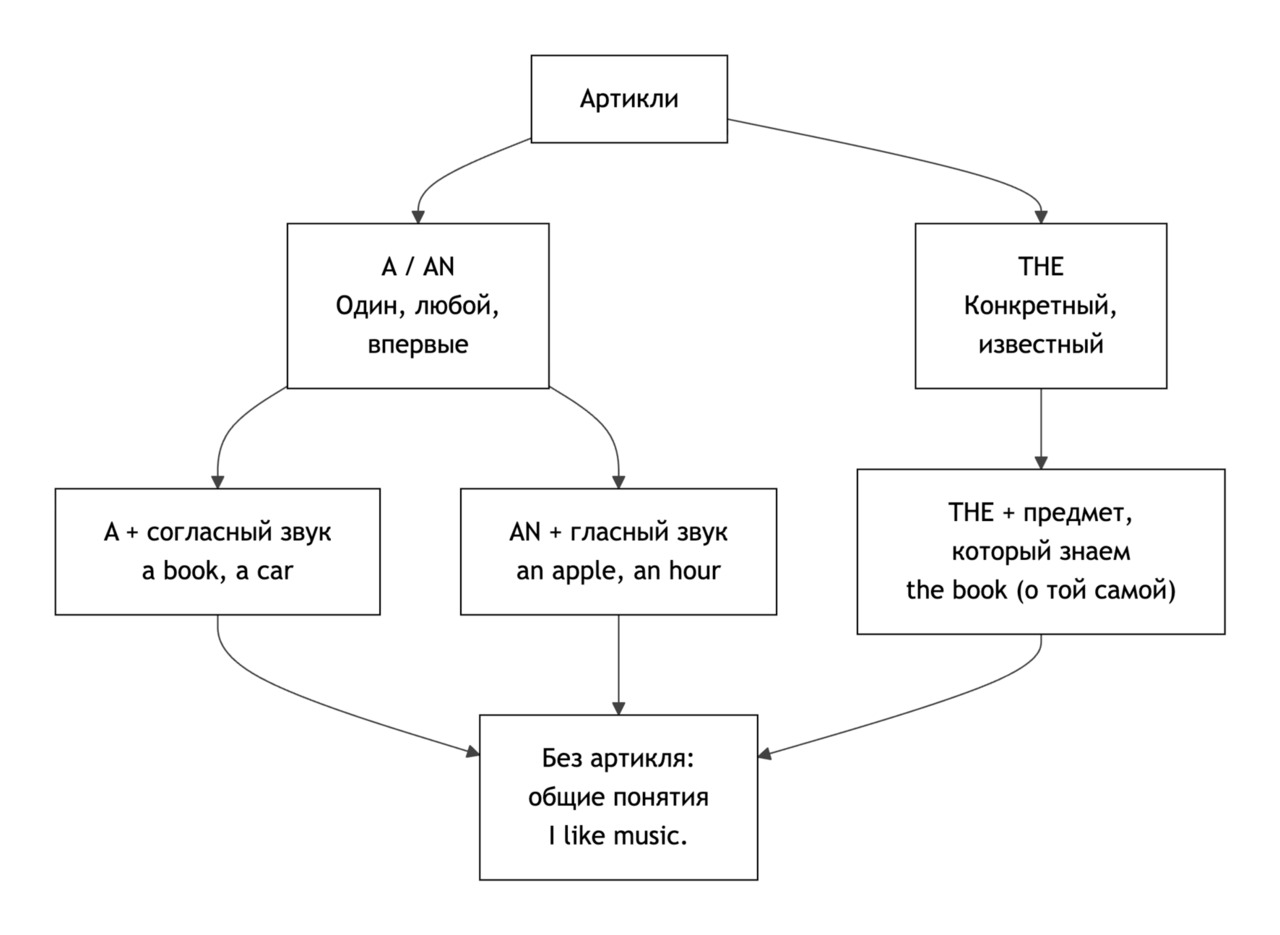
Articles — это короткие слова, которые стоят перед существительными и помогают понять, о чём именно мы говорим. В английском языке есть два типа артиклей: неопределённые (a, an) и определённый (the).
A и an используются с исчисляемыми существительными в единственном числе, когда мы говорим о предмете впервые или в общем смысле.
A используется перед словами, которые начинаются с согласного звука.
A book, a school, a student.
An используется перед словами, которые начинаются с гласного звука.
An apple, an hour, an English lesson.
The используется, когда предмет известен, конкретен или уже упоминался ранее.
I see a teacher. The teacher is in the classroom.
The book on the desk is mine.
Артикль the также используется с уникальными объектами и местами:
the sun, the sky, the world, the school (если понятно, о какой школе идёт речь).
Советы для школьников:
Считай звуки, а не буквы: an hour, но a university.
Если предмет один из многих — чаще всего нужен a или an.
Если понятно, какой именно предмет, — нужен the.
Story
In the morning, I walk to school with a bag on my shoulder. There is a small park near the road and a café on the corner. I usually buy an apple there before classes. It is a simple habit, but it makes the morning better.
At school, I go to the classroom on the second floor. The classroom is bright, and the windows are big. On the wall, there is a map and a clock. The clock is old, but it works well.
During the lesson, the teacher explains a new topic. The topic is interesting and useful. I open a notebook and write with a blue pen. After the lesson, I talk to a friend near the door. The friend is in my class, and we walk home together.
In the evening, I sit at the desk in my room. There is a lamp on the desk and a book in my hands. The book is about travel, and it helps me relax after a long day.
Useful Words and Expressions
morning — утро
shoulder — плечо
corner — угол
habit — привычка
second floor — второй этаж
wall — стена
clock — часы
topic — тема
notebook — тетрадь
pen — ручка
door — дверь
evening — вечер
desk — письменный стол
lamp — лампа
travel — путешествия
relax — расслабляться
Exercises
Exercise 1. Fill in the blanks
This is ___ book about history.
There is ___ apple on the table.
___ sun is bright today.
I see ___ teacher in the hall.
___ teacher is very kind.
Exercise 2. Choose the correct answer
I have (a / the) small bag.
She buys (a / an) orange every day.
(The / A) classroom is on the first floor.
He opens (a / the) notebook on his desk.
Exercise 3. Answer the questions
What is there on the desk in your room?
Do you have a favourite place at school?
What do you usually do in the morning before school?
Is there a book in your school bag now?
What helps you relax in the evening?
Answer Key
Exercise 1:
a
an
The
a
The
Exercise 2:
a
an
The
a
Exercise 3 (sample answers):
There is a lamp and a notebook on my desk. The desk is near the window.
Yes, I have a favourite place at school. The library is quiet and comfortable.
In the morning, I usually have breakfast and check my school bag. It helps me feel ready.
Yes, there is a book in my school bag. The book is for my English lesson.
In the evening, music helps me relax. It makes the day feel complete.
Mini Tips
Если сомневаешься, задай вопрос: мы говорим об этом впервые или уже знаем, о чём речь?
Читай тексты вслух и обращай внимание, почему автор выбирает a, an или the.
This, That, These, Those
Grammar Focus
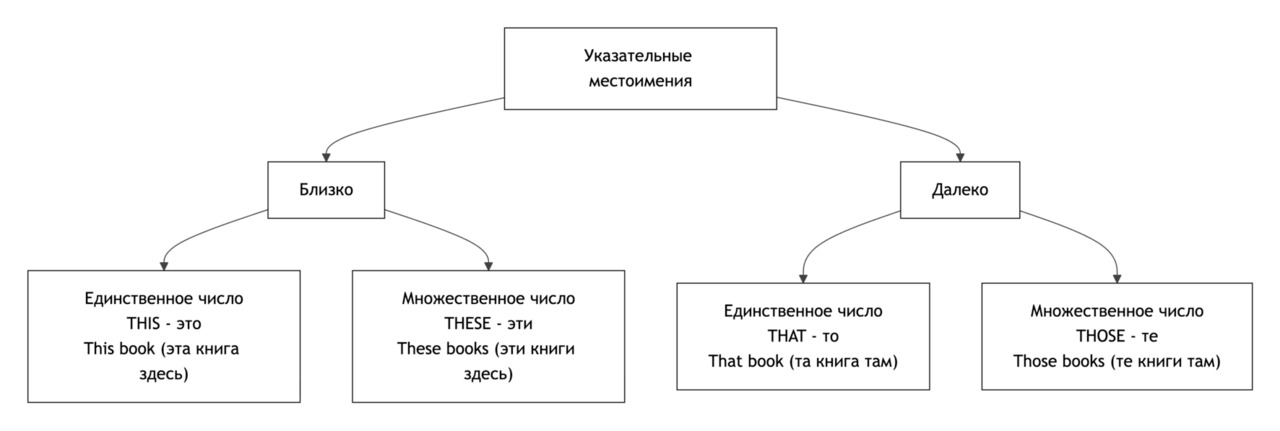
Слова this, that, these, those — это указательные местоимения. Они используются, чтобы показать, какой предмет мы имеем в виду и где он находится — близко или далеко.
This используется с единственным числом, когда предмет находится рядом.
This book is interesting. — Эта книга интересная.
That используется с единственным числом, когда предмет находится далеко.
That building is very old. — То здание очень старое.
These используется с множественным числом, когда предметы находятся рядом.
These students are my friends. — Эти ученики — мои друзья.
Those используется с множественным числом, когда предметы находятся далеко.
Those houses are beautiful. — Те дома красивые.
Указательные местоимения часто используются с глаголом to be.
This is my desk.
Those are our teachers.
Советы для школьников:
Сначала подумай: один предмет или несколько.
Затем определи: близко или далеко.
После this и that используется is, после these и those — are.
Story
This morning is calm, and this place feels familiar. I am in my classroom, and this desk near the window is mine. These books on the desk are new, and they are very useful for my lessons. I like this quiet moment before class.
From the window, I can see the school yard. That tree in the centre is very old. Those benches near the wall are usually full during breaks. I remember many conversations near those places.
After the lesson, we walk outside. These students around me are in my class. We talk about homework and plans. That building across the street is a library. Those rooms inside are silent and comfortable.
In the evening, I think about my day. These moments are important for me. They are simple, but they help me understand that this school and these people are part of my life.
Useful Words and Expressions
morning — утро
familiar — знакомый
desk — парта
useful — полезный
moment — момент
yard — двор
centre — центр
bench — скамейка
break — перемена
conversation — разговор
outside — снаружи
across the street — через улицу
library — библиотека
silent — тихий
comfortable — удобный
important — важный
Exercises
Exercise 1. Fill in the blanks
___ book in my hand is interesting.
___ students near me are very friendly.
___ building over there is a hospital.
___ chairs in this room are new.
___ desk near the door is not mine.
Exercise 2. Choose the correct answer
(This / These) is my classroom.
(That / Those) are old houses.
(This / That) book on the table is mine.
(These / That) students are in my class.
Exercise 3. Answer the questions
What is this place where you are now?
What are these things near you?
Is there something that is far from you right now? What is that?
Who are those people you see at school?
Which of these places at school do you like most?
Answer Key
Exercise 1:
This
These
That
These
That
Exercise 2:
This
Those
This
These
Exercise 3 (sample answers):
This place is my classroom. It is bright and comfortable.
These things near me are my books and my notebook. They are on the desk.
Yes, that building across the street is far from me. It is a library.
Those people at school are my classmates. They are friendly and helpful.
I like the library most. It is quiet and good for studying.
Mini Tips
Представляй жест рукой: this / these — рядом, that / those — далеко.
Повторяй примеры с реальными предметами вокруг тебя — так слова запоминаются быстрее.
Plural Nouns and Countable / Uncountable Nouns
Grammar Focus
В английском языке существительные могут быть исчисляемыми и неисчисляемыми.
Исчисляемые существительные — это предметы, которые можно посчитать. У них есть форма единственного и множественного числа.
a book — books
a student — students
Обычно множественное число образуется с помощью окончания -s или -es.
book — books
class — classes
Некоторые существительные образуют множественное число не по правилу.
man — men
child — children
foot — feet
Неисчисляемые существительные нельзя посчитать поштучно. У них нет формы множественного числа, и с ними не используется артикль a / an.
water, milk, information, advice, money
I have some water. — У меня есть немного воды.
This information is useful. — Эта информация полезная.
Чтобы указать количество неисчисляемых существительных, используются слова и выражения:
some, a lot of, much, a piece of, a glass of.
Советы для школьников:
Если можно сказать one, two, three — слово исчисляемое.
Не используй a / an с неисчисляемыми существительными.
Некоторые слова в английском неисчисляемые, хотя в русском могут быть исчисляемыми, например information.
Story
In my school bag, there are many things that I use every day. There are books and notebooks for different subjects. There are also pens and pencils in a small case. These objects are simple, but they are important for my studies.
There is some food in my bag too. There is an apple and some bread for a short break. I also have a bottle of water. Water is important, especially after long lessons.
In the classroom, there is a lot of information on the walls. There are posters, charts, and pictures. This information helps students understand difficult topics. Our teacher often gives us good advice before tests.
After school, I usually have some free time. There are many activities to choose from. There is music, sport, and reading. All these things make my day full and balanced.
Useful Words and Expressions
school bag — школьный рюкзак
thing — вещь
notebook — тетрадь
subject — предмет
case — пенал
object — предмет
food — еда
break — перерыв
bottle — бутылка
information — информация
wall — стена
poster — плакат
chart — схема
advice — совет
activity — занятие
balanced — сбалансированный
Exercises
Exercise 1. Fill in the blanks
There are two ___ on the desk. (book)
I need some ___. (water)
These ___ are very interesting. (story)
There is a lot of ___. (information)
Three ___ are in the classroom. (child)
Exercise 2. Choose the correct answer
I have (a / some) milk for breakfast.
There are many (student / students) in the hall.
This advice (is / are) very useful.
She buys (a / an) apple every day.
Exercise 3. Answer the questions
What things are in your school bag?
Is there any food or water with you today?
What information do you usually see in your classroom?
What activities do you like after school?
Is advice from teachers important for you? Why?
Answer Key
Exercise 1:
books
water
stories
information
children
Exercise 2:
some
students
is
an
Exercise 3 (sample answers):
There are books, notebooks, and pens in my school bag. They help me study every day.
Yes, there is some water with me today. It is in a small bottle.
I usually see information about subjects and rules in my classroom. It helps me learn better.
I like activities such as reading and listening to music. They help me relax after school.
Yes, advice from teachers is important for me. It helps me avoid mistakes and improve my results.
Mini Tips
Запоминай неисчисляемые существительные вместе с выражениями: some water, a piece of advice.
Проверяй себя вопросом: можно ли посчитать? Если нет — слово неисчисляемое.
Have got / Has got
Grammar Focus
Конструкция have got / has got используется, чтобы говорить о наличии чего-то, принадлежности или свойствах. Она часто переводится на русский как «имею», «есть у…».
Have got используется с I, you, we, they.
I have got a book. — У меня есть книга.
We have got two cats. — У нас есть две кошки.
Has got используется с he, she, it.
He has got a bicycle. — У него есть велосипед.
She has got blue eyes. — У неё голубые глаза.
Отрицание:
I have not got a pen. — У меня нет ручки.
He has not got a dog. — У него нет собаки.
Вопрос:
Have you got a mobile phone? — У тебя есть мобильный телефон?
Has she got a sister? — У неё есть сестра?
Советы для школьников:
Have got / has got — это разговорная форма. В письменной речи можно просто использовать have / has.
В вопросах и отрицаниях вспомогательный глагол have / has ставится перед подлежащим.
После have got / has got всегда идёт существительное.
Story
My friend Lucy has got a small dog. Its name is Max, and it is very playful. She has got a blue collar and a soft bed for him. Max has got many toys, and he likes to play with them in the garden.
I have got a bicycle, and I often ride it after school. My brother has got a new skateboard, but I have not got one yet. We sometimes ride together, and it is always fun.
Our classroom has got a large window, and it has got a bright light. The classroom has got many desks and chairs, and each student has got a place to sit. Our teacher has got a big bag with books and materials. She has got everything she needs for the lessons.
In the evening, I feel happy because I have got good friends and a supportive family. We have got time to relax and talk about our day.
Useful Words and Expressions
dog — собака
playful — игривый
collar — ошейник
bed — кровать
toy — игрушка
garden — сад
bicycle — велосипед
skateboard — скейтборд
classroom — класс
window — окно
light — свет
desk — парта
chair — стул
bag — сумка
material — материал
supportive — поддерживающий
family — семья
Exercises
Exercise 1. Fill in the blanks
I ___ got a new pen.
She ___ got a red dress.
We ___ got two cats.
He ___ got a computer.
They ___ not got any problems.
Exercise 2. Choose the correct answer
My friend (have got / has got) a new phone.
I (have got / has got) a lot of books.
(Have / Has) you got a bicycle?
She (have got / has got) a small bag.
Exercise 3. Answer the questions
Have you got a pet? What is it?
Has your best friend got a favourite toy?
Have you got a bicycle or another transport?
Has your classroom got many windows?
Have you got something special at home?
Answer Key
Exercise 1:
have
has
have
has
have
Exercise 2:
has got
have got
Have
has got
Exercise 3 (sample answers):
Yes, I have got a dog. Its name is Rex. He is playful and friendly.
Yes, my best friend has got a teddy bear. It is soft and very old.
I have got a bicycle. I ride it every day after school.
Yes, our classroom has got three big windows. They make the room bright.
Yes, I have got a small lamp on my desk. It helps me read in the evening.
Mini Tips
Повторяй структуру: I/We/You/They — have got, He/She/It — has got.
Используй с предметами, животными и членами семьи, чтобы практиковать принадлежность.
В вопросах и отрицаниях всегда меняй порядок: Have you got …? / I have not got ….
Present Simple: Affirmative Sentences
Grammar Focus
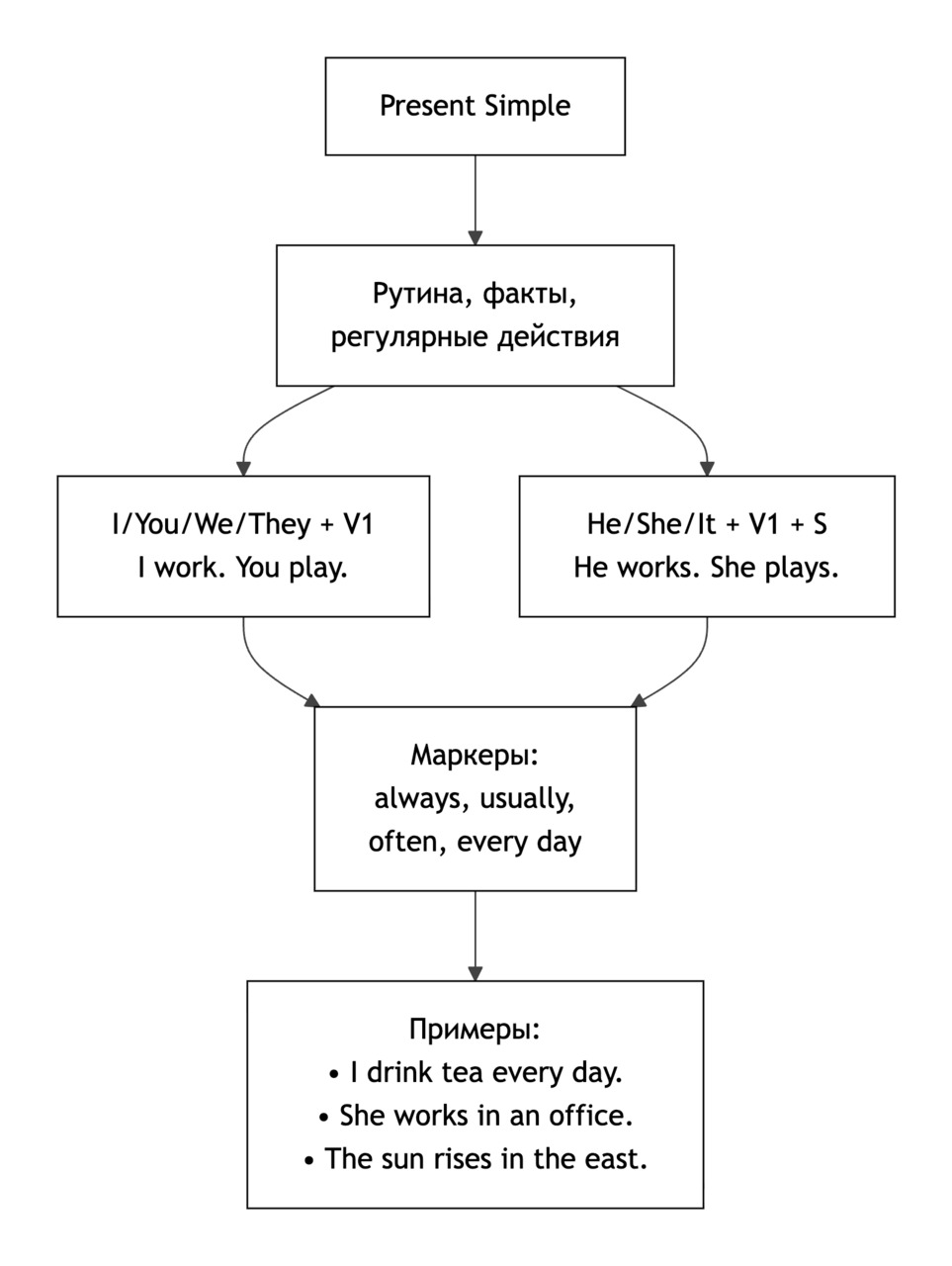
Present Simple — это настоящее простое время. Оно используется, чтобы говорить о регулярных действиях, привычках, фактах и общих истинах.
Структура утвердительного предложения:
Подлежащее + глагол (основная форма)
I play football. — Я играю в футбол.
She likes music. — Она любит музыку.
We study English every day. — Мы учим английский каждый день.
Особенности:
Для he, she, it к глаголу добавляется -s или -es:
He watches TV. — Он смотрит телевизор.
She goes to school by bus. — Она ездит в школу на автобусе.
С другими местоимениями глагол остаётся в основной форме:
I read books.
They play football.
Советы для школьников:
Не забывай про -s/-es с he, she, it.
Present Simple часто используется с наречиями частоты: always, usually, often, sometimes, never.
Для отрицаний и вопросов используется do / does, но это будет в другой главе.
Story
Every morning, I wake up at seven o’clock. I brush my teeth and wash my face. Then I eat breakfast with my family. My mother makes tea, and my father reads the newspaper. We usually talk about our plans for the day.
After breakfast, I go to school. I walk with my friends, and we talk about our lessons. My teachers teach different subjects. My favourite subject is English because I like learning new words. We always have fun in the English class.
In the afternoon, I play football with my classmates. They enjoy the game, and I enjoy it too. After that, I go home and do my homework. In the evening, I read a book or listen to music. I usually go to bed at ten o’clock. Every day is full, but I am happy with my routine.
Useful Words and Expressions
wake up — просыпаться
brush teeth — чистить зубы
wash face — умываться
breakfast — завтрак
newspaper — газета
plan — план
lesson — урок
favourite subject — любимый предмет
learn — учить
word — слово
fun — удовольствие
game — игра
classmate — одноклассник
homework — домашнее задание
listen to music — слушать музыку
evening — вечер
routine — распорядок дня
Exercises
Exercise 1. Fill in the blanks
I ___ up at seven o’clock every day.
She ___ breakfast with her family.
They ___ football in the afternoon.
My brother ___ English at school.
We ___ music in the evening.
Exercise 2. Choose the correct answer
He (play / plays) tennis on Saturdays.
My friends (like / likes) reading books.
I (watch / watches) TV every evening.
She (go / goes) to school by bus.
Exercise 3. Answer the questions
What time do you usually wake up?
What do you eat for breakfast?
Which subject do you like at school?
Do you play any sports? Which ones?
What do you usually do in the evening?
Answer Key
Exercise 1:
wake
eats
play
studies
listen
Exercise 2:
plays
like
watch
goes
Exercise 3 (sample answers):
I usually wake up at seven o’clock. I start my day by washing my face.
I eat cereal and drink tea for breakfast. Sometimes I have fruit.
My favourite subject at school is English. I enjoy learning new words.
Yes, I play football with my friends. We usually play after school.
In the evening, I do my homework and listen to music. It helps me relax.
Mini Tips
Для he, she, it добавляй -s / -es: he plays, she watches.
Наречия частоты помогают практиковать Present Simple: always, usually, sometimes, never.
Читай вслух свои утвердительные предложения, чтобы запомнить структуру естественно.
Present Simple: Negative and Questions
Grammar Focus
В английском языке Present Simple используется для регулярных действий и фактов, а в отрицательных предложениях и вопросах появляются вспомогательные глаголы do / does.
Отрицательные предложения:
I / you / we / they + do not (don’t) + глагол
I don’t play tennis. — Я не играю в теннис.
They don’t like pizza. — Им не нравится пицца.
He / she / it + does not (doesn’t) + глагол
She doesn’t watch TV. — Она не смотрит телевизор.
He doesn’t eat sweets. — Он не ест сладости.
Вопросительные предложения:
Do + I/you/we/they + глагол?
Do you play football? — Ты играешь в футбол?
Do they like English? — Им нравится английский?
Does + he/she/it + глагол?
Does he study English? — Он учит английский?
Does she have a dog? — У неё есть собака?
Советы для школьников:
В отрицании и вопросах не добавляем -s к глаголу для he, she, it — вместо этого используем does / doesn’t.
Ответы на вопросы короткие:
Yes, I do. / No, I don’t.
Yes, she does. / No, he doesn’t.
Story
I usually wake up at seven o’clock, but sometimes I don’t get up on time. I don’t eat sweets in the morning because my mother says they are not healthy. Do you eat sweets before breakfast? I think it is not a good idea.
My brother goes to school by bus, but he doesn’t like it. He usually walks with his friends when the weather is nice. Does he walk fast? Yes, he walks very fast.
In the classroom, we don’t always listen to the teacher. Sometimes students talk and laugh, but the teacher doesn’t get angry. Do you talk in class? I try not to talk because I want to learn.
In the afternoon, I play football with my friends. We don’t play every day, only on weekends. Does your friend play football too? I hope so, because it is fun to play together.
Useful Words and Expressions
usually — обычно
sometimes — иногда
sweets — сладости
healthy — здоровый
get up — вставать
weather — погода
fast — быстро
listen — слушать
talk — разговаривать
laugh — смеяться
angry — сердитый
afternoon — после обеда
weekend — выходные
idea — идея
fun — весело
together — вместе
Exercises
Exercise 1. Fill in the blanks
She ___ (not / like) chocolate.
I ___ (not / watch) TV in the morning.
He ___ (not / go) to school by car.
___ you ___ (play) football on weekends?
___ he ___ (study) English every day?
Exercise 2. Choose the correct answer
They (doesn’t / don’t) like pizza.
He (do / does) not go to the park.
(Do / Does) she have a pen?
I (don’t / doesn’t) play computer games in the evening.
Exercise 3. Answer the questions
Do you wake up early every day?
Do you like sweets?
Does your best friend go to school by bus?
Do you play any sports?
Does your teacher give homework every day?
Answer Key
Exercise 1:
doesn’t
don’t
doesn’t
Do… play
Does… study
Exercise 2:
don’t
does
Does
don’t
Exercise 3 (sample answers):
Yes, I wake up early every day. I usually get up at seven o’clock.
Sometimes I like sweets, but I don’t eat them every day.
Yes, my best friend goes to school by bus. He likes it.
Yes, I play football with my friends after school.
Yes, my teacher gives homework every day. It helps me learn.
Mini Tips
Для he, she, it не добавляй -s после does / doesn’t.
В вопросах вспомогательный глагол ставится перед подлежащим: Do you…? Does he…?
Короткие ответы помогают быстро говорить: Yes, I do. / No, he doesn’t.
Adverbs of Frequency
Grammar Focus
Adverbs of frequency — это слова, которые показывают, как часто происходит действие. Они помогают говорить о привычках, распорядке дня и повторяющихся событиях.
Основные наречия частоты:
always — всегда
usually — обычно
often — часто
sometimes — иногда
rarely — редко
never — никогда
Позиция в предложении:
Перед основным глаголом (но после to be):
I always wake up at seven.
She never eats sweets.
Если глагол to be, наречие стоит после него:
He is usually happy.
They are never late.
Советы для школьников:
Наречия частоты помогают строить предложения в Present Simple.
Ставь наречие перед глаголом, если это не to be.
Используй эти слова, чтобы говорить о своих привычках.
Story
Every day, I wake up at seven o’clock. I always brush my teeth and wash my face. I usually eat breakfast with my family. My mother always makes tea, and my father often reads the newspaper.
After breakfast, I go to school. I usually walk with my friends, but sometimes I go alone. At school, my teachers always explain new topics clearly. We sometimes do fun activities in class.
In the afternoon, I play football with my friends. We often meet at the school yard. My brother rarely joins us because he has other hobbies. In the evening, I do my homework. I always finish it before dinner. After that, I sometimes watch TV or listen to music.
I am happy with my routine because I always have time for school, friends, and hobbies. Life is better when I follow a plan.
Useful Words and Expressions
wake up — просыпаться
brush teeth — чистить зубы
wash face — умываться
breakfast — завтрак
usually — обычно
always — всегда
often — часто
sometimes — иногда
rarely — редко
never — никогда
school — школа
teacher — учитель
topic — тема
activity — занятие
yard — двор
hobby — хобби
dinner — ужин
Exercises
Exercise 1. Fill in the blanks
I ___ brush my teeth in the morning. (always / sometimes)
She ___ goes to school by bus. (never / usually)
We ___ play football after lessons. (often / rarely)
He is ___ happy with his results. (always / never)
My parents ___ eat out on weekends. (rarely / always)
Exercise 2. Choose the correct answer
They (always / never) do homework on time.
I (usually / rarely) watch TV in the morning.
She (often / sometimes) helps me with lessons.
He is (never / always) late for school.
Exercise 3. Answer the questions
How often do you wake up early?
How often do you eat sweets?
How often do you do your homework?
How often do you play sports?
How often do you see your friends?
Answer Key
Exercise 1:
always
usually
often
always
rarely
Exercise 2:
always
usually
sometimes / often (either works)
always
Exercise 3 (sample answers):
I usually wake up at seven o’clock. Sometimes I wake up a little later.
I rarely eat sweets because I want to stay healthy.
I always do my homework in the afternoon. It helps me understand the lessons.
I often play football with my friends after school.
I sometimes see my friends on weekends. We like to walk and talk together.
Mini Tips
Наречия частоты помогают делать речь точнее: I always eat breakfast vs I eat breakfast.
Вспомни правило: перед глаголом, после to be.
Попробуй составить список своих привычек с этими наречиями — это хорошо закрепляет материал.
Present Continuous: Actions Now
Grammar Focus
Present Continuous используется, чтобы говорить о действиях, происходящих прямо сейчас, или о временных действиях.
Структура утвердительного предложения:
Подлежащее + am/is/are + глагол + -ing
I am reading a book. — Я читаю книгу (сейчас).
She is watching TV. — Она смотрит телевизор (прямо сейчас).
Бесплатный фрагмент закончился.
Купите книгу, чтобы продолжить чтение.