
Бесплатный фрагмент - Designer of life: 70 golden rules of deep transformation
A practical guide to mindfulness. Will replace years of spiritual seeking

Expert Reviews
Review by Irina A. Kairova, PhD in Philosophy, Associate Professor of the Public Relations Department at Don State Technical University (DSTU), Master of Psychology
“I am not what happened to me. I am what I choose to become.”
— C. G. Jung
Dear readers, I am incredibly happy for you!
The fact that you are holding this book in your hands means one thing: you are already on the right path to your true self. You are ready to make your life conscious, which is a direct road to self-respect, self-acceptance, and genuine happiness.
In the modern world, oversaturated with information about personal growth, finding a clear and reliable guide is becoming increasingly difficult. Against this backdrop, Irina Zakharchenko’s book, Life Designer, is a true breath of fresh air. The uniqueness of this work lies in its bold and, most importantly, harmonious synthesis of three key pillars of knowledge: evidence-based approaches from modern psychology, profound philosophical principles underlying world wisdom, and, what is especially valuable, personal, lived experience.
The author masterfully builds a bridge between what was long considered esoteric and what is now confirmed by empirical science. As someone with a background in philosophy, I see in this book a modern interpretation of the eternal questions of free will, responsibility, and the search for meaning. As a psychologist, I highly value its foundation in proven concepts such as neuroplasticity, cognitive psychology, and positive psychology, which gives each rule scientific weight and practical validity.
The author presents readers with 70 concise rules, supporting them with real-life examples, which turns reading into a fascinating process. The idea of an “instruction manual for life” is a brilliant approach in terms of communication with the reader. It removes the fear of the large and complex topic of self-development and makes complex concepts accessible to the widest audience, including teenagers, for whom such a guide can become an invaluable support at the start of their adult lives.
The importance of the principles and rules collected here is confirmed by the words of the great psychologist and founder of logotherapy, Viktor Frankl: “We should not ask what we can expect from life, but rather, ‘What does Life expect from us?’” The rules in this book will become a compass to help find the answer to this question.
I confidently recommend Life Designer to anyone who is tired of anxiety and uncertainty and is ready to take up the “designer’s tools” to create their own happy Future!
I wish the author and her book an interesting and bright path!
I. A. Kairova
Review by Olga S. Vasilyeva, PhD in Biology, Professor of the Department of General and Educational Psychology at the Academy of Psychology and Pedagogy, Southern Federal University (SFU), Head of the Continuing Professional Development Program “Health Psychology”
Irina Zakharchenko’s book, Life Designer: 70 Golden Rules, is a unique combination of a scientific approach, deep personal experience, and practical tools aimed at developing mindfulness and strengthening a person’s psychological well-being.
The author consistently and accessibly reveals the fundamental principles that govern Life and shows how these principles are confirmed by modern psychological research. Of particular importance is the emphasis on mindfulness as a key personal resource: the book presents numerous practices that allow the reader not only to better understand themselves but also to change their perception of life.
The book’s special value is enhanced by its reliance on the author’s own scientific research on the relationship between the level of mindfulness and life satisfaction, self-actualization, and anxiety levels, which serves as living proof of the effectiveness of the proposed tools.
The writing style is clear and concise: the material will be equally useful for specialists in the field of psychology and for a wide range of readers, including teenagers. A strong point of the book is its practical orientation — the proposed exercises and techniques are easily integrated into daily life.
Irina Zakharchenko’s book is of undeniable value for both personal growth and the professional practice of psychologists and educators. It can be recommended for use in educational programs, emotional intelligence development courses, and personal growth trainings.
Overall, this work is a holistic and deeply thoughtful study that offers practical benefits and inspires positive change.
With deep respect and best wishes on your unique life path!
O. S. Vasilyeva
Introduction
Dear Friend,
Have you ever wondered why even the simplest devices, like a coffee grinder, always come with an instruction manual, but the most complex and important “device” — our Life — does not? We spend years learning to use technology, yet no one has ever taught us how to live our own Life. We have to figure it out as we go: through trial and error, by listening to others’ advice that doesn’t always suit us.
This book is that very instruction manual that will help you become a conscious designer of your own reality. Step by step, by following the simple yet important principles of depth psychology, you will notice how everything gradually begins to change: your attitude toward yourself, your loved ones, your work — and the world as a whole.
My goal is not to change the world, for the Universe is always in perfect balance, and each of us is exactly where we are meant to be. My goal is to share with you powerful tools of mindfulness. They have helped me and my clients, and I believe they will help you too to cope with fears, anxiety, overcome depression, and live in harmony with yourself.
The natural aspiration of every human being is the pursuit of Beauty. And this is not just about aesthetics, but a deep spiritual quest, for it is “Beauty that will save the world,” as the great thinker Fyodor Dostoevsky asserted. My entire life has been dedicated to this creative pursuit, but in different dimensions. As a fashion designer, I worked with external beauty, transforming a person’s image and influencing their self-perception. As an interior and landscape designer, I created harmony in the environment, contributing to a change in worldview through contemplation. Now, as a psychologist, I am engaged with the deepest, spiritual Beauty — a person’s inner world, their self-acceptance, and happiness.
I have tried to present everything as briefly and clearly as possible so that the book is understandable to a wide audience, including teenagers from the age of 12 who are just beginning their amazing journey. For them, it will become a valuable guidepost that will help build a solid foundation for their own happiness.
On the following pages, you will discover valuable rules that will show you the path to inner freedom and joy. You, too, can become a designer of your own life. You already have everything you need for this — you just need to learn how to use it.
With love and faith in you,
Irina Zakharchenko

Chapter 1. The Universe
The Universe is the all-encompassing structure of being, which includes the physical, spiritual, and energetic laws that govern existence. It encompasses the material world, human consciousness, and the higher principles that guide the development of all that is.
Rule 1. Like Attracts Like
“With the law of attraction, your thoughts are like a boomerang: whatever boomerang you throw, the exact same boomerang will return to you.”
— Rhonda Byrne
This rule, often called the Law of Attraction, states that we attract into our lives whatever we focus our thoughts, feelings, and beliefs on. By concentrating on positivity, joy, and gratitude, we attract similar situations. Conversely, a constant focus on negativity and fear attracts trouble and disappointment. It is important to understand that this law is not a magical formula for fulfilling wishes. Rather, it reflects how our mindset and emotional state influence our actions, which, in turn, shape our reality.
Research in positive psychology, particularly the work of Martin Seligman, shows that qualities like optimism (which is directly linked to focusing on the positive and believing in a favorable outcome) correlate with better life outcomes. Optimistic people are more likely to persevere in achieving their goals, cope more effectively with stress, and demonstrate better physical health and overall well-being.
This rule manifests in all areas of life. In relationships: if you are convinced that “people can’t be trusted,” your behavior will push away honest people and attract those who confirm your fears. At work, a person with a “scarcity mindset” focuses on problems, is afraid to act, and ultimately remains in a state of lack. In health, it shows up like this: a constant fear of getting sick creates chronic stress, which weakens the immune system. In daily life, your inner state works like a radio receiver: if you’re tuned to the frequency of irritation, you will only notice rudeness; if you’re tuned to the frequency of gratitude, you will notice a passerby’s smile and the beautiful weather on the same day. The world doesn’t change — what you are tuned to perceive changes. Your inner vibration, your state of mind, is your main tool for creation.
A real-life example. When I had my own sewing and clothing repair shop, for some reason, I was terrified of a tax audit. It wasn’t that I had problems with my documents; I was just afraid they would find something to nitpick, and I didn’t want to pay fines out of my small profit. And, of course, a few days later, an employee would inform me of an audit. I would go and resolve the issue. In essence, nothing terrible ever happened: they issued recommendations that needed to be followed within a certain timeframe, and that was it. This experience became a confirmation of this rule for me: thoughts and worries can create and attract specific situations.
With my fear and anxiety, I was essentially “attracting” the very thing I wanted to avoid. I was mentally focused on problems with the tax office, and this led to an audit. This is a classic example of a self-fulfilling prophecy: we believe so strongly in a certain outcome that we unconsciously contribute to its realization. Each of us can find similar examples in our own lives. But there is a positive side to this rule: if we can attract what we fear, it means we can also attract what we desire (we’ll talk more about this in Chapter 9). Understanding this rule is the path to consciously creating your reality.
To learn how to apply this rule to attract pleasant moments into your life, you can use the “Positive Affirmations” technique. Affirmations are short, positive statements that you repeat regularly to program your subconscious for success.
• Formulate affirmations in the present tense, as if what you desire has already happened. For example:
— “I am wealthy and prosperous!”
— “I am healthy and full of energy!”
• Choose affirmations that evoke positive emotions in you and that you can believe in. Do not use statements that seem implausible to you (see Appendix 3 for a full list of affirmations).
• Write down your affirmations. This will help you remember them better and focus on them. When you repeat your affirmations, imagine that what you desire has already come true — visualize the image and feel the emotions that arise.
• Repeat your affirmations regularly, preferably several times a day, in the morning after waking up and in the evening before bed. You can say them out loud or to yourself.
• Remember that belief is the key ingredient for success. Believe that your affirmations are working, and you will surely see results.
The rule “like attracts like” is a powerful tool for creating the life you want. By changing your mindset and emotional state, you can change your reality. If you control your thoughts and emotions, you control the circumstances they attract.
Rule 2. The Outer World = The Inner World
“What you see in others exists in yourself.” — Carl Jung
This rule states that everything we see and experience in the external world is a reflection of our inner thoughts and beliefs. Our internal perceptual filters literally shape our reality. If we experience a lot of negativity inside, we tend to see more negativity around us. Conversely, if we are filled with love and gratitude, the world seems kinder and more beautiful to us. This phenomenon is studied within cognitive therapy, which proves that our thoughts and emotions influence how we interpret events.
Modern research in neurobiology and the concept of neuroplasticity scientifically confirm how our brain forms these very “perceptual filters” based on our experiences and emotional state. As neuroscientist Norman Doidge describes in detail in his book, our brain is not a fixed structure; it is capable of physically changing and reorganizing itself throughout life in response to new experiences.
This means that when we constantly focus on certain thoughts (for example, worrying about the future), the corresponding neural pathways in our brain are strengthened. The brain literally “tunes in” to these signals. Such connections become habitual “perceptual filters” through which we begin to automatically interpret new information. If our brain is “tuned” to anxiety, it will be more inclined to look for potential threats in the external world, even if they are minor. Thus, our inner state and experiences literally rewire the architecture of the brain, creating biased ways of perceiving that determine how we see and experience the external world.
A real-life example. I came to this realization at 49, when terrible events began to repeat in my life. Not even two years after a knife wound and surgery, another man in another country held a huge knife to me. In that moment, of course, I wasn’t thinking that it was a reflection of my inner state — in such stressful situations, it’s hard to assess anything soberly. The realization came later: if a situation with a knife is repeating, the cause must be within me.
Even after moving to another continent, to America, I couldn’t escape myself, because I brought my inner state with me. These events showed me just how much stress I had put myself under, how much I had stopped listening to my heart. This became the impetus for self-discovery and studying my emotional states. I started by analyzing which news, TV shows, and movies made me feel comfortable and which made me feel bad. In the end, I stopped watching news channels, reading news online, and watching thrillers. Not because I don’t care, but because I don’t want to live in constant anxiety. Now I try to choose information that gives me resources, rather than taking them away.
Such drastic measures helped me stop “getting stuck” in negative states. At first, breaking old habits was not easy. My hand would automatically reach for the remote to turn on the TV news. And this is where you have to tell yourself:
— “Stop! I don’t want to live the old way anymore!”
After these words, I would resolutely put the remote down and go do something else: read an interesting book or watch an educational video to learn something new. I suddenly had a lot of free time, and in the fall and winter of 2016, I watched YouTube tutorials on how to build a house — after all, that had once been my dream.
Spring came, and I started building a house based on my own design (workers did the construction, and I supervised the process), as my first degree is in civil engineering. My new habits are still with me, and I feel good and calm with them. In my new reality, there are no more threats with knives and constant tension. I transformed my inner content, and Life reflected these changes in the external world. You can do it too, I sincerely believe in you.
To apply this rule, start with the “Inner World Analysis” technique. This practice will help you better understand the connection between your inner state and external events, identify patterns, and learn to manage your perception.
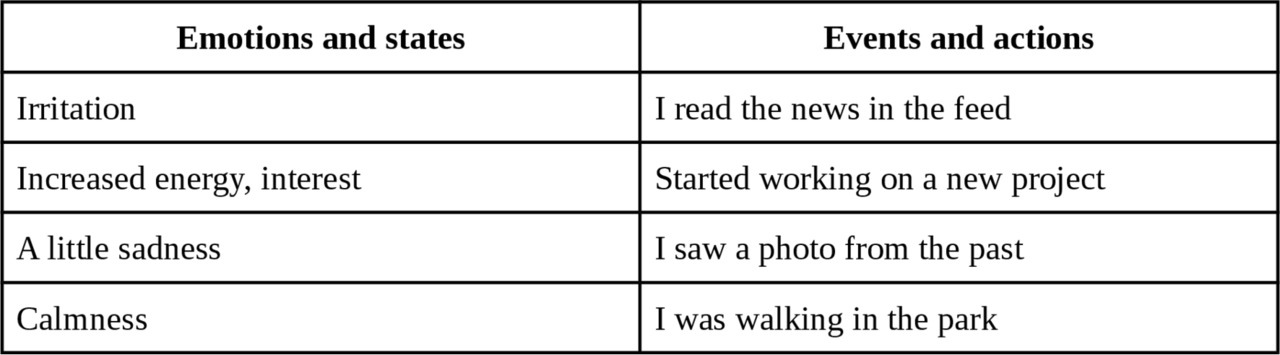
• Define a period for analysis (e.g., one day or one week). It’s convenient to do this analysis in a two-column table: in the first column, “Emotions and States,” and in the second, “Events and Actions.”
Example of filling out the table:
Step 1: Throughout the day — notice your emotions. When you notice an emotion, pause and ask yourself the main question:
— “What am I feeling right now?”
Simply name the emotion without judging it. This trains the “muscle” of mindfulness.
Step 2: At the end of the day — analyze the causes. Review your notes in the table and answer the next question:
— “Why did I feel this way?”
Try to see the connection between the event (column 2) and the emotion that arose (column 1).
Step 3: At the end of the week — draw conclusions. Analyze all your records for the week and answer the key questions:
— “What brings me joy, and what upsets me?”
— “What recurring situations do I notice?”
• Analyze the connections between the columns: which actions/events most often cause positive states, and which cause negative ones? Which habits (information consumption, social interactions) lead to the desired state, and which lead away from it? Use these conclusions to consciously change your habits in the future.
This principle is the key to managing your reality. By realizing that the external world is merely a reflection of your inner state, you stop being a victim of circumstances and become their creator. Working on your thoughts and emotions makes the world around you more harmonious. Start small — change one habitual thought — and you will see the world begin to change with you.
Rule 3. Everything in the World is Relative and Subjective
“In this world, there are no absolute truths, only different points of view.” — Albert Einstein
This rule suggests that there is no objective reality that is the same for everyone. Our perception of the world is colored by our personal experiences, beliefs, values, and cultural context. What seems good to one person may seem bad to another. What one person considers important, another may find insignificant. The idea of the relativity and subjectivity of our perception of the world has deep roots in both philosophy and science.
For example, Einstein’s theory of relativity showed that even such fundamental quantities as time and space are relative and depend on the observer. As the scientist himself joked, “When you sit with a pretty girl for an hour, you think it’s a minute. But let a minute seem like an hour when you sit on a hot stove. That’s relativity.”
In psychology, research in social perception confirms that our judgments about other people and situations are subjective and prone to various cognitive biases. Leading researchers in this field, psychologists Lee Ross and Richard Nisbett, demonstrated this convincingly in their work, The Person and the Situation. They showed how we often commit the fundamental attribution error, overestimating the role of personal traits while underestimating the powerful influence of the situation when explaining others’ behavior.
This research underscores that our perception is not objective. On the contrary, it is actively constructed by our mind, which relies on past experiences, beliefs, and various cognitive “filters.” Understanding these biases is important because it is our interpretations, not the events themselves, that influence our judgments and, consequently, our entire social reality.
This law applies to everyday life as well. What is a difficulty for one person is a trifle for another. For example, if I were to ask my audience to describe me, I would receive different answers. A stern person would see sternness in me, a kind person would see kindness, a cynical person would see cynicism. We perceive the world through the lens of our own experience, and everyone projects onto me the traits that exist within themselves. You cannot see in me what is not in you.
We often project our fears, expectations, and unaccepted parts of ourselves onto others. Someone who struggles with insecurity may see it even in a confident person. Someone who suffers from self-criticism will be particularly sensitive to criticism from others. This is why public opinion is so contradictory: the same person can seem gentle to some and harsh to others.
This explains why we react so strongly to certain traits in others — they reflect what we do not accept in ourselves. Irritation over someone else’s trait often says more about us than about them. Another person’s opinion does not carry an absolute assessment. Everything is relative. Our perception of happiness or problems depends on what or whom we compare ourselves to. This rule helps us realize that our Life depends on our frame of reference.
To apply this principle, use the “Objective Thinking” method. This practice will help you recognize the subjectivity of your perception and learn to see situations and people more objectively.
• When you encounter any information, situation, or person that triggers a strong, automatic reaction (judgment, strong disagreement, irritation), pay attention to that moment.
• Formulate and write down your first automatic judgment. For example:
— “I don’t like this person.”
— “This idea is stupid.”
• Critically analyze your automatic thoughts. Ask yourself the following questions:
— “What is my opinion based on?”
— “Can I trust the source of information my opinion is based on?”
— “What biases might be present in my perception of this situation (e.g., confirmation bias)?”
• Look at the situation from different perspectives. Ask yourself:
— “How would another person (with different beliefs, values, experience) view this?”
— “What are other possible explanations for this situation?”
— “Could there be other reasons that I’m not aware of?”
— “How have I acted in similar situations in the past?”
• Don’t cling to your initial beliefs. Be prepared for the possibility that your first perception was incomplete and distorted.
• Now that you have a deeper understanding of the situation, choose your next step. This could be a new attitude toward the person.
The law of relativity teaches us to see the world more broadly and to value our unique development. Stop comparing yourself to others and focus on your own progress. Your Life is your story, and every step of it is important. By freeing yourself from comparisons, you will find harmony and peace that will help you live with joy.
Rule 4. Everything Has Its Opposite
“Harmony is a combination of opposites.” — Aristotle
This law, known as the principle of polarity, states that everything in the world exists as pairs of opposites: day and night, hot and cold, good and evil, love and hate. These opposites are not absolute but rather represent two sides of the same coin. This principle is reflected in various philosophical and spiritual teachings, such as the Chinese philosophy of Yin and Yang.
In psychology, the eminent Swiss psychiatrist Carl Gustav Jung developed the concept of the “shadow,” which vividly illustrates this principle as it applies to the human psyche. According to Jung, the “shadow” represents the part of our personality that we suppress and do not acknowledge. This can include negative character traits (anger, envy, selfishness) — everything we consider “bad” and which is the opposite of our conscious self-image.
Jung argued that ignoring or repressing the “shadow” does not make it disappear; on the contrary, it continues to influence us from the unconscious, often manifesting in projections (when we see in others what we do not accept in ourselves). Understanding and gradually integrating the “shadow” — that is, recognizing and accepting these repressed aspects — is an important step on the path to psychological wholeness. Jung described this concept in detail in his works, including the collection The Essential Jung. Understanding the principle of polarity helps us accept the duality of the world and find balance between opposites, not only externally but also within ourselves.
Understanding this rule changes everything. In self-discovery: the harder you try to be only “good,” the louder your “shadow” — suppressed aggression — knocks from within. Accepting both sides brings freedom and wholeness. In a career: it is impossible to appreciate the taste of success without knowing the bitterness of failure. Failures are not the opposite of success, but an integral part of it, providing the most valuable lessons. In emotions: by suppressing sadness, we devalue joy. By accepting the full spectrum of feelings, you become emotionally alive and resilient, knowing that after the night, the dawn always comes.
A real-life example. At 49, a year after the death of a loved one, I fell into a deep depression. Losing someone close is the collapse of your familiar world. This is especially difficult to endure in adulthood, when a significant part of life has been lived together (in my case, seven years) and shared habits have been formed. After such a loss, I felt as if I had lost a part of myself. Every event reminded me of her. The depression built up gradually until it became an ocean of sorrow. But it was this depth of suffering that became the turning point. When the future seems empty and the past is painful, all that remains is the present moment.
In this state of depression, something unexpected happened: when the outer world lost its color, my attention turned inward. Depression, which had seemed so terrifying, became a guide to understanding myself. It cleared a space for new experiences. The practice of presence helped me find an anchor within myself. It was the fusion of depression and presence that created a state of harmony within me. This is a story of how difficult trials can become a path to a conscious existence, how pain can become a teacher, and how darkness can be a path to light.
To apply this principle in your life, you can use the “Accepting Opposites” technique. This practice will help you recognize the natural duality of the world and learn to accept both “positive” and “negative” aspects of life, finding balance and strength in them.
• Start by simply acknowledging that opposites always exist in the world (light and dark, joy and sadness, ups and downs). This is the natural order of things. Nothing is absolutely good or absolutely bad outside of a context.
• Don’t fight your “negative” emotions (fear, anger, sadness, irritation). Allow yourself to feel them. Don’t try to suppress them. Acceptance is the first step toward learning to manage them. When you accept your emotions, they lose their destructive power over you.
• Realize that opposites do not necessarily exclude each other. On the contrary, they often complement each other and create balance. Without darkness, we could not truly appreciate light; without sadness, joy; without difficulties, achievements.
• Strive not for the exclusion of one side (e.g., only “positivity”), but for harmony between them. Understand that downs are as natural as ups, and that difficulties carry lessons within them.
• Pay attention to the manifestations of opposites in your daily life. Notice how they alternate, how they coexist. This will help you understand this principle more deeply and learn to live in harmony with it.
Recognizing and accepting duality opens up a new level of awareness. Study this principle, and you will see how even the most complex situations become understandable and useful. Flexibility and wisdom are born in balance, and inner strength comes from the ability to see value in every experience.
Rule 5. Everything Follows Cycles and Seasons
“Everything in the world flows and changes, Life follows rhythms and cycles. Tides follow the ebb, day follows night, joy follows sorrow.”
— Hermann Hesse
This rule reflects a universal principle of nature: everything in the world is subject to cyclical changes. The alternation of day and night, the seasons, tides, and the phases of the moon are all examples of natural cycles. This same principle applies to human life. We go through cycles of growth and decline, activity and rest, joy and sorrow. Understanding this cyclical nature helps us accept the inevitability of change and adapt to it more effectively.
A prominent example of research in this area is the work on ultradian rhythms, which were studied in detail by Nathaniel Kleitman, a pioneer of sleep research. Ultradian rhythms are recurring cycles of activity and rest lasting about 90–120 minutes throughout the day. Research shows that our energy and concentration naturally fluctuate according to these cycles. Periods of high productivity are followed by periods of decline when the body needs rest and recovery. Ignoring these natural cycles and trying to work at full capacity without breaks leads to burnout. This research perfectly illustrates that our physiology and psychology are subject to rhythms, and respecting them is the key to sustainable productivity.
In addition to daily rhythms, there are longer biological rhythms — infradian rhythms — related, for example, to seasonal changes. A well-known phenomenon is Seasonal Affective Disorder (SAD), which manifests as depressive states in the autumn and winter due to a lack of sunlight. This is a clear example of how natural cycles directly affect our psychological state.
This rule affects all areas of life: health, relationships, career, and creativity. For example, by observing your mood and energy throughout the day, you can notice that periods of high energy are followed by periods of fatigue.
In 2017, I planted a beautiful garden of my own design, where I can now observe all the seasonal cycles of nature. I love it very much. I love how it is beautiful in its own way in every season. Plants do not fight the elements; they accept their gifts with humility and reveal themselves to us in all their glory.
I learn from nature to accept storms and misfortunes by living through them. If sadness comes over me, I study it with sensitivity and attention, observing this part of myself. Instead of fighting it, I perceive it as part of a natural process that is constantly changing. This awareness helps me not to resist but to act in harmony with the cycles. It is important to understand: just as nature rests in winter before a new bloom, so too must a person learn to accept their difficulties and periods of rest.
To apply this law in your life, try the “Map Your Cycles” technique. This will help you better understand your personal rhythms and learn to live in harmony with them. You can use a scale, for example, from 1 to 10, to rate your state on key parameters:
Step 1: Daily Tracking (Data Collection)
• Physical State: Energy level, quality of sleep, appetite, physical activity (1 = complete exhaustion, 10 = high energy and vitality).
• Emotional State: Mood, emotions (joy, sadness, anger, fear), stress level (1 = feeling down/anxious, 10 = joyful/calm).
• Energetic State: Overall energy level, enthusiasm, motivation (1 = weakness, 10 = inspiration).
• Mental State: Clarity of thought, concentration, creativity (1 = brain fog, 10 = deep focus and mental clarity).
Next to the numbers, briefly note a key event of the day that could have influenced your state (e.g., “slept poorly,” “conflict at work,” “long walk”).
Step 2: Weekly Analysis (Finding Connections)
At the end of the week, analyze your records to find clear patterns. Ask yourself the main questions:
— “What gives me energy, and what drains it?”
— “During which days/hours am I most productive, and when do I need to rest?”
You might notice: “Intensive work in the morning exhausts me by the evening, but a 15-minute walk at lunch changes everything.”
Step 3: Conscious Planning (Harmonization)
Now, start planning your life in harmony with these rhythms.
• Schedule your most challenging tasks during your “peak” hours, and routine tasks and rest during periods of decline.
• Consciously prepare for energy-draining meetings by planning for recovery afterward.
This is what it means to live in harmony with your natural cycles — the wisest path to productivity and well-being.
Life is a dance of rhythms. By learning to move in time with them, you will find harmony and inner strength. Any downturn is part of the path to a new upswing. By accepting your natural rhythms, you can use your energy more effectively and achieve greater results.
Rule 6. Everything in the Universe is Interconnected
“The action of even the tiniest creature leads to changes in the entire universe.” — Nikola Tesla
This fundamental principle, known as the law of interconnectedness, asserts that everything in the universe is linked and interdependent. From the smallest particles to the largest galaxies, everything is part of a Single Whole. Our thoughts, words, and actions have consequences that extend far beyond our immediate surroundings. Imagine the flap of a butterfly’s wings in Brazil, which, according to chaos theory, could trigger a tornado in Texas. This is a vivid illustration of how a seemingly insignificant event can have global consequences.
This rule is reflected in various scientific disciplines. In ecology, the concept of an ecosystem emphasizes the interconnectedness of all living organisms. Quantum physics points to the fundamental interconnectedness of particles at the subatomic level, where it is impossible to consider one particle in isolation from others.
Physicist and systems theorist Fritjof Capra, in his book The Web of Life: A New Scientific Understanding of Living Systems, offers a comprehensive scientific vision of this interconnectedness. The author synthesizes ideas from different fields to show that living systems, including our planet, are complex networks of interconnected elements. The properties of these elements are determined not only by their individual characteristics but also by their relationships and interactions within the entire network.
The reality we observe is merely a projection of a deeper, interconnected structure. According to this concept, every region of spacetime contains the entire order of the universe, much like a hologram, where each fragment carries information about the Whole. This means that even the slightest change in one place can instantly be reflected throughout the entire system, creating a domino effect.
The principle of interconnectedness manifests in all areas of life, but it is especially evident in our interactions with others. There was a period in my life when I was often dissatisfied with everything. Almost every trip to a restaurant ended in disappointment: the music seemed too loud, the steak wasn’t cooked enough, and the waiters were slow. Interestingly, my mood also affected my boyfriend: he would start getting irritated over small things, which created tension in our relationship. However, when I began to work on my perception and focus on the positive moments, our relationship significantly improved.
Understanding this deep interconnectedness — that every inner state and every action has a response in the external world — builds a sense of responsibility and awareness. Your actions and thoughts are not isolated; they are intricately woven into the single web of Life.
To apply this rule, you can use the “Benevolence” method. It is based on the understanding that our inner state and actions form a network of connections that influence our reality.
• Accept yourself as you are, with all your strengths and weaknesses. Speak kind words to yourself, and take care of your physical and emotional health. Remember: your benevolence toward the world begins with kindness to yourself.
• After you have learned to show benevolence to yourself, begin directing it outward. Smile at people, wish them a good day, give compliments, and help those in need. These simple acts of kindness actively form positive connections around you.
• Forgiveness is also an important aspect of benevolence. Forgive yourself for your mistakes and learn to forgive others for their wrongdoings. Forgiveness will free you from negative emotions and help you live in peace with yourself and others. By letting go of grudges and guilt, you break negative ties with the past and strengthen harmonious relationships in the present.
By realizing your inseparable connection with all that is, you accept responsibility for every word, thought, and deed. Remember that even the smallest changes in your life can have a positive impact on the world around you. Start right now, and you will see how your efforts transform not only your Life but the world around you!
Rule 7. Energy is Never Lost, Only Transformed
“Energy cannot be created or destroyed; it can only be changed from one form to another.” — Albert Einstein
This law, known as the law of conservation of energy, is a fundamental principle of physics. It states that energy cannot be created from nothing or completely destroyed; it only changes from one form to another. This applies to all types of energy: kinetic, potential, thermal, electromagnetic, and so on.
A rigorous theoretical explanation of this and other fundamental laws is presented in courses on theoretical physics. In the classic textbook Mechanics by Lev Landau and Evgeny Lifshitz, this law is derived as a consequence of the homogeneity of time in a closed system, demonstrating its universality. Their work shows that if the laws of physics do not change over time, then there exists a conserved quantity — energy.
According to this principle, the total amount of energy in a closed system remains constant, merely changing from one form to another. You cannot “destroy” or “suppress” an unwanted emotion. Trying to lock anger in the basement of your consciousness or pretending that fear doesn’t exist is like trying to hold water in your hand. The energy won’t go anywhere. It will either seep through your fingers in the form of passive aggression or one day burst out in an uncontrolled flood.
The essence of this rule is to stop fighting with energy and learn to transform it. Realize that the energy of anger can become fuel for decisive action. The energy of fear can be a signal for careful planning. The energy of sadness can be a source for re-evaluating values. It is important to consciously observe these processes so as not to end up in a state where your resources are being spent unconsciously and uncontrollably.
Waking up in the morning, I make a choice about which energy I want to start my day with: gratitude for a new beautiful day, or anxious thoughts about how it will go? For the past seven years, I have been waking up with a feeling of gratitude for the opportunity to express myself in a new day for the benefit of myself and others. This feeling sets the tone for the entire day and provides a reserve of energy that lasts with ease. But it wasn’t always like this. Before, before I got to my planned activities, I could waste this energy on: replaying the past, worrying about the future, being dissatisfied, judging others, doubting, excessive control, fear of change, comparing myself to others, consuming too much information, and much more. By evening, I would return home exhausted, not realizing where all my energy had gone.
Now I invite you to do the same. Look at my list and note what you spend your energy on (see Appendix 1 for the full list). Throughout the day, write down what drains your energy and what fills you with strength. Analyze and adjust your habits. This will help you become more conscious in how you allocate your energy. By learning to manage your attention, you will make your Life more balanced and productive. Every step requires energy, and only you decide where to direct it. The more conscious your choice, the more energy remains for creating the life of your dreams.
To apply this law, you can use the “Energy Transformation” method. This practice will help you learn not to suppress “negative” emotions, but to use the energy contained within them to achieve your goals and improve your well-being.
• Do not try to suppress or ignore negative emotions when they arise. Acknowledge that you are experiencing them and name them to yourself. For example:
— “I am very angry right now.”
— “I feel fear.”
— “Sadness has overcome me.”
• Realize that there is energy contained in every strong emotion, even a “negative” one. This energy can be used for your purposes.
• Consciously channel the energy of a negative emotion into a constructive outlet. Think about what useful activity you can spend it on right now. For example, if you are angry, you can channel this energy into sports, creativity, or cleaning.
• Imagine the energy being transformed. For example, picture the dark and heavy energy of anger turning into the bright and light energy of determination.
• Find what brings you joy and fills you with energy (see the list of sources in Appendix 2). Regularly return to these activities — this way you will restore your strength and reinforce your new, harmonious state.
Remember that working with energy is an ongoing process. When you understand that energy is never lost, only transformed, you can learn to manage it and create a Life full of joy, harmony, and success.

Chapter 2. Responsibility and Freedom
Responsibility is a person’s ability to make conscious decisions and be accountable for their consequences. It implies inner maturity, the skill to act independently of external circumstances, and not to shift blame onto others.
Freedom is the right to choose and the opportunity to act according to one’s convictions. However, freedom is impossible without responsibility, as a truly free person is aware of the consequences of their decisions and actions.
Rule 8. Cause and Effect
“Life can be neither just nor unjust, as everything within it has a cause and an effect.” — Alexander Sviyash
This rule, also known as the law of karma or the cause-and-effect relationship, states that every action has a consequence, and every event has a cause. It is a fundamental principle that operates in all areas of life, from physics to psychology. In physics, for example, Newton’s third law states that for every action, there is an equal and opposite reaction. In biology, evolution is the result of the cause-and-effect relationship between mutations and natural selection.
The manifestation of this principle is particularly evident in the realm of the human psyche. Our behavior, emotions, and even physiological reactions are often the consequence of our thoughts and beliefs. One of the most prominent examples of the practical application of the law of causality is Cognitive Behavioral Therapy (CBT). As shown in the works of A. Beck, CBT is based on understanding the link between thoughts, feelings, and behavior. It helps people to recognize and change dysfunctional cycles where negative thoughts lead to negative emotions and maladaptive behavior. By identifying the causes (distorted beliefs), CBT helps to change negative patterns, thereby influencing the effects — improving emotional well-being and quality of life.
Understanding the law of cause and effect helps us take responsibility for our actions and create the results we desire. Every action, no matter how small, leaves its mark, shaping our future. Where you are now and in what state is a consequence of your past actions.
A real-life example. At the age of 40, after a knife wound that doctors considered fatal and a many-hour surgery, I returned to life. More accurately, Life reemerged along with me. This became a sign for me: it meant the world still needed me!
A vague feeling of physical discomfort and a torturous thirst — these were the first glimmers of my returning consciousness. My parched mouth could barely make a sound. Someone moistened my lips with water. Opening my eyes, it took me a long time to understand where I was. An unfamiliar room, unfamiliar surroundings. My “personality” switched on a bit later, along with memories of what had happened.
My first thoughts were, “Why did this happen?” and “What did I do to deserve this?” Only many years later did I realize that this event was a consequence of my mindset and state in the past. The most important thing is not to fall into judgment or look for someone to blame. I believe that nothing in life happens by chance. This event, as painful as it was, gave me the opportunity to start with a clean slate. It was a kind of “reset” that forced me to take full responsibility for my thoughts and actions. It was then that I understood that the harshest trials are not a punishment from fate, but lessons that lead to true transformation.
To effectively use this law, you can apply the “Action Self-Analysis” technique. It will help you identify the patterns between your actions, their hidden causes (thoughts, emotions, states), and their consequences.
• Start a dedicated journal. In it, you will regularly record your actions and their results. You don’t have to describe every single step; focus on actions that seem important to you and triggered a strong reaction (positive or negative).
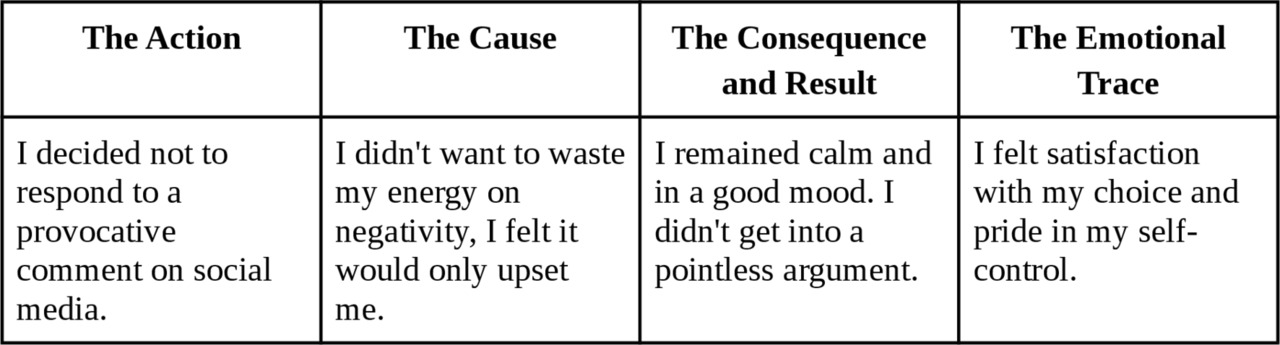
• For each significant event, record as many details as possible in a table to help identify the cause-and-effect link:
— “What exactly did you do?” (The Action).
— “Why did you do it? What inner state (thoughts, feelings, beliefs, needs) motivated this action?” (The Cause).
— “What specific result did you get? How did the situation unfold after this action?” (The Consequence and Result).
— “What emotions did you feel during and after the action?” (The Emotional “Trace” of the cause and effect).
Example of filling out the table:
• Set aside time, for example, once a week, to reread your entries from the past period and analyze them.
• Ask yourself questions to identify patterns and learn lessons:
— “Which of my actions (and their internal causes) led to positive results?”
— “Which of my actions (and their internal causes) led to negative results?”
— “What can I do differently next time if a similar situation arises?”
— “What useful lesson can I take from this situation?”
Self-analysis requires honesty with yourself. Don’t be afraid to admit your mistakes and see the undesirable consequences of your actions. Remember that the goal of self-analysis is not to berate yourself for the past, but to learn from it and make more conscious choices in the future.
Recognizing and applying this rule is the key to freeing yourself from the victim role. It gives you a powerful tool for managing your Life. By understanding that every action has consequences, you become more responsible in your decisions and can purposefully create the results you desire, shaping your future through conscious actions in the present.
Rule 9. You Alone Are Responsible for the Events in Your Life
“Habit. That is the problem. All you need is to be aware of your choices and responsible for your actions.” — Socrates
This rule states that you are the author of your story. Your Life is not the result of random chances or the actions of other people, but a consequence of your own choices and reactions to what happens. Although external circumstances are unavoidable, your interpretation of these circumstances and your subsequent actions shape your experience and, ultimately, your Life.
The assertion that you alone are responsible for the events in your life is based on the concept of an internal locus of control, first described in detail by psychologist Julian Rotter. In his research, he showed that people who attribute events to their own actions, rather than external circumstances, demonstrate higher levels of self-confidence and greater resilience to stress.
According to Rotter, an internal locus of control correlates with a sense of personal efficacy and the ability to make conscious decisions, which in turn affects psychological well-being. This research indicates a direct link between taking responsibility for one’s life and the level of satisfaction with it: the stronger the belief in one’s own influence on events, the less room there is for feelings of helplessness.
This rule affects virtually all areas of life: career, relationships, health, financial well-being, and personal growth. When you accept responsibility for your Life, you stop being a victim of circumstances and start actively managing your future. My realization of this rule was like discovering a superpower within myself: if I brought myself to “Point A” (a swamp), then I can pull myself out of it, like Baron Munchausen, and move to “Point B” (harmony).
I exclaimed:
— “Eureka! I don’t need anyone else for this! It all depends only on me!”
By accepting responsibility for my choices, I realized: it is I, and only I, who can change my life. As a result, I re-evaluated my priorities, took additional training in landscape and interior design — and found professional fulfillment in it.
When you recognize your role in shaping your reality, it becomes easier to adjust your behavior, learn new things, and move toward your desired results. Taking responsibility becomes the key to self-development and achieving goals, allowing you to consciously shape your Life and move toward a happier, more harmonious future.
To stop being a consequence of circumstances and become the cause of desired events, it is important to learn to see the clear connection between your internal reactions and external results. An effective tool for this is the “Personal Responsibility Diary.” This diary is your personal gym for developing awareness. It will help you stop acting on autopilot and start consciously choosing responses that lead to harmony and success.
• Start a dedicated journal or create a separate document on your computer. It’s important that this is your personal space for an honest dialogue with yourself.
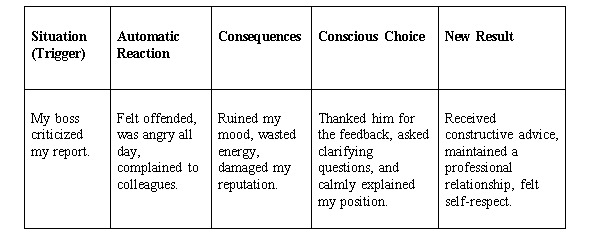
• Every evening (or immediately after a significant event), choose one situation that caused a strong emotional reaction in you. Analyze it by filling out a 5-column table.
Example of filling out the table:
• Be sure to also record instances where you managed to react in a new, more conscious way. If you chose calmness instead of your usual anger, write it down. Describe the feeling of pride and satisfaction you felt. This will strengthen your self-belief and create new positive neural pathways.
• At the end of the week, reread your entries and honestly answer these questions:
— “Which of my automatic reactions most often lead to undesirable consequences?”
— “What deep-seated need or fear is behind them?”
— “Which conscious choices brought me the most peace and satisfaction?”
— “What is one constructive action I can make my new habit for next week?”
This practice is a workout for your awareness. You are learning to see that it is your thoughts, feelings, and reactions that create the events in your life. Step by step, you will gradually stop being a hostage to circumstances and become a skilled designer of your own harmonious reality.
Taking responsibility is your most powerful tool. By stopping the search for blame in the external world, you take back the power over your Life from circumstances and become its designer. Start your diary, and you will see: as soon as you change your choice, your Life changes too. The key to freedom and happiness has always been and always will be in your hands.
Rule 10. You Are = Life
“Life isn’t about finding yourself. Life is about creating yourself.” — George Bernard Shaw
This rule states that your Life does not exist without you, just as you do not exist without it; you are a single organism. It appears in this world with you and disappears with you. Your connection is unbreakable: it came to experience itself through your body. And for you to resonate in unison, you must know the rules of this game. But humans are designed in such a way that they often fail to notice It — their Life — until the very end.
Everything you fill yourself with as you grow — your thoughts, feelings, beliefs, values — shapes your reality and fills your Life. If you are full of negativity, your Life will likely be filled with difficulties and problems. If you radiate positivity, love, and gratitude, your Life will be happier and more harmonious.
From the perspective of positive psychology, this principle is close to what Martin Seligman wrote about. He emphasized that a person’s subjective self-perception has a profound impact on all areas of life. The scientist cited experiments where participants with a more positive self-image showed more persistence, coped with difficulties more easily, and ultimately demonstrated a higher level of life satisfaction. His work in the field of “learned optimism” shows that our habitual ways of interpreting events and perceiving ourselves are not unchangeable but can be consciously adjusted. This confirms the idea that we are capable of “creating ourselves” and influencing the quality of our lives through internal changes.
Your inner state is the foundation of your life. It determines how you perceive the world, how you react to events, and, ultimately, how happy you are. Restructuring your habitual way of perception is not an easy task, but it is achievable. Since childhood, most of us — myself included — have been accustomed to focusing on what is “wrong.” It’s a kind of inheritance passed down from generation to generation. But this vicious circle can and must be broken.
I started simply — by learning to see what “was right” in every event. Gradually, I began to notice the pleasant little things that accompany each day: my morning coffee, a ray of sunshine, a passerby’s smile, a delicious dinner. At first, it required conscious effort, but over time, this attentiveness became a natural part of my life. Then, I began to consciously fill my day with things that I liked and that brought me pleasure. To do this, I had to study myself well — my interests and values. I made a list of what I love: foods and drinks; scents I love to inhale; fabrics I like to wear and touch; music that soothes my soul. All these actions changed my inner state, filling it with joy, and, as a consequence, transformed my reality.
To start changing your inner state, try making a list of everything that brings you joy and pleasure, using your “five senses”:
• Sight: Write down a list of things that are pleasant for you to look at. This could be natural phenomena, works of art, favorite colors, fire, a cozy interior, beautiful objects, photos of loved ones. Hang a print of your favorite painting on the wall, buy a bouquet of your favorite flowers, take a walk in a beautiful park.
• Hearing: Compile a list of pleasant sounds. This might be music, birdsong, the sound of rain, a cat’s purr. Listen to music by your favorite composers and the sounds of nature, even for just a few minutes a day.
• Smell: Make a list of your favorite scents. This could be the aroma of freshly brewed coffee, freshly baked bread, flowers, the sea air, your favorite perfume. Use essential oils and candles with your favorite fragrances.
• Taste: Create a list of foods that bring you pleasure. These could be your favorite dishes, fruits, sweets, or drinks. Prepare delicious food for yourself, savoring every bite. Linger on this pleasure a little longer than usual, filling yourself with this feeling of enjoyment.
• Touch: Make a list of pleasant sensations. This could be the softness of a blanket, the warmth of the sun on your skin, a massage, or swimming. Try to experience these pleasant sensations every day.
Consciously shaping your inner state is an active process that requires time and effort. But it is the key to a happy and fulfilling life. When your inner state is harmonious, you become more resilient to stress and more open to new opportunities. You start attracting pleasant events and kind people into your Life. Therefore, investing in your inner state is the best investment you can make right now.
Rule 11. Change Begins with You, Not with the External World
“If you wanna make the world a better place, take a look at yourself and make a change.” — Michael Jackson
This rule is based on the fundamental principle of personal responsibility. It states that if you want to see lasting and significant changes in your life, you must direct your efforts toward yourself. You cannot wait for the external world to change first and adapt to your expectations. By trying to change others and circumstances directly, we most often waste our energy, encountering resistance. Real, long-term changes happen when we change our inner world: our thoughts, feelings, beliefs, and behavior. After all, it is our inner world that determines how we perceive external events and how we react to them.
This principle is deeply explored in psychology, particularly in works on emotional intelligence. The renowned psychologist and science journalist Daniel Goleman, in his seminal work Emotional Intelligence, emphasizes that key components of emotional intelligence, such as self-awareness and self-regulation, directly influence our decisions, our interactions with others, and, consequently, our behavior.
The author presents data from numerous studies where people with high emotional intelligence (i.e., those who can recognize and control their internal processes) showed better results in building relationships and careers. In effect, Goleman points to a close connection between internal changes and transformations in external conditions: by improving our internal perception and ways of reacting, we automatically change our interaction with the world, which leads to an overall improvement in the quality of life.
This rule affects all areas of life, from personal relationships to professional growth. When you take responsibility for your own changes, you stop being a victim of circumstances and start actively influencing your reality. Instead of blaming your partner for your problems, you can turn your attention to your own emotional needs and learn to express them in a healthy way.
A real-life example. At the end of 2017, a year after the death of the man I loved, I started looking for a new partner. After a couple of dates, I asked myself: “What am I trying to find in a new man? What do I want him to give me? Love?” Yes, like many women, I wanted to be loved and for someone to help solve my problems. But then I honestly admitted to myself: I am looking in another for what I must find in myself, simply trying to shift the responsibility. I made a promise to myself — not to look for anyone until I found all of it within myself: love and an inner foundation. And when I truly found them, the need to search disappeared on its own. What a paradox!
From that moment, I began to actively engage in self-discovery, and it was one of the best decisions of my life. It was then that my Life began to change rapidly for the better. It was a moment of epiphany: if you want to change something, you have to start with yourself.
To implement this rule in your Life, you can use the “Emotion Study” technique. This practice will help you learn to recognize your emotional states, accept them, and use them for a better understanding of yourself.
• Pay attention to what you are feeling right now. Name the emotion — anger, fear, sadness, irritation.
• Notice the thoughts and bodily sensations that accompany this emotion. Where in your body do you feel it? What thoughts are running through your head?
• Simply observe the emotion, thoughts, and sensations. For example:
— “I feel anxiety in my chest.”
— “My thoughts are racing, I can’t focus.”
— “My hands are cold.”
• Allow the emotion to be. Don’t resist it, don’t try to suppress or change it. Simply acknowledge its existence. Say to yourself (mentally or out loud):
— “Yes, I am feeling anxious right now. And that’s okay.”
This can be difficult, but it’s important to remember that emotions are a natural part of life.
• Once you have acknowledged the emotion, you can explore it. Ask yourself questions aimed at understanding, not judgment:
— “Why am I reacting this way?”
— “What is causing this emotion?”
— “What need is hidden behind it?”
— “What do I really need right now?”
Don’t look for the “right” answers; just observe what comes up.
Your observation is a powerful tool for experiencing an emotion without escaping into thoughts. As soon as you come face-to-face with your emotion, its power will weaken, and it will no longer control you.
Remember, you are the most important person in your life. Your thoughts, feelings, and actions shape your reality. Start by transforming yourself, and you will be surprised at how much your world can change. Believe in yourself, and you will succeed!
Rule 12. You Are the Creator! Create Your Own Meaning of Life
“Everything can be taken from a man but one thing: the last of the human freedoms — to choose one’s attitude in any given set of circumstances, to choose one’s own way.” — Viktor Frankl
This rule emphasizes your ability to actively shape your Life and give it meaning. There is no universal meaning that fits everyone. Each person is free to create their own, based on their values, beliefs, and aspirations. You are not just an observer in this world — you are its co-creator. Every thought, every internal belief shapes the reality around you. Doubt destroys, while faith creates. If you believe something is impossible, it will be. If you believe that doors are open, they will begin to open for you.
This rule resonates with the ideas of existentialism, a philosophical movement that emphasizes free will and personal responsibility. According to Viktor Frankl, author of the famous work Man’s Search for Meaning, the search for and discovery of personal meaning is a key factor in psychological resilience. Frankl, having endured the trials of concentration camps, noted that people who could find even a small purpose in their suffering maintained the will to live. These findings have been confirmed in subsequent research, which has found a direct correlation between having meaningful goals and a person’s overall level of well-being. Thus, the idea of personally creating meaning extends far beyond philosophy and is supported by scientific data — meaning is not given to us from the outside; it is born in the depths of our consciousness.
Throughout my life, at the end of each specific stage, I created a new one. For a time, I was engaged in creating fashionable clothing, putting a piece of myself into every outfit. In another period, I became passionate about creating harmonious design projects for apartments and houses, transforming the space around people and making their lives more comfortable and beautiful. Then came the time for landscape projects, where I worked on creating harmony with nature, bringing beauty and tranquility to the environment.
Recently, since 2021, I have fully dedicated myself to research in the field of mindfulness. I am now writing a book, sharing my experience and knowledge to inspire and help others on their path of self-discovery. My long-term plans include building and opening a “Center for Mindfulness,” a space where people can gain knowledge and support. After all, I already have all the necessary skills for this: I am a civil engineer, an interior designer, a landscape designer, and hold a master’s degree in psychology. Yes, each career change was a certain risk, a step out of my comfort zone, but the realization that I myself create the meaning of my life gave me strength and confidence. Each new project became not just a job, but a way to know myself better and unlock my potential.
To learn how to creatively shape your own meaning, you can use the “Creating a Meaning Map” method. This practice will help you identify your values, goals, and desires and see how different areas of your life contribute to their realization.
• Take a large sheet of paper (the bigger, the better) and colored pencils. In the center, draw a circle and write your main idea in it: “My Meaning,” “What I Want from Life,” “My Purpose,” or any other phrase that reflects your deepest aspiration.
• From the central circle, draw several arrows branching out in different directions. Each direction will represent an important area of your life. For example: “Work/Career,” “Relationships (family, friends),” “Creativity/Hobbies,” “Health (physical, emotional),” “Personal Growth/Learning,” “Spirituality/Self-Discovery,” “Finances,” “Contribution to the World/Society.” Choose the ones that are most significant to you (usually 4 to 8). Write the name of each area on its corresponding branch. Use different colors for each direction — this will help structure the information better.
• From each branch, draw sub-branches. On these, write down key values, specific goals, and desires that are meaningful to you in that area of life, using short phrases. For example:
— Area “Work” (main branch): fulfilling potential, helping people, financial stability, interesting projects, growth (sub-branches).
— Area “Relationships” (main branch): mutual understanding, trust, love, growing together, sincerity (sub-branches).
— Area “Contribution to the World” (main branch): sharing knowledge, inspiring others, creating a useful product, charity (sub-branches).
• Analyze how the different areas are interconnected. Use lines or arrows to show these connections. Write above the connecting lines what the connection is. For example:
— An arrow from “Financial Stability” (Work) to “Travel” (Personal Growth/Hobbies). An arrow from “Sharing Knowledge” (Contribution to the World) to “Writing a Book” (Creativity/Work).
• Use symbols or simple drawings next to keywords — this activates visual thinking and helps you better remember and feel the connections.
• When the map is complete, look at it carefully. Which areas are most developed? Which seem less connected to your central meaning?
• Place the map where you will see it often. Use it as a guide when making decisions, as a source of inspiration, and as a reminder of your true priorities. Remember: this map is not static; you can add to and change it as you evolve.
The rule “You Are the Creator!” reminds you that no one but you can determine what brings joy and a sense of deep significance. When you take responsibility for creating your personal meaning, you begin to look at potential paths of development differently and make decisions based on your own priorities.
Rule 13. Mindfulness is the Key to True Freedom
“Freedom is the recognition of necessity.” — Hegel
This rule suggests that mindfulness is the path to liberation from the automatic reactions, negative thoughts, and emotions that often control our lives. Mindfulness allows you to become an observer of your internal processes without identifying with them. You begin to see your thoughts and feelings as temporary phenomena, not as absolute truth. This gives you a choice: to react to situations automatically or to choose a more conscious path.
Numerous studies confirm the positive impact of mindfulness practice on psychological health. Research conducted by myself and Professor O. S. Vasilyeva showed that the level of mindfulness affects levels of stress and depression. Our study revealed that respondents with a high level of mindfulness scored highly on scales of self-actualization and life satisfaction. These same respondents demonstrated low levels of stress and depression.
Other studies confirm that mindful presence promotes brain neuroplasticity: when you are aware of your internal processes “here and now,” you have the opportunity to consciously choose which thoughts to follow and which to let go. By practicing a mindful and kind attitude toward your inner states, you become a kind of “secure adult figure” for yourself, which heals old traumas and allows you to build healthier relationships with others.
Mindfulness is a powerful tool capable of transforming all areas of your life. It allows you to live more fully and happily, improves relationships with others, increases efficiency at work, and helps you endure stress and make well-considered decisions. It’s like turning on a light in a dark room — you begin to see clearly what was previously hidden in the dark corners, what you simply didn’t notice before.
A real-life example. It was mindfulness that led me to psychology. In the spring of 2021, I had the intention to share mindfulness tools with people so they could independently and quickly achieve a state of happiness. At the end of June, when my son came home after receiving his third higher education diploma from Southern Federal University (SFU), he said to me:
— “SFU also has a psychology program, don’t you want to apply?”
— “I’ll have to think about it!” I replied, and a month later, I paid for the preparatory courses. In September, I successfully passed the entrance exams, scoring enough points to be admitted to a state-funded spot. Two years later, I graduated with a master’s degree with honors. Psychology allowed me to take a scientific approach to studying the influence of mindfulness on a person’s psychological aspects. That’s how quickly my intention to “share useful knowledge with the world” was realized. This is true freedom. Now, as a Master of Psychology and a mindfulness expert, I am writing this book for you, my friend. I hope it becomes a kind and wise friend for you, one that will support you on your path to harmony and happiness.
To develop mindfulness, use simple practices that can be applied at any moment, even while doing everyday tasks.
• Mindful Eating: When you eat, don’t rush. Put away your phone and other distractions. Focus on the taste, texture, and smell of your food. Chew slowly and consciously.
• Mindful Dishwashing: When you wash dishes, feel the temperature of the water, the texture of the sponge and the dishes, and the smell of the detergent. Pay attention to the movements of your hands.
• Mindful Walking: When you walk, pay attention to the sensations in your body, to the movement of your legs. Observe your surroundings — the trees, the sky, the clouds, the flowers. Don’t lose sight of the space that fills everything around you. Listen to the birds singing, the rustling of leaves. Feel the wind on your skin, the warmth of the sun’s rays.
• Mindful Breathing: Several times a day, direct your attention to the tip of your nose and observe your breath: how you inhale cool air and exhale warm air. Observe how your heart beats. This is a simple and effective way to return to the present moment.
• Mindful Performance of Any Daily Task: Cleaning, cooking, showering, driving. Simply direct your attention to what you are doing in the moment, to your sensations and feelings.
These simple yet effective ways to return to the present moment will help you increase your level of mindfulness and fill your Life with your presence.
Thus, mindfulness is not just a trendy buzzword but a necessary tool for living in our modern world. It is a skill that develops with practice, just like the ability to read and write. Practice, and more practice: when thoughts or feelings arise, don’t judge them, just observe them. Be aware of how they influence your actions. Be persistent, and you will surely achieve a result that will exceed all your expectations.
Rule 14. Everyone Has the Power of Choice
“The choices you make every day determine your destiny.”
— Napoleon Hill
This rule emphasizes the fundamental principle of free will: in every situation, even the most difficult, you have a choice. You can choose how to react to events, what thoughts to think, what feelings to experience, and what actions to take. This is not always obvious, especially in stressful situations when we tend to react automatically based on our old habits. However, recognizing your power of choice gives you back control over your Life.
In existential psychology, free will is considered a core characteristic of human existence. Jean-Paul Sartre, one of the key figures of this movement, argued that man is “condemned to be free” and is fully responsible for his choices. Your free will is truly free because its exercise always yields real results — not sometimes, but always. And it brings us exactly the results we strive for. Moreover, having a choice and recognizing one’s own autonomy contributes to the growth of intrinsic motivation and an increased level of well-being.
The power of choice determines the quality of life in all its manifestations, from everyday decisions to global issues of career and relationships. Every day, we make hundreds of choices: what to eat for breakfast, what clothes to wear, what to do with our time. And each of these choices, no matter how small, shapes our reality.
Every morning, you can choose: to wake up with gratitude or under the weight of thoughts about the day ahead. This choice determines how your morning and the entire day will unfold. This is why some people hear, “He’s lucky in everything,” while others are told, “He woke up on the wrong side of the bed.” Throughout the day, you constantly face the need to choose: how to react to difficulties; with whom and how to communicate; how to manage your time. Each of these choices, like a brick, builds the foundation of your life. Recognizing this gives you strength and confidence, because even in the most difficult circumstances, you always have the ability to choose how to respond to them.
To more deeply feel and realize your power of choice, you can use the “Analysis of Choices and Reactions” method. It is based on the principle that there is always a gap between an event and the reaction to it — that very moment when you have the power to choose how to respond. The practice is to learn to notice this gap and consciously choose your reaction, rather than acting on autopilot.
• Recall (or better yet, in the moment) a situation that triggered a strong emotion and the urge to react in your usual way (irritation, resentment, fear). Briefly describe it.
• Identify your first, automatic thought, feeling, or action. This is the reaction that arises without conscious control.
• Pause. Realize that you have a choice in how to react. You are not obligated to follow your first impulse. This is the most crucial moment of the practice.
• Decide how you want to react, based on your values and goals. Choose a thought, feeling, or action that is different from your usual one.
• Act in this new way and observe what happens next. How did the situation change? How did you feel?
• At the end of the day (or immediately after the situation), analyze what you noticed. How easy was it to make the choice? How did the result differ from your usual reaction? What did you learn about yourself?
Regularly applying this practice will help you strengthen the “muscle” of conscious choice and gradually reduce the power of automatic reactions.
Understanding that Life is a continuous flow of choices offers incredible opportunities. You are an active Creator of your reality. By making conscious decisions in every moment, you can change your Life for the better and find inner happiness.
Chapter 3. Self-Knowledge
Self-knowledge is the process by which a person becomes aware of and studies their own thoughts, emotions, values, beliefs, and true nature. It helps to unlock one’s inner potential, understand personal strengths and weaknesses, recognize the core beliefs that influence one’s Life, and transition to a conscious existence. Self-knowledge leads to harmony with oneself and the surrounding world, liberates from the limitations of the mind, and promotes personal growth.
Rule 15. Self-Knowledge = Self-Love
“You yourself, as much as anybody in the entire universe, deserve your love and affection.” — Buddha
This rule asserts that self-love is impossible without deep self-knowledge. The better you understand yourself — your thoughts, feelings, needs, strengths, and weaknesses — the easier it becomes to accept and love yourself unconditionally. We often don’t love ourselves precisely because we don’t know our true selves. We hide our “shadow” aspects, weaknesses, and flaws, afraid to acknowledge them. But it is the complete acceptance of oneself, with all of one’s “imperfections,” that forms the basis of true self-love.
In psychology, self-knowledge is a key aspect of personal growth. In humanistic psychology, Carl Rogers emphasized the importance of self-actualization — the human drive to realize one’s full potential, which is impossible without understanding one’s true desires and needs. People with a high level of self-knowledge are more aware of their motivations, which allows them to treat themselves with greater kindness and less self-criticism. Rogers pointed out that without a deep knowledge of ourselves, we are prone to unproductive self-criticism and dependent on external validation, which hinders the development of healthy self-love.
Self-love is the solid foundation upon which healthy relationships, a successful career, and overall well-being are built. It helps you see your intrinsic value, confidently set boundaries, and accept yourself with all your strengths and weaknesses. However, as with everything, balance is crucial. Imbalances in self-love can manifest in two extremes: egoism and self-sacrifice (altruism), both of which can cause significant harm.
Egoism is a distorted, hypertrophied form of self-love. An egoist places their interests above all else, ignoring the feelings and needs of others. They are inclined to use others to achieve their goals and see themselves as the center of the universe.
Self-sacrifice, at first glance, seems like a noble opposite to egoism, but when taken to an extreme, it also becomes destructive. A pathological altruist gradually loses their identity, forgets their own needs and desires, and sacrifices themselves for the sake of others. Ultimately, they accumulate resentment and disappointment if others do not show sufficient gratitude.
Only a delicate balance between healthy self-love and genuine care for others is a reliable key to a harmonious and fulfilling life. It is important to learn to listen attentively to your inner needs, establish personal boundaries, and practice self-care, without forgetting the interests and needs of those around you. Only then will healthy self-love become a solid foundation for true happiness, self-realization, and a complete life.
To get to know yourself better and find that balance, use the “Self-Knowledge” technique, based on the principles of mindfulness meditation. This practice will help you deepen your connection with yourself and learn to observe your thoughts and feelings without judgment.
• Find a quiet and calm place where you will not be disturbed.
• If you have never meditated before, start with 5–10 minutes a day. Gradually increase the meditation time as you feel more comfortable.
• Sit on a chair with a straight back. You can also lie down, but there is a risk of falling asleep. Close your eyes to reduce distractions.
• Take three deep breaths in and out. With each exhale, try to relax your body.
• Observe how the air enters through your nose and exits. When your thoughts begin to wander (and they will), gently bring your attention back to your breath and simply observe your thoughts like clouds floating across the sky. If you don’t cling to them, they will pass by.
• Your task is to learn to observe yourself without any judgment, just to study and feel. Stay with yourself for as long as possible.
• To come out of meditation correctly, first wiggle your fingers and toes, take a deep breath in and out. You can then open your eyes. Meditation is a skill that develops with regular practice. Just keep practicing, and you will surely feel the positive effects.
Self-knowledge is a lifelong journey. You are creating a reliable foundation for stable self-esteem, getting rid of unnecessary fears, and reaching a new level of relationship with yourself and the world. Be kind to yourself and enjoy the process of this amazing exploration. The better you know yourself, the more you will love yourself.
Rule 16. Intuition = Depth of Self-Knowledge
“Intuition is a very powerful thing, more powerful than intellect.” — Steve Jobs
This rule shows that intuition is not a mystical ability but the result of deep self-knowledge and accumulated experience. Your intuition is the voice of your subconscious, which processes a vast amount of information unnoticed by the conscious mind. The better you know yourself — your values, beliefs, fears, and desires — the clearer and more distinct the voice of your intuition becomes. It helps you make the right decisions, even when there is no logical reason for them.
In psychology, intuition is seen as a form of implicit knowledge that we acquire through experience but cannot always articulate. Research in cognitive psychology shows that intuitive decisions can be very effective, especially in complex situations. According to psychologist Gerd Gigerenzer, intuition is based on unconscious heuristics that arise from deeply learned personal experience. In his book, he provides examples of how people who rely on their “gut feeling” often make more accurate decisions under uncertainty. The ability to instantly assess a situation is closely linked to how well a person knows their true values. That is, intuition grows in the fertile ground of self-understanding and helps not only in decision-making but also in deeper self-discovery.
Intuition affects all areas of our lives — from choosing a partner to creativity and career success. In my life, the more I practice mindfulness, the more refined the connection with my inner feelings becomes. At first, I dedicated 15–30 minutes every day, before sleep and right after waking up, to sitting meditation with my eyes closed. During this time, I simply observed my thoughts and sensations.
After six months, the practice helped calm my mind, free me from anxious thoughts, and overcome insomnia. Gradually, formal meditation naturally flowed into my daily life. Now, whatever I am doing, I try to be fully present in the process, directing all my attention to what is happening here and now, without evaluation or judgment. In such moments, the separation between the doer and the action disappears.
It is then that access to intuition opens up — the deep wisdom that has always lived within us. When the mind falls silent and stops its endless analysis, the quiet but confident voice of intuition becomes audible. It guides us, helping us make the right decisions and follow the path that resonates with our true essence.
To unlock your intuition, in addition to mindful meditation, you can use the “Inner Archetypes” method. This practice is based on Carl Gustav Jung’s ideas about archetypes; it helps you connect with your deep wisdom..
• Choose a place where you will not be disturbed and assume a comfortable position.
• Close your eyes and imagine an image of an “advisor” or “sage” within you. This can be any image that symbolizes wisdom and intuition for you — an old man, an animal, a spiritual guide.
• Ask your inner “advisor” the questions you want answers to. These can be questions related to any area of your life.
• Pay attention to the first, spontaneous answers that pop into your head. Do not analyze or judge them; just write them down. Even if the answers seem strange or illogical, write them down. It is in them that deep meaning is hidden. If images appear instead of words, write them down too and try to decipher their meaning.
Intuition is the result of deep self-knowledge. When you learn to listen to your inner voice, you begin to make decisions that align with your true desires and values. It is important to remember that working with intuition is a process that requires time and practice. Be patient and trust yourself. Over time, you will learn to better understand and use your intuition.
Rule 17. All Paths to Happiness Lead to the Self
“You don’t have to chase happiness. You have to lie down in its path.” — Mark Twain
This rule reflects a profound psychological truth: true happiness cannot be found in external circumstances, things, or other people — it can only be born within you. External circumstances, be it success, money, or relationships, can bring temporary joy, but true satisfaction comes only through inner self-knowledge and harmony with oneself. Real happiness is a state of being that arises from within when you know yourself, accept yourself, live in accordance with your values, and are in contact with your inner essence. This rule echoes ancient philosophical traditions, but today it also finds confirmation in modern scientific research.
Psychologist Sonja Lyubomirsky, a leading researcher on happiness, has confirmed in her work that genetic predisposition determines about 50% of our happiness level, while external circumstances account for only about 10%. The remaining 40% depends on our own intentional activities, thoughts, and habits — that is, on our inner world. This research, based on the analysis of many other studies, convincingly demonstrates that the key to significantly increasing one’s level of happiness lies not in changing external conditions, but in changing our internal focus and attitudes.
People who engage in regular reflection and inner development tend to experience a stable sense of life satisfaction much more often, regardless of external circumstances.
Like many, I tried to find happiness in the external world: in work, travel, shopping, and relationships. Each time I reached a goal, I felt a fleeting joy that quickly faded, leaving behind emptiness and a new race for the next “dose” of achievement. Moving to another country did not change my inner state. I thought that maybe when I met “the one,” my Life would become happy. But, unfortunately, or fortunately, my expectations were not met, and I felt yet another disappointment and dissatisfaction. I asked myself:
— “Maybe I’m looking for happiness in the wrong place? Maybe I need to figure myself out first?”
I began to engage in self-development, studying my feelings and needs. I learned to spend time with myself, do things I enjoy, and appreciate my solitude. Gradually, I realized that the most important thing is my inner state and being at peace with myself. Now, I experience a much deeper and more stable happiness, and external events have become a pleasant addition rather than a prerequisite for my well-being.
To begin your journey toward yourself and discover this inner source of happiness, I suggest a simple practice — “Meeting Your Inner Self.” This technique is aimed at establishing contact with your inner world.
• Set aside 10–15 minutes a day when you will not be disturbed. This can be in the morning, evening, or any other convenient time. Sit comfortably, either on a chair with a straight back or on the floor with your legs crossed.
• Close your eyes. Take a few deep, slow breaths. With each exhale, let go of tension, thoughts about your to-do list, and expectations. Feel your body, your breath. Shift your attention inward.
• Ask your Inner Self questions. When you feel sufficiently relaxed, mentally turn to your Inner Self (you can imagine it as a wise friend, your intuition, your heart — whatever feels most comfortable). Ask yourself one or more of the following questions (choose the ones that are most relevant to you right now):
— “What is truly important to me in life right now?”
— “What brings me genuine, deep joy?”
— “What makes me feel truly alive?”
— “What are my true needs at this moment?”
— “What do I need to feel happier?”
— “What small step can I take today to get closer to myself?”
• After asking a question, just listen. The answers may come in the form of thoughts, images, or sensations. Do not analyze, criticize, or try to “come up with” the right answer. Just be open to what comes. Sometimes the answers may be unexpected and not immediately clear — that’s normal.
• Thank your Inner Self for the answers. Take a few more deep breaths. Slowly open your eyes. If you wish, you can write down your insights in a journal. Try to remember these answers throughout the day and, if possible, take small steps in accordance with them.
The external world can offer you many pleasures and temporary joys, but the true, unshakeable source of happiness, peace, and satisfaction lies within your own heart and consciousness. Get to know yourself, accept yourself, love yourself. When you find this inner center, you will discover that happiness is not a goal to be pursued, but a state in which you can abide, regardless of external circumstances. You already possess everything you need for happiness. Simply turn toward yourself.
Rule 18. Self-Care = Not “Killing” Yourself with Bad Habits
“It is easier to prevent bad habits than to break them.”
— Benjamin Franklin
This rule emphasizes that true self-care begins with abandoning habits that harm your physical and psychological health. Bad habits — smoking, alcohol abuse, an unhealthy diet, chronic sleep deprivation, and a lack of physical activity — lead to a decline in overall well-being, reduce vital energy, and can cause serious illnesses.
According to the World Health Organization (WHO), harmful habits are a leading cause of chronic diseases and shorten life expectancy. A conscious approach to one’s habits is the first step toward transformation. Scientific research has repeatedly confirmed that the negative impact of such habits affects not only health but also cognitive functions and emotional state.
In his book The Power of Habit, psychologist Charles Duhigg emphasizes that habits form neural pathways in the brain, and if they are destructive, you are constantly triggering processes that negatively affect your physical and mental state. His research shows that a conscious approach to identifying and changing behavioral patterns is a sure way to reduce health risks and regain control over your own Life. Thus, this rule reminds us that every bad habit is a small act of self-betrayal, and giving it up is the first step toward a full, healthy life.
This rule manifests in the daily choices we often make on autopilot. Here’s what it looks like: when you regularly “kill” yourself with sleep deprivation, fast food, or a lack of movement, your body responds with chronic fatigue, frequent illnesses, and a loss of energy. You cannot be an effective life designer if your main tool — your body — is constantly malfunctioning.
In your career, you cannot generate brilliant ideas and work productively if your brain and body are exhausted. Trying to achieve success while ignoring the basic needs of your body is like trying to build a skyscraper on sand. In relationships, you simply don’t have the resources for patience and sincere involvement in the lives of your loved ones. You become irritable, distant, and unable to offer support. You cannot share with others what you do not have. Ultimately, every bad habit is an unconscious choice for momentary relief at the expense of long-term well-being.
A real-life example. I was lucky: in my entire life, I have never smoked a single cigarette. More accurately, it was to my credit that I didn’t succumb to the “fashionable trends” of my youth to seem older with a cigarette in hand. I once tried to light one, but I didn’t like the taste or the smell at all. I decided it wasn’t for me, and I have never regretted it.
With alcohol, it’s a different story: in my youth, at the holiday table, to the toast “To your health!”, only the sick didn’t drink. For the last seven years or so, I haven’t consumed alcohol at all — not because I can’t, but because the need for it has disappeared. Now I don’t need to artificially lift my mood or relieve stress — I already know how to do that without it. It’s important to understand why you need alcohol.
After returning from America in 2013, I weighed 62 kg at a height of 160 cm. Now my weight is 52 kg, and it has been stable for the last six years. That’s a loss of 10 kg without diets or starvation. Mindfulness worked as a perfect regulator: as soon as I started listening to my body, I stopped overeating and choosing foods that drained my energy. It was the shift from automatic behavior to conscious choice that led me to understand that self-care is a necessary condition for a long and happy life.
To start on this path in practice, I suggest a simple method of conscious replacement — “How to Rewrite an Old Habit”:
• Notice the old habit and pause. Bad habits operate on autopilot. Your task is to insert a pause into this mechanism.
• The moment you feel the urge to smoke or eat something sweet out of boredom — stop. Just for one second. Notice this impulse.
• Ask yourself:
— “Why?”
— “What do I really want to get right now?”
Is it comfort? A break? A pleasant sensation? Try to honestly see the need hidden behind the habit.
• Now, knowing your true need, find a healthy way to satisfy it. Want a break? Instead of a cigarette, take 5 deep breaths or step outside for 2 minutes. Craving sweets due to stress? Instead of a pastry, drink a cup of fragrant herbal tea or eat a piece of fruit. The main thing is that the new habit should be simple, accessible, and enjoyable.
• If you slip up and return to the old habit — don’t scold yourself. It’s part of the process. Instead of beating yourself up, be as mindful as possible in that moment.
• Feel what is happening to your body and mood. This will help your brain understand more quickly that the old program no longer works.
Self-care is not selfishness; it’s a vital necessity. By giving up bad habits, you free up energy for more important and creative endeavors. Remember that you are the Creator of your Life, and only you can make it full and happy. Start by replacing old habits, and you will see how your Life changes for the better.
Rule 19. Everything You Do, You Do for Yourself
“Do not do to others what you do not want them to do to you.”
— Confucius
The essence of this rule is simple: every action you take, even the most altruistic, is ultimately aimed at satisfying your own inner need. When you help a friend, you do it because it’s important for you to be a good friend, because it’s unpleasant for you to see their suffering, and because helping another brings you a sense of satisfaction. When you concede in an argument, you do it to preserve a relationship that is important to you. Acknowledging this fact does not devalue your good deeds; on the contrary, it makes them a conscious choice, free from the expectation of gratitude. You stop waiting for something in return because you have already received your “reward” at the moment of the action — in the form of harmony with your own values.
This rule reflects one of the central ideas in the neuroscience of motivation, which was explored in detail by Antonio Damasio, a professor of neuroscience and the author of the somatic marker hypothesis. In his book Self Comes to Mind, he shows that the entire structure of our consciousness and decision-making is based on emotionally charged bodily signals that indicate what is beneficial or harmful to us as an organism and as a person.
The author explains that our brain is an organ whose task is to constantly evaluate our internal state and direct our behavior to avoid pain and achieve well-being. This explains why even seemingly selfless acts (helping, caring) activate the pleasure centers in the brain: they align with our inner values and create a sense of security and wholeness.
Бесплатный фрагмент закончился.
Купите книгу, чтобы продолжить чтение.