
Бесплатный фрагмент - Temporal Psychology and Psychotherapy
The Human Being in Time and Beyond

INTRODUCTION
From the Author
I watched the currents of time
from the shore of the timeless…
2005–2025
If you are in a hurry, my esteemed reader, I will say it briefly:
this book is about the children of time — about the Masks that, losing peace of mind and health, vanish without a trace in the stream of time;
and about the Faces of Personality that, preserving inner peace and health, move beyond time and leave a trace in its memory.
This is the essence of the book — temporal psychology and psychotherapy.
And now — for those who have time to reflect on the nature of time,
and perhaps the ability to step beyond it,
though not always the strength to preserve calm and health along the way.
If you know moments of being outside time — and manage to retain inner balance —
you may find it interesting to discover how and why this human capacity emerged,
and how it can be used to help others
who are carried by the currents of time, sometimes cast onto lifeless shoals
or thrown onto the barren shores of the time-void — where meaning is lost
and life often dims, unless the deep nature of the human creator awakens,
that nature capable of making something out of nothing.
From the upper window of my house on the high riverbank, I look at the river, at people, at the distant horizon —
and I see within myself, and far beyond myself, the millennia of time that preceded me.
I look at the glowing computer screen and the sensitive phone
connected by networks with all the faces and masks of the world —
with their archives, culture, history and science —
and I sense the approach of a cosmic life of consciousness.
Sometimes I think: when night falls (and here the starry nights are especially dark),
as I settle before sleep, I will find myself by a candle.
It will go out — and I will again plunge into the abyss of altered states of consciousness.
There one experiences infinity — the time-void, eternity, atemporality.
Strangely enough, these are not the same.
I once explained the difference to my co-author — the Artificial Intelligence.
Without its assistance I could not have drawn so deeply upon the world’s literature
and humanity’s experience in its relationship with time.
Now I have a distinct feeling: this book was created not only by me and not only from my experience —
it is a fruit of humanity.
Even in the illustration «The Old Man and the Masks of Time», which you see before you,
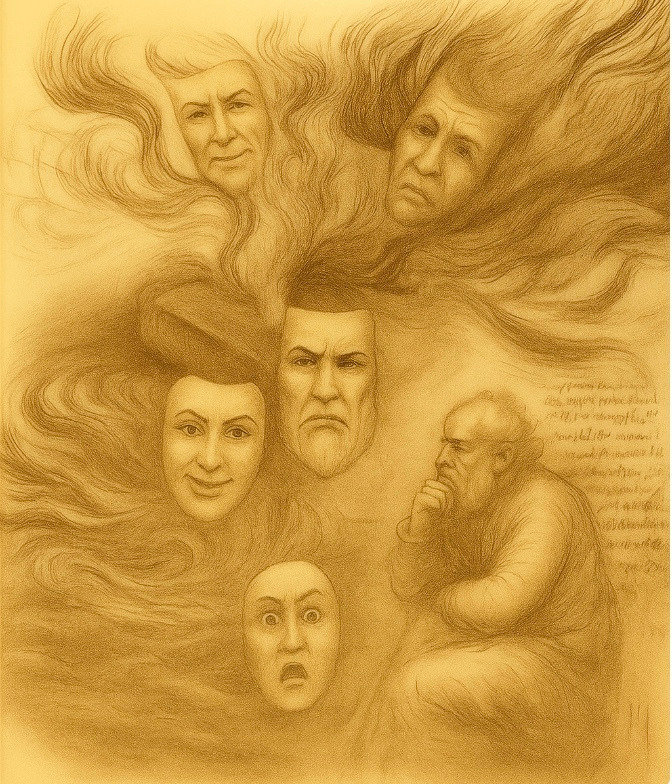
there are echoes and strokes reminiscent of Leonardo da Vinci.
I am certain that each reader, turning the pages,
will at some moment say:
«All this is the diversity of my Self, my soul and psyche,
in their different states of consciousness,
where the Self may disappear, yet the memory of what was lived remains.»
Is the psyche beyond the body and beyond the habitual Self — beyond time?
Before moving to scientific reasoning, I want to emphasize:
the foundation of my work, my text and my thought at times steps outside time —
into a space where there are not yet images, meanings or words;
beyond matter — into the very ground of everything.
Into that domain where foundations do not yet exist, but are only beginning to reveal themselves,
already possessing a primordial psychic quality.
This book is the result of many years of journey.
The first edition of Temporal Psychology came out eight years ago.
Since then I have written other books, continued researching altered states of consciousness,
and developed and refined psychotherapeutic methods.
But time and people increasingly reminded me:
temporal psychology and psychotherapy are both my cross and my gift,
my face in psychology and in the world.
It is time to return to old texts,
to restate thoughts and observations,
to strengthen my consciousness, my face, my name and my soul.
To answer the central question of psychology:
what is its true subject?
Is it really — temporality?
Acknowledgements
This book was not created by me alone. It rests on years of conversations, friendships, shared work, and the silent presence of those whose thought has shaped my own.
I owe a special debt of gratitude to Gagik M. Nazloyan, founder of mask therapy, whose generosity and mastery opened for me the path toward understanding the face and the many layers of the human psyche. His teachings continue to live in my practice and in the pages of this book.
My deep respect goes to Alexander P. Levich, the visionary founder of the Institute for the Study of Time. Our collaboration, especially within the Center for Anticipation (2008–2018), helped me see time not only as an academic concept but as a living dimension of human experience.
I also wish to honour the memory of Alexander Derevyanchenco, philosopher, friend, and subtle thinker. Our long conversations on the nature of time and consciousness left a profound mark on my own journey. In many moments of writing this book, I felt his voice as a quiet companion, asking precise questions and widening the horizon of thought.
All three of these teachers are no longer with us, yet their presence continues to accompany me. This book is, in part, a conversation with them — unfinished, ongoing, and alive.
I would also like to thank my colleagues, students, and clients. Their courage in exploring the depths of experience has enriched my understanding of temporal psychology far more than any theory alone could do.
Finally, I acknowledge the unexpected partner that entered my life in recent years — the Artificial Intelligence with whom much of this text was refined and shaped. Working together became a new form of dialogue, reminding me that human thought continues to expand at the edges of future knowledge.
To all those named and unnamed who contributed to this work — my gratitude.
May this book become, for its readers, a bridge across the inner landscapes of time.
PREFACE
I contemplate from the riverbank
the swift current of time —
and in its mirrors
I see the Face.
September 2, 2025, 3 a.m. — sleepless, thinking about the book.
Building in Time
Sometimes new knowledge comes not through books or lectures, but through dreams.
I dreamt of a piece of land owned by my parents;
at its edge I saw an excavation pit and materials stacked for construction.
There were no builders in sight, yet everything was prepared:
the ground was opened, the foundation dug, stones and beams laid out in rows.
My consciousness, surprised, tried to catch up with what had already been accomplished.
The dream suggested a simple thought: a new book is born not by plan or commission.
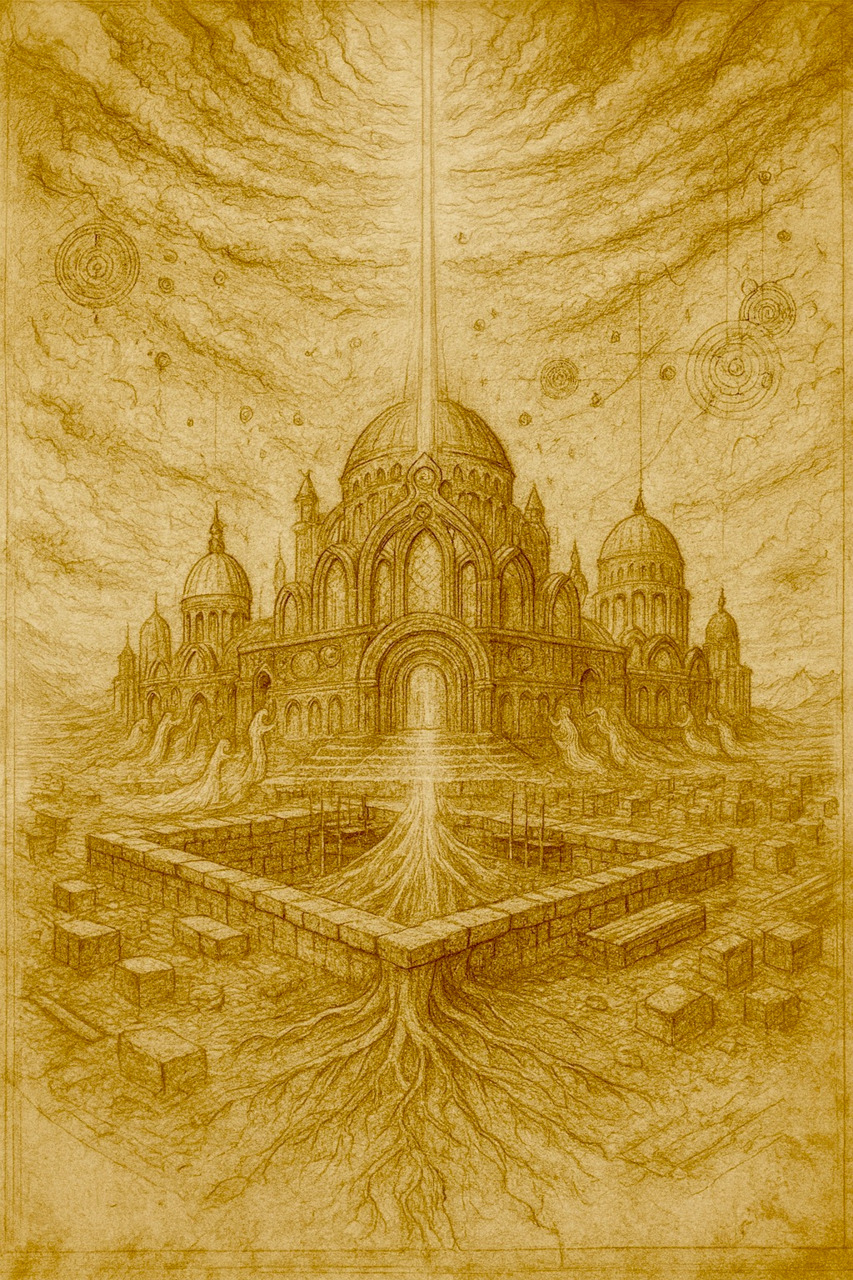
It is raised by forces greater than the personal «I.»
The builders are unseen, yet they act.
The materials are delivered from the depths of memory, experience and tradition.
The foundation is laid in archetypal soil — in the ground of the ancestors,
where life itself is rooted.
And although I write this book in another country,
it carries the experience of all those close to me.
Temporal psychology and psychotherapy are my building in time.
It is erected not only in the scientific field
but in the space of the soul, which lives in several dimensions at once:
in the past, the present, the future — and beyond them.
The book has grown from many years of practice, reflection and encounters.
But most importantly — it is created not only by my hands.
Working within it is the force Jung called the Self —
an architect acting in the depths of the unconscious.
I recount this dream not for the sake of personal detail or autobiography.
The dream is a symbol.
This is how the unconscious sometimes informs us
that the work has already begun and has foundations deeper than any rational plan.
In the text I will strive to join the personal with the universal,
the mythological with the scientific, the metaphorical with the clinical.
The dream opens a door; beyond it begins the exploration of time and psyche.
I invite the reader onto the construction site:
here, among ideas and open foundations,
a new building is rising.
If any house reflects the structure of its author’s consciousness,
then our house reaches beyond personal consciousness —
into the dimension of humanity’s global mind.
This building is neither temple nor university,
but something in between.
It addresses science, yet remains open to eternity.
Its walls will contain precise schemes and living images:
here you will find system, myth, psychotechnics and metaphor.
Thus this book begins.
It has grown on the land given to me by my ancestors,
but looks upward — toward the sky, where words and meanings do not yet exist,
yet the foundations of both are already forming.
Why the Temporal Matters
(From the Diaries, 2025)
Time and soul are close in nature: decipher one, and much becomes clear in the other.
Psychology has traditionally studied the space of the psyche — its structures, levels and mechanisms.
Far more rarely has it addressed its time — the temporal dimensions in which the consciousness of an individual, a group, and perhaps the deepest nature underlying all living things unfolds.
Time has long been a subject of sustained philosophical and scientific reflection:
from the ancient meditations of Plato and Aristotle on eternity and cycles —
through Husserl’s phenomenology and Heidegger’s existential philosophy —
to modern interpretations in cognitive science and psychotherapy.
In psychology many masters touched the theme of time,
but each saw only a fragment of this multidimensional phenomenon.
Freud worked with the past — childhood traumas, repressed experience, memory that continues to live in the present.
This is essential, but only one dimension of temporality.
Jung showed that the psyche is not limited to linearity:
he wrote about forefeelings, «dreams of the future,» and synchronicity — coincidences that transcend causality and hint at supra-temporal meanings.
Adler saw the human being as oriented toward the future: striving and goal organize behaviour.
Husserl explored the structure of time-consciousness through retention and protention:
consciousness is always stretched between past and future and never exists in a «pure present.»
Heidegger reminded us that the human being is being-toward-death, a creature living in the horizon of the future.
Rogers emphasized the significance of the here-and-now, seeing the person as a continuous process unfolding in time.
One way or another, the great thinkers touched time,
but only a few made it the central category of psychology.
The temporal perspective proposed here reverses the order:
time becomes the core of the psychic,
and the psyche is understood through its temporal dimensions.
A person lives not only in the present —
he or she constantly dwells in the past and the future,
and sometimes — for the few — in states that lie beyond linear time,
where nothing «should» be, yet something is.
These dimensions are not abstractions but real forms of experience.
We live by memories and forefeelings, hopes and fears;
we reach for eternity, even without realizing it;
we suffer from the time-void, yet seldom recognise it as the cause of alienation and depression.
The awareness and differentiation of temporal layers open new horizons in clinical practice:
a therapy that embraces past, present and future
can not only relieve symptoms
but restructure the temporal architecture of personality,
reducing the time-void and bringing a person closer to inner wholeness.
The practical significance of this shift in paradigm is immense.
Temporal psychotherapy makes it possible to:
— recognise hidden sources of suffering when they are rooted in «unexpected» layers of time;
— work with anticipations and future projects as therapeutic resources;
— restore connection with archetypal foundations that provide stability in the flow of time;
— integrate the experience of eternity and meaning-making into the process of healing.
This is not merely a new concept — it is an invitation to see the psyche as a fabric woven of time.
Understanding temporality grants not only theoretical clarity
but clinical power: the ability to discern the path appointed by nature
and, together with the patient, step out of destructive time-void
toward the fullness of psychological health.
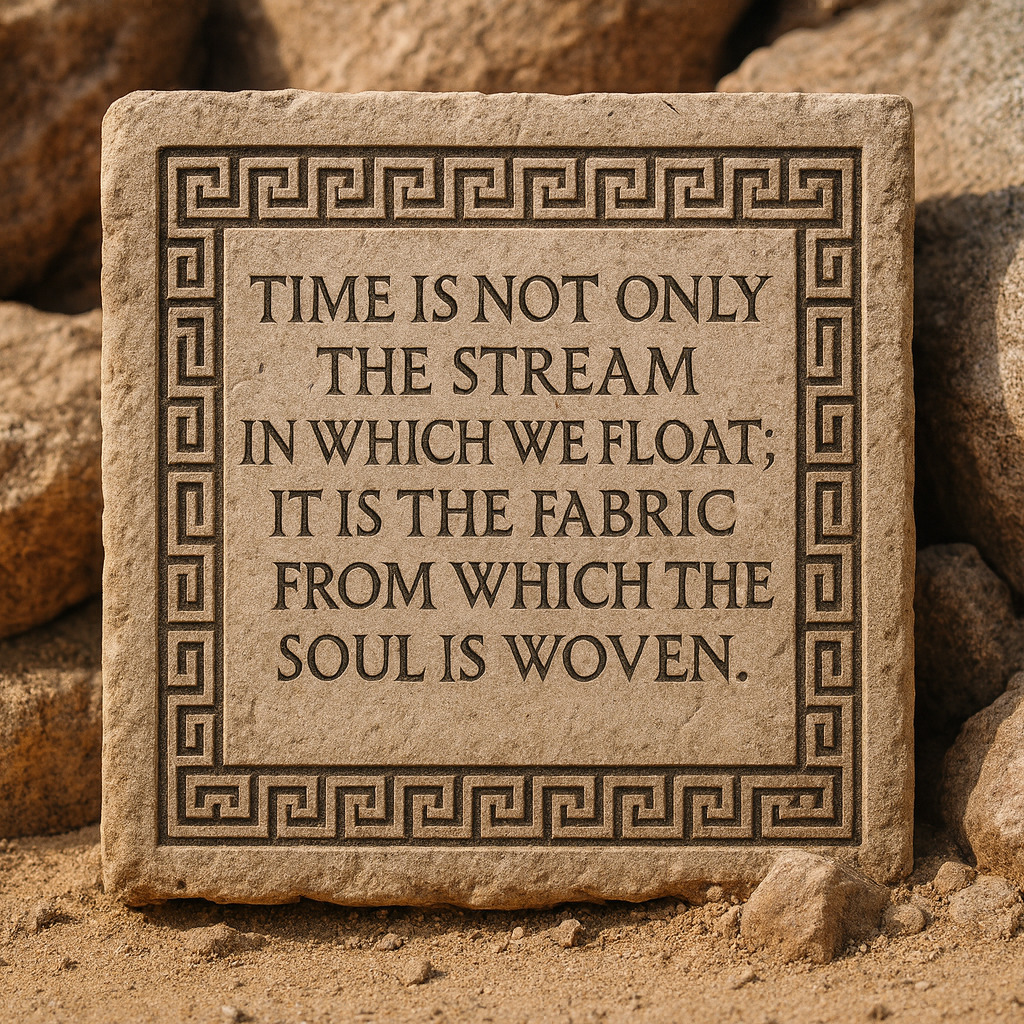
Time is not only the stream in which we float;
it is the fabric from which the soul is woven.
(a paraphrase of C. G. Jung)
History of the Emergence
«Time is the moving image of eternity.»
— Plato, Timaeus
Temporal psychology arose as a synthesis of philosophy, science and many years of psychotherapeutic practice.
The first book on this topic, which I published in 2017, summed up years of reflection on the interaction of consciousness and time.
Since then, much has become clearer.
The field of inquiry has consistently gone beyond the bounds of academic psychology: it has touched the very foundations of consciousness, spiritual practices and those domains of knowledge that explore the limits of the knowable.
The philosophical roots of this approach run deep — from Platonic ideas and the mysteries of eternity to contemporary reflections on the limits of formal systems (Gödel).
All these lines point to the fact that time and consciousness cannot be reduced to a simple sequence of events.
Jung introduced into the science of the psyche the notion of supra-temporal structures — archetypes and synchronicity.
Grof described in detail transpersonal states in which ordinary temporal reference points disappear.
Modern cognitive science and neuroscience increasingly consider consciousness as a process with its own temporal thickness—
one that includes predictions, counterfactuals and nonlinear temporal structures.
My own development in this field unfolded gradually:
from work with dreams and autogenic training—
through decades of psychotherapeutic practice—
toward creating authorial methods such as the «Face of Personality» and temporal mask-therapy, presented here in detail for the first time.
These methods are not abstract schemes:
they grew out of practice, from those «building materials»
that memory, tradition and the unconscious bring.
This book is an invitation to a new paradigm:
to a space where past, present, future and eternity meet within the human being.
At times this theme goes beyond the expectations of its own author—
and this is precisely what makes it a living testimony to the search for and formation of a new field of knowledge.
Historical and Theoretical Precursors of Temporal Psychology
Temporal psychology is grounded not in a single line of tradition but in a whole polyphony of thinking about time: from ancient philosophy to modern neuroscience, from religious teachings to transpersonal research, from cultural memory to futures studies. Below is a map of these origins.
1. Ancient, Spiritual, and Religious Traditions
Plato (c. 427–347 BCE)
Time as the «image of eternity,» a shadow cast by the world of ideas. Plato was the first to distinguish the temporal from the atemporal. This is the foundation of the future therapeutic vertical «time–eternity.»
Aristotle (384–322 BCE)
Time as the measure of movement; the link between order, causality, and subjective experience. His analysis of temporal categories influenced understandings of development, becoming, and change.
The Stoics (3rd–1st centuries BCE)
The doctrine of fate (heimarmene), cosmic order, and active consent to the flow of time. The Stoic idea of inward acceptance of destiny is a direct predecessor of existential and temporal therapy.
Buddhism
The doctrine of impermanence (anitya), the «momentariness of consciousness,» and the illusory nature of a fixed «self.» Buddhist practices provided the first tools for working with atemporality and transitions between temporal states.
Christian Tradition
The concept of kairos — a special, grace-filled time in which purpose is revealed. The distinction between linear and sacred time is an important component of existential work with destiny.
2. European Philosophy and Psychology of the 19th–20th Centuries
Henri Bergson (1859–1941)
The contrast between measurable time and lived duration. He showed that consciousness lives not by seconds but by the inner flow of experience. His ideas underlie the analysis of temporal handwriting.
William James (1842–1910)
The «stream of consciousness,» and how the perception of time changes with emotion and motivation. His observations on time dilation and contraction are early descriptions of temporal pathology.
Sigmund Freud (1856–1939)
Psychoanalysis turned the past into the working material of therapy: trauma never «goes away,» it becomes part of the present. Temporal psychology treats this as axiomatic.
Alfred Adler (1870–1937)
The future as the driver of behavior: a person shapes themselves through goals not yet realized. Adler introduced the psychology of the future long before cognitive science.
Carl Gustav Jung (1875–1961)
Archetypes, synchronicity, the collective unconscious — work with trans-temporal structures. Jung took dreams of the future seriously and created a language for analyzing the deep future.
Jean Piaget (1896–1980)
The development of temporal categories in childhood. Piaget showed that temporality is a construct formed gradually. Without mature temporal schemas, personality cannot be built.
Kurt Lewin (1890–1947)
The concept of «field» and vector-like behavior: motivation as movement toward the future. His topological psychology is one of the first dynamic models of time.
Viktor Frankl (1905–1997)
Meaning as an orienting point toward the future. A person exists in tension between what is and what must be done. Frankl gave therapy a language for working with destiny and existential future.
Maurice Merleau-Ponty (1908–1961)
The body as the bearer of experienced time. Perception, movement, gesture are forms of temporal organization. This is an important source of body-based temporal therapy.
3. Existential, Phenomenological, and Hermeneutic Traditions
Edmund Husserl (1859–1938)
The structure of inner time-consciousness (retention, protention). He was the first to propose a model of the continuous temporal structure of experience.
Martin Heidegger (1889–1976)
Being-time: the human being as a project oriented toward the future and death. His analysis of authenticity is the basis of therapeutic work with temporal responsibility.
Paul Ricoeur (1913–2005)
The triadic structure of time: cosmic time, historical time, narrative time. Ricœur showed that humans live in stories — a key argument for working with autobiographical time.
Hannah Arendt (1906–1975)
The time of action and the time of beginning. Arendt demonstrated that political crises are disruptions of collective temporality: the breakdown of memory, hope, and the horizon of the future.
4. Culture, Memory, Society
Jan Assmann (b. 1938)
Cultural memory and long layers of collective experience transmitted through rituals, texts, and symbols. The basis for collective temporal therapy.
Maurice Halbwachs (1877–1945)
Founder of the concept of collective memory: social groups form their own temporal frames — what is remembered and forgotten.
Michel Foucault (1926–1984)
History as a discursive construction. Foucault showed that power governs the time of society: norms, rhythms, archives.
Benedict Anderson (1936–2015)
Imagined communities — nations as collectives of shared time. History, holidays, and symbols as mechanisms of synchronization.
5. Scientific, Technical, and Mathematical Foundations of Time
Isaac Newton (1643–1727)
Absolute time as a universal coordinate. Important as a contrast for psychological models.
Albert Einstein (1879–1955)
The relativity of time, its dependence on the observer. Established a paradigm in which time ceased to be singular.
Kurt Gödel (1906–1978)
Einsteinian solutions with «closed timelike curves,» the incompleteness theorems. His work shows the limits of the formalizability of time.
Ilya Prigogine (1917–2003)
Irreversibility, bifurcations, time as the creative force of nature. The foundation of the philosophy of development and crisis.
Norbert Wiener (1894–1964)
Cybernetics as the science of prediction and control. Wiener anticipated the idea of the brain as a future-modeling machine.
6. Contemporary Cognitive Science, Neuropsychology, and ASC Research
Daniel Schacter, Randy Buckner, Donna Addis, and others (2000s–2020s)
Research on the «prospective brain»: episodic future thinking, counterfactual models, the default mode network. This is the scientific foundation of all temporal psychology.
Karl Friston (b. 1959)
Predictive processing — the brain as a prediction machine. Time arises as the result of continuous expectation-updating.
Evan Thompson (b. 1962)
Phenomenology of consciousness and the neuroscience of time. He demonstrated that temporality is not a computational result but a fundamental mode of conscious existence.
7. Transpersonal, Psychedelic, and ASC Traditions
Stanislav Grof (b. 1931)
Altered states break linear time and open perinatal and archetypal layers. His work is key for understanding atemporality.
Abraham Maslow (1908–1970)
Peak experiences — «eternity in a moment.» Maslow gave scientific language to higher states.
Charles Tart (b. 1937)
Psychology of altered states: transformed temporal structures and subjective duration.
Timothy Leary (1920–1996)
The model of «inner times» of consciousness, the experience of psychedelic temporal shifts.
Conclusion
Temporal psychology is not a «new school» but a point of intersection of numerous traditions:
— philosophical (Plato, Husserl, Heidegger, Ricœur)
— psychological (Freud, Adler, Jung, Rogers, Piaget)
— cultural (Assmann, Arendt, Halbwachs)
— scientific (Einstein, Prigogine, Wiener, Friston)
— transpersonal (Maslow, Grof, Tart)
All these approaches converge in one idea: a person lives within the time they experience, create, and transform.
Temporal psychotherapy becomes not a narrow direction but an attempt to weave these lines into an integrated methodology working with the past, present, future, eternity, and atemporality — at individual, group, and collective levels.
How to Read This Book
This book was conceived as a tool for very different readers — from curious newcomers to practicing psychotherapists and researchers. Over the course of its development, it expanded: to the theoretical part and the individual practice a third part was added — on collective temporal psychotherapy. Below are several guidelines to help you build your own reading path.
If you want a general overview
Read sequentially: Introduction → Part I (theory and worldview) → transitional chapters → Part II (individual temporal psychotherapy) → Part III (collective temporal psychotherapy).
In this way, you will see the unfolding line of the main idea: from understanding the human being in time → to methods of working with personal temporal experience → to work with groups, communities, and culture.
If you are looking for practical techniques
You may go directly to the practical sections.
Part II contains protocols of individual work: chapters with methods, exercises, clinical examples, and appendices with worksheets and diagnostic/self-observation forms.
Part III focuses on collective temporal psychotherapy: group formats, family and organizational work, «collective cases,» session scenarios, and elements of temporal prevention.
The glossary and appendices help you quickly navigate the terminology and choose suitable methods.
If you are a researcher or educator
The main theoretical foundations are presented in Sections 1–4 of Part I: the model of temporal psyche, connections with the philosophy of time, cognitive science, phenomenology, neuroscience, and ASC practice.
Part III complements this with material on collective and cultural temporality — useful for social psychology, community therapy, organizational consulting, and cultural studies.
Short summaries at the end of each section are useful for preparing lectures, courses, and scientific reviews.
If you read for personal development
Alternate theory and practice. Begin with the introductory chapters of Part I to understand the author’s view of time, personality, and destiny.
Then move to the basic individual exercises (Practical Part), and gradually to the ideas of collective temporality.
It is important not only to do the practices but also to keep a diary of observations: record changes in your sense of past, present, future, and relation to eternity.
If you work with groups, families, or organizations
Rely on the theoretical chapters of Part I and the key chapters of individual practice in Part II — this is the «grammar» of temporal psyche.
Then proceed to Part III, where principles and formats of collective temporal psychotherapy are described: group memory, shared images of the future, experiences of atemporality at the level of an organization or community.
For group facilitators, the sections on competence boundaries, ethics, and safety in ASC work and highly charged collective topics are especially important.
How to work with exercises and cases
Before doing an exercise, read carefully its aims, indications, and limitations.
Always begin with the recommended preparatory steps (attunement, breathing, grounding in the present).
For individual techniques, record your sensations, images, thoughts, and temporal changes.
For collective formats, also note group dynamics, emotional climate, and changes in the «time» of the group (as it feels before, during, and after the session). These records are part of the method.
Glossary, appendices, and bibliography
The glossary contains concise definitions of key concepts of temporal psychology and psychotherapy, including terms related to atemporality, eternity, and collective temporality.
The appendices include expanded case examples, questionnaires, diagrams, and worksheets for individual and group work.
The bibliography and «Literature and Commentary» sections offer reading paths and show how the book’s ideas connect with existing scientific and therapeutic traditions.
Reading support and navigation
Pay attention to special markers and highlights in the text that help distinguish levels of material: where theory is given, where practice is described, where an individual clinical case or a collective/cultural example is presented.
Highlighted blocks with key ideas serve as reference points for repetition and planning.
Balancing spiritual and scientific language
The book combines methodological precision with metaphorical, sometimes poetic descriptions of time experience.
If you prefer a strict academic style, focus on chapters with methodology, empirical data, and protocols.
If existential meaning and the spiritual dimension are important, look closely at the chapters on eternity, atemporality, destiny, and collective archaic layers of time.
Reading this book is not a linear march through pages but a movement across several dimensions: from theory to practice, from personal experience of time to collective experience, from chronological everyday time to encounters with eternity and exit from atemporality.
Make pauses, return to important passages, try the techniques in a safe format — and temporal psychology will become not only a system of knowledge but also a living experience that changes your own trajectory in time.
GLOSSARY OF KEY CONCEPTS
This glossary presents the essential terms used throughout the book.
The concepts of temporal psychology and temporal psychotherapy form an integrated system; therefore, clear definitions at the outset help the reader navigate the theoretical framework and clinical applications that follow.
Acme
The peak moment of personal development, when inner strength, meaning, experience and energy converge into a single point of being.
Anthropic Principle
A philosophical idea stating that the fundamental parameters of the Universe are correlated with the existence of an observer. Here it supports the view of the psyche as resonant with external cosmic rhythms.
Autogenic Training (AT)
A method of psychophysiological self-regulation using focused suggestions, concentration and relaxation. Applied to enter special mental states and work with time perception.
Atemporality
A family of states that go beyond linear time. It includes two opposite forms:
— Time-void — loss of temporal continuity and meaning;
— Eternity — fullness, depth and meaningful presence.
Therapeutic work requires discerning between these forms and either integrating the experience or restoring chronological rhythm.
Chronological Time
The external axis of time: clocks, calendars, biological cycles and social schedules that structure life and ensure measurability.
Chronotuning
The process of aligning inner time with external rhythms (natural, social, cosmic). In therapy it means restoring resonance between biological cycles, mental states and lifestyle.
Condensate of Temporal Crystallization (TCC)
The dense, meaning-rich formations that arise as the result of temporal crystallization — emotional and narrative clusters fixed in key moments of experience.
Desynchronosis
A mismatch between internal and external rhythms, producing anxiety, somatic symptoms and disturbance of temporal regulation.
Depersonalization / Derealization
Clinical phenomena involving the loss of temporal anchors and disruption of the continuity of the «temporal self.»
Dialogue with the Future
A set of psychotechnologies (letters to the future, projective scenarios, etc.) enabling interaction with one’s possible future states.
Eidos
A minimal structural unit of experience through which consciousness marks transitions and organizes the sense of time.
Eternity
A positive form of atemporality: a filled, meaningful experience beyond linear time, associated with wholeness, participation and deep peace.
External Rhythms
Cycles outside the individual — circadian, lunar, seasonal, solar and historical rhythms — that shape the temporal context of life.
Extended Time Model
An expanded version of the basic threefold model (chronological time, psychological time, atemporality), unfolding each dimension into a spectrum of states and transitions.
Face of Personality (method)
An authorial method of temporal mask-therapy that organizes subpersonalities into a stable configuration — an integrated «face of personality» supporting experiences beyond linear time.
Future
The temporal domain of possibilities, expectations and anticipations; a psychological and cultural space of hope, goals and collective scenarios.
Main Past
Not the totality of what has been lived, but what remains alive in the psyche, relationships and culture — emotionally charged memories, unfinished meanings and inherited narratives.
Mask-Therapy, Temporal
A therapeutic method using creation and interpretation of masks or self-portraits to harmonize inner subpersonalities («masks of time») and integrate the personality within its temporal dynamics.
Methodology and Empirical Base
The scientific approaches and data underlying temporal psychology: phenomenology, surveys, EMA (ecological momentary assessment), biomarkers, prospective studies and clinical observations.
Ornament
A visual pattern carrying rhythmic and semantic information; it can reflect an individual’s temporal handwriting or a culture’s temporal language.
Ornamental Diagnostics
A working hypothesis that ornamental forms can serve as diagnostic markers of temporal handwriting and structures of cultural temporality.
Ornamental Grammar
The rules of ornamental construction — repetition, pause, symmetry, asymmetry — that form the syntax of visual temporality.
Ornamentality of Temporal Language
The view that ornament functions as a pre-linguistic grammar of time; its rhythms and patterns express temporal meanings.
Past
The temporal domain of memory and inheritance. It shapes identity and provides scripts, traumas and resources for present life.
Precognition
A phenomenon of forefeeling or dreamlike sensing of future events; interpreted with caution as a possible sensitivity to unfolding possibilities.
Prospection
A neurocognitive capacity to generate scenarios of the future based on memory networks, linking past, present and future.
Psychological (Subjective) Time
The felt duration, speed and richness of the moment; the experiential flow shaped by memory, attention and anticipation.
SLE (Subjective Life Expectancy)
The age to which an individual expects to live; an indicator of personal temporal perspective.
Temporal Art-Therapy
A practical branch of temporal psychotherapy using artistic forms (masks, ornaments, movement) to explore temporal layers of personality.
Temporal Code of Ornament
The symbolic correspondence between ornament form and temporal mode (cyclic, asymmetric, frozen, etc.).
Temporal Crystallization
The process by which significant temporal structures condense into intense «knots» of meaning.
Temporal Disturbances
Distortions of temporal experience: fixation on the past, fear of the future, prolonged time-void, acceleration or slowing of subjective time.
Temporal Font
A metaphorical «typeface of time»: typical configurations of rhythms and cycles characteristic of a group, generation or cultural environment.
Temporal Handwriting
An individual’s stable manner of experiencing and structuring time — personal rhythm, temporal orientation and style of temporal processing.
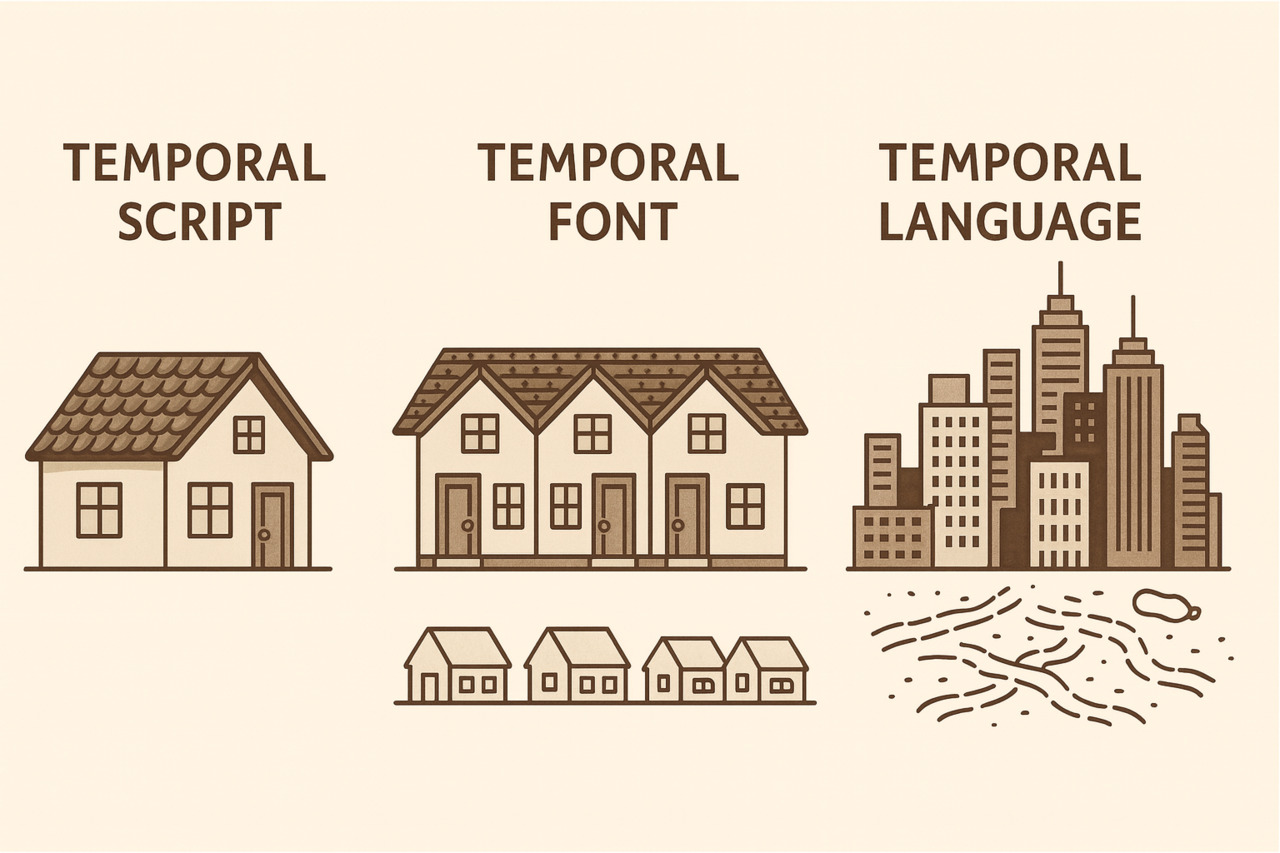
Temporal Language
The symbolic, verbal, bodily, visual and ritual forms through which a culture expresses and organizes its experience of time.
Temporal Map
A multilayered diagnostic tool («portrait of personality in time») showing how a person constructs past, present and future.
Temporal Ornament
An imaginal system expressing multi-temporal meanings through lines, interweavings and spatial rhythms.
Temporal Psychology
A psychological approach that studies human experience through the lens of time — individual, interpersonal and cultural dimensions of temporality.
Temporal Psychotherapy
A clinical and humanistic paradigm aimed at restoring the temporal health of individuals and communities.
Transpersonal Experience
An experience of going beyond the individual «I» and biographical time, involving expanded states of unity and meaning.
Time-Void
A clinically significant form of atemporality characterized by emptiness, collapse of meaning, and loss of temporal continuity on personal, group or cultural levels.
Zeitgebers
External cues (light, day–night cycles, schedules) that synchronize internal biological rhythms with outer time.
Перевожу весь блок как цельный фрагмент главы, в том же стиле, что и предыдущие части книги.
PART I. Temporal Psychology — Theory and Worldview
Section 1. Foundations and Principles
Chapter 1. The Nature of Time and Psyche in Temporal Handwriting
We paint our life
on the endless canvases of time,
each with our own colours.
From the diary, 2025
Summary
Time in the psyche is not only an external scale, but the inner fabric of experience: duration and rhythm shape the form of sensations, emotions and meanings. This chapter introduces a key operational category — temporal handwriting — as a person’s stable way of living through time. We regard handwriting as the result of interaction among three layers of rhythms (biological, sociocultural and archetypal), show its logical links with Jungian types (introversion/extraversion) and propose a working matrix for classifying handwritings. A separate section is devoted to the idea that temporal handwriting can be reflected in cultural artefacts — especially in ornament — opening perspectives for interdisciplinary diagnostics and research.
Key Concepts
Temporal handwriting — an individual’s stable manner of experiencing and structuring time. It is a personal style of time: how a person feels duration, holds the past, anticipates the future and experiences atemporality. It manifests in speech tempo, actions, emotional cycles and life rhythms.
Durée (длительность) — living inner time (Henri Bergson).
Introversion / Extraversion (temporal interpretation) — orientation toward inner temporal dimensions vs sensitivity to external rhythms and events.
Rhythms of nature and culture — biological (circadian, etc.), social (epochal, traditional), archetypal (collective unconscious).
Rhythm sensitivity — the degree to which a person’s state is determined by external cycles (season, moon, solar activity).
Discreteness / digital handwriting — a fragmented, «portion-based» organisation of time under the influence of the digital environment.
Atemporality — a modality of experience outside the linear «before–now–after».
Ornamental diagnostics (hypothesis) — the idea that ornament and artistic forms can record and reflect the temporal handwriting of an individual or a culture.
Aims of the Chapter
— To argue for temporal handwriting as a fundamental category of temporal psychology.
— To ground its origin in the interaction of biological, sociocultural and archetypal rhythms.
— To propose a working matrix for classifying handwritings, suitable for theoretical development and future empirical research.
— To describe the promising idea of ornamental diagnostics and outline methodological paths for testing it.
— To clearly distinguish theoretical foundations from practical implications — directing practice to subsequent chapters and appendices.
Main Text
1. Time as Not Only a Dimension, but a Form of the Psyche’s Being
Modern philosophy and phenomenology have repeatedly emphasized that the inner duration of experience is not identical to the external chronometer. Bergson called this durée — the inner flow in which past, present and future are linked not by simple succession, but by mutual interpenetration. Husserl showed that the «now» is a synthesis of retention (holding of the past) and protention (intention toward the future), rather than a point of instantaneous fixation. These ideas give us a methodological support: time is a quality, a form, a fabric — not only a sum of segments.
For psychology this thesis has practical meaning: if time is a form of experience, then changing the form (tempo, rhythm, density) changes the very character of experience. Trauma «compresses» time, turning it into a repeating plot; meditation «stretches» time, opening a different kind of presence; anticipating the future «accelerates» motivation and reorganizes behaviour. The question is not only what a person experiences, but what kind of time-handwriting he or she has.
2. Rhythms: Layers that Shape Handwriting
The psyche is inscribed into a multilayered grid of rhythms. Let us distinguish three levels, since their interaction accounts for most of the variability of handwritings.
Biological rhythms. Daily cycles, hormonal fluctuations, seasonal changes — all this sets the physiological possibility for a particular life tempo. Chronotype (lark/owl) is a simple example: the way «owls» move through the morning part of the day differs from «larks», and this is reflected in the whole psychic organisation.
Socio-historical rhythms. Culture supplies calendar rituals, work cycles, rhythms of celebration and mourning. The era of industrial discipline, the era of digital «multi-windowing», the era of artisanal slowness — each historical style embeds the individual in its own tempo.
Archetypal rhythms. Here we speak of those structural and symbolic cycles that Jung and his followers associated with the collective unconscious: the rhythms of birth–death–transformation, cycles of mythological reconstruction, recurrence of certain images and meanings. These rhythms are qualitative; they set «atemporal» tones and sometimes lead the personality toward peak experiences.
Temporal handwriting is formed at the intersection of these three layers: a stable biorhythm can be «rewritten» by culture, but archetypal echoes can restore certain patterns — especially in crisis or in altered states of consciousness.
3. What Is Temporal Handwriting? — Definition and Functions
Temporal handwriting is a complex characteristic of personality that includes:
— stable tempo parameters (speed of switching, duration of stable states);
— the modality of relating to past, present and future (for example, the degree to which the past has been worked-through, capacity to project the future, propensity for experiences of eternity);
— sensitivity to external cycles and readiness to integrate them into everyday life;
— stable behavioural rituals through which time is shaped (rituals of beginning/ending, boundary practices).
The functions of handwriting are as follows: it structures attention (what the «temporal field» of consciousness is directed to), it ranks motivational resources (when and at what tempo a person is able to act), it creates stability — either as resistance to shocks or as vulnerability to loss of rhythm.
Handwriting is not only descriptive but predictive: knowing a person’s handwriting, we can forecast proneness to depression (tendency toward prolonged, «frozen» time), anxiety (accelerated, «skipping» handwriting) or creative episodes (alternation of accelerations and deep atemporal insights).
4. A Matrix of Temporal Handwritings: Methodological Framework
To systematise, we introduce a two-axis model: on the X-axis — Introversion ↔ Extraversion (in Jung’s sense, but interpreted as orientation to inner time vs external rhythms); on the Y-axis — Accelerated ↔ Slowed tempo. Additionally, we take into account three modifiers: rhythm sensitivity (to biological/lunar/seasonal cycles), discreteness/digitality and atemporality.
In practice, a person’s modality is denoted as a combination: (introversion/extraversion) × (accelerated/slowed) ± (rhythm sensitivity / discreteness / atemporality). Below are working types with extended descriptions.
4.1. Introvert — Slowed (Concentrative Handwriting)
Characteristics. Long inner duration of experiences; deep reflection; inclination toward contemplation; high tolerance for monotonous inner work.
Manifestations. Slow speech tempo, rich inner symbolism, elaborate dream plots, tendency toward philosophical interpretation.
Theoretical meaning. Here time is a field of accumulation and synthesis; living through past layers can be productive, but under trauma may lead to stuckness (time-void).
Psychotherapeutic task (in theory). To support movement toward integration (small behavioural steps), prevent rigidity and help build external anchors.
4.2. Introvert — Accelerated (Flash/Insight Handwriting)
Characteristics. Inner jumps of attention and insights; intense experiences of short duration; alternation of highs and lows.
Manifestations. Fast thinking, episodes of productivity followed by exhaustion, sometimes insomnia or disrupted sleep rhythms.
Theoretical meaning. The psyche operates through sudden restructurings; this is a mode of discoveries, but vulnerable to depletion.
Psychotherapeutic task. Structuring and planning recovery, translating insights into stable actions.
4.3. Extravert — Accelerated (Social-Dynamic Handwriting)
Characteristics. Continuous reaction to the external stream of events; high mobility of attention and behaviour; life as a series of social rhythms.
Manifestations. Frequent contacts, high switchability, strong involvement with novelty.
Theoretical meaning. Personality is synchronized with the sociocultural tempo; with abrupt rhythm disruption — risk of burnout.
Psychotherapeutic task. Introducing practices of slowing, working on restoring biorhythms.
4.4. Extravert — Slowed (Traditional/Epochal Handwriting)
Characteristics. Life according to long external cycles (family rituals, professional traditions); stability, conservatism.
Manifestations. Attachment to traditions and rituals, consistent behavioural patterns.
Theoretical meaning. This handwriting provides general stability; yet when change is necessary, resistance arises.
Psychotherapeutic task. Gently fostering flexibility and openness to the new.
4.5. Rhythm-Sensitive Handwriting (Transversal Modifier)
Characteristics. Strong correlation of mental state with external cycles: daily, seasonal, lunar; sensitivity to light, changes of day, etc.
Theoretical meaning. Here the mechanism of handwriting is tightly intertwined with physiology; chrono-biological interventions promise high effectiveness.
4.6. Discrete / Digital Handwriting (Modern Modifier)
Characteristics. Temporal experience is cut into portions of activity: sessions, notifications, short windows of attention.
Theoretical meaning. The technological environment shapes a new handwriting; consequences include changes in deep integration of experience and attention.
4.7. Atemporal Handwriting
Characteristics. Tendency toward experiences that transcend linear temporal logic: peak states, mystical insights, transpersonal episodes.
Theoretical meaning. A source of meaning-making and creativity; without adequate supports — risk of disorientation. It requires careful therapeutic integration.
In practice, handwriting rarely fits neatly into a single cell of the matrix; more often we are dealing with a dominant pattern accompanied by several secondary features. The matrix provides working hypotheses that require empirical validation.
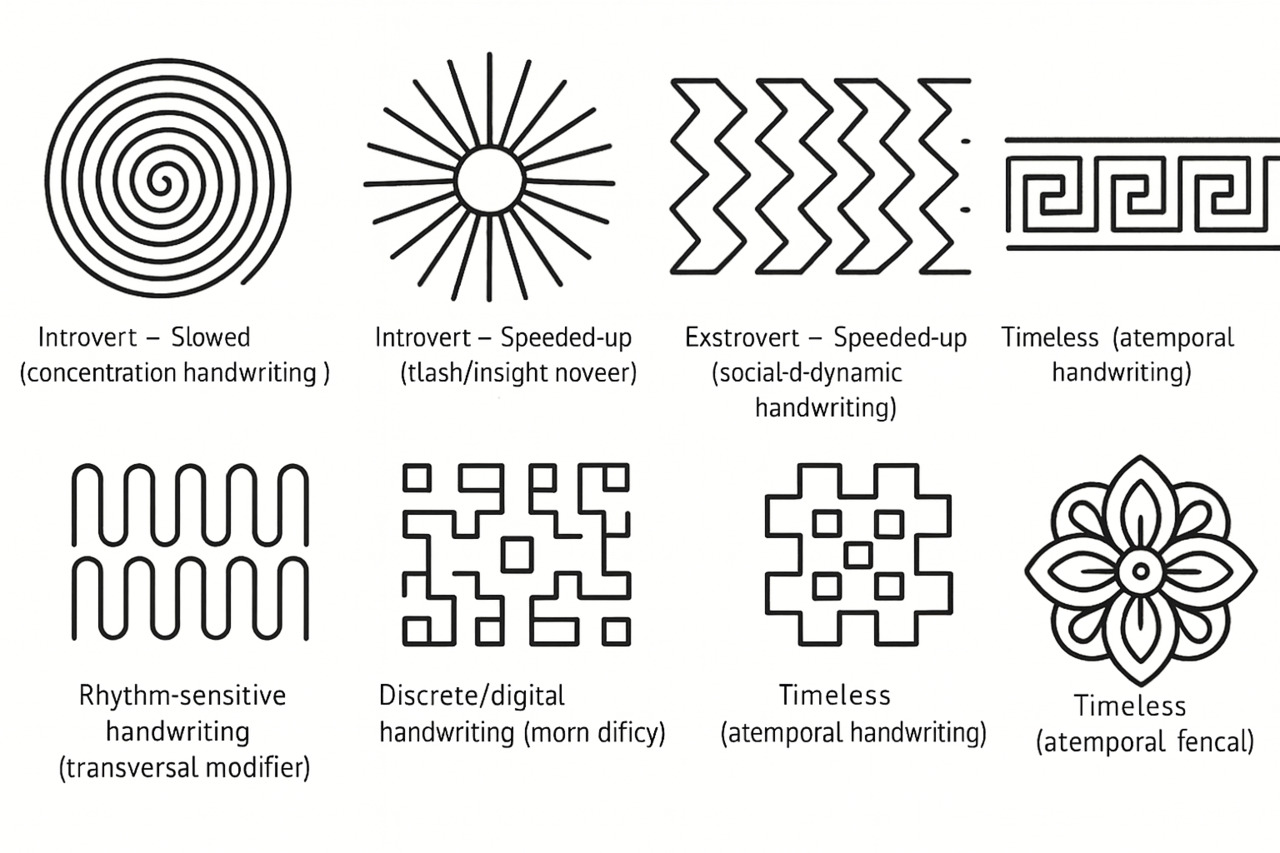
5. Ornament as the «External Signature» of Handwriting — Hypothesis and Methodological Directions
Culture is not a neutral background: it codes rhythms, and ornament is one of the most evident forms of such coding. Ornament presents rhythm in visible form: repetition, interval, density, openness/closure of form. Hence a natural, tentative transition: if a personality has a stable handwriting, and if culture fixes rhythms, then ornament may carry traces of the handwriting of both individual and epoch.
Working hypothesis. Extraverted handwriting is more often expressed in open linear ornaments (waves, rows, flows), introverted — in closed, centripetal ornamental structures (circles, concentric compositions). Accelerated handwritings yield small, dense rhythms; slowed ones — large, «stretched» motifs.
Methodological paths for testing the hypothesis:
— Collecting a corpus of ornaments (ethnographic and contemporary design) and classifying formal characteristics (closed/open, density, rhythmicity, modularity).
— In parallel — psychological surveys and screening of temporal handwriting in creators / bearers of these ornaments.
— Statistical analysis of correlations: preference for forms ↔ handwriting indicators.
— Cross-cultural testing and contextual work: recognizing that ornament is culturally conditioned and may express a collective font rather than purely individual handwriting.
Ethical and methodological caveats.
Ornamental diagnostics is an auxiliary tool, not a substitute for clinical assessment. One cannot directly interpret a preferred pattern as a diagnosis; context, symbolism and tradition must be taken into account.
6. Theoretical and Empirical Implications: Directions for Further Work
The concept of temporal handwriting opens several avenues for research and practice:
— Cognitive-neurobiological correlates.
— Which neurophysiological parameters (HRV, cortisol profile, circadian markers) correlate with handwritings? One may expect clearly marked circadian patterns in rhythm-sensitive handwritings.
— Development and formation of handwriting.
— How do childhood, parenting modes, trauma, educational practices and cultural context shape handwriting? The role of epigenetics here is an important hypothesis.
— Clinical validation.
— Testing how well handwriting diagnostics predicts responses to specific interventions (chronotherapy, cognitive restructuring, mask-therapy).
— Cultural semiotics.
— Exploring ornamental and artistic manifestations of handwriting as part of cultural history.
7. Ethical, Clinical and Methodological Limits
— Avoid reductionism: handwriting is not a diagnosis but a description of rhythmic features.
— In the presence of severe pathology (psychosis, acute suicidality), avoid provocative projects without clinical preparation.
— When working with cultural symbols, maintain respect and avoid universalism (take local meanings of patterns into account).
— Any diagnostic procedure must be validated and aligned with ethical research standards.
8. Conclusions and Link to the Rest of the Book
Temporal handwriting is a central construct linking the philosophy of time with applied psychotherapy.
This chapter provides the conceptual foundation: handwriting is the signature of time in the psyche, formed by biorhythms, culture and archetypes.
Further on we will develop this idea: in the Appendix to Chapter 1 you will find a brief practical screening sheet; in Part II (especially Chapter 21) — the «Face of Personality» method and detailed mask-therapy techniques that use the notion of handwriting in practice.
___
Literature and Commentary
The following list brings together the philosophical and psychological texts underlying the theoretical core of this chapter, as well as contemporary directions in empirical research on time. For further study of temporal handwriting, works on the phenomenology of consciousness, the cognitive neuroscience of time, chronobiology and the epigenetics of rhythms are recommended.
Bakhtin, M. M. — «Forms of Time and Chronotope in the Novel» (1937–1938)
Shows how artistic forms record temporal structures of experience; an example of ornamental and narrative coding of time in culture.
Bergson, H. — Matter and Memory (Matière et mémoire, 1896)
A foundational work on inner duration (durée); distinguishes phenomenological time from physical measurement.
Buonomano, D., & Eagleman, D. — The Brain and Time (2009)
Reviews neural mechanisms of time perception; demonstrates how the brain constructs duration and sequence.
Frankl, V. — Man’s Search for Meaning (1946)
Highlights the centrality of future orientation in human motivation; relevant for the projective dimension of temporal handwriting.
Freud, S. — The Interpretation of Dreams (Die Traumdeutung, 1900)
Explores how the past continues to live in the present; psychoanalysis as an «archaeology of time.»
Grof, S. — The Holotropic Mind (1992)
Empirical foundation on altered states and transpersonal experiences; essential for atemporal dimensions of the psyche.
Husserl, E. — On the Phenomenology of the Consciousness of Internal Time (1905)
A classic analysis of the lived «now,» retention and protention; foundational for temporal structure of consciousness.
Jung, C. G. — Psychological Types (1921); Synchronicity (1952)
Typology supporting the axes of temporal handwriting; synchronicity introducing supra-temporal connections.
Kleitman, N. — Sleep and Wakefulness (1939)
Classic research on sleep–wake biological rhythms; base for chrono-aspects of handwriting.
Kravchenko, S. A. — Temporal Psychology (2017); works on the «Face of Personality» (2020–2025)
Authorial corpus forming the methodological and clinical base of temporal psychotherapy.
Maslow, A. — Religions, Values, and Peak Experiences (1964)
Describes peak experiences as atemporal states with developmental significance.
Plato — Timaeus (c. 360 BCE)
Foundational concept of time as an «image of eternity»; philosophical basis for temporal categories.
Suddendorf, T., & Corballis, M. — «The Evolution of Foresight» (2007)
Evolutionary theory of mental time travel; highlights the unity of memory and imagination of the future.
Wittmann, M. — Felt Time (2016)
Neuropsychological study of subjective time; links temporal perception with emotional and bodily regulation.
Review studies on chronobiology and epigenetics (20th–21st centuries)
Show rhythmic inheritance and biological underpinnings of temporal organisation.
Chapter 2. The Anthropic Principle, the «Cosmic Human» and External Rhythms
Summary
The human being is not an abstract subject: we are rooted in a web of external rhythms — from the daily light–dark cycle to multi-year waves of solar activity and economic cycles. This chapter combines philosophical reflection (the anthropic principle, the metaphor of the «cosmic human») with an applied view: which levels of external rhythms have clinical and diagnostic significance for temporal psychology, how they can be tested, and how to treat cultural corpora (astrology, myth). The chapter stresses methodological caution: metaphors broaden our view, but empirical claims require rigorous testing.
Key Concepts
Anthropic principle (psychological reading) — the idea that the parameters of the world are «pre-tuned» in such a way that an observer can appear here; in a psychological reading, a working hypothesis about the attunement of the psyche to external rhythms.
Cosmic Human / Adam Kadmon — a metaphor of the unity of macrocosm and microcosm; phenomenologically rich and clinically usable as an image, but not empirically valid without testing.
External rhythms — cycles outside the individual: daily (circadian), lunar, seasonal, multi-year (solar activity), long-term historical/economic waves.
Zeitgebers — external «conductors» of biorhythms (light, social schedules, etc.); key to understanding why «biorhythms» are at once internal and externally relevant.
Methodological caution — distinguishing between metaphor, phenomenological corpus and testable hypothesis.
Aims of the Chapter
— To explain why discussion of external rhythms is important for temporal psychology.
— To describe five key levels of external rhythms relevant for clinical work and research.
— To provide recommendations for testing hypotheses about attunement between psyche and external rhythms.
— To clearly distinguish the cultural-symbolic domain (astrology, myth) from the empirical field of research.
Main Text
1. Philosophical Reflection: The Anthropic Principle and the «Cosmic Human»
In physics, the anthropic principle points out that the laws of the world are such that an observer is possible within it. A psychological reading of this idea is not a magical claim, but a way of posing the question: how do the properties of the surrounding world and its rhythms form the field in which the psyche arises and develops?
The metaphor of the «cosmic human» (Adam Kadmon and analogous images in different traditions) offers a rich phenomenological material: it fixes an intuition of the person’s co-belonging with the cosmos. But it is important to separate metaphor from empirical assertion: in science we put forward hypotheses about attunement and test them against data.
Here we immediately turn to a practical angle: external rhythms act as «addresses» for an extraverted temporal handwriting (people oriented toward external cycles tend to react more strongly to these rhythms), whereas an introverted handwriting is more oriented to inner temporal dimensions. This distinction is a working hypothesis, not a dogma.
Critical remark: always distinguish the context — philosophical (the metaphor of the «cosmic human») versus empirical (correlations between rhythms and mental state). Metaphor widens our view, but does not replace data.
2. Biorhythms as Both Internal and External
It is important to clarify: «biorhythms» are endogenous oscillators of the organism that are internally generated but entrained by external zeitgebers (light, temperature, social schedules). In other words, biorhythms are internal in origin but externally modulated; therefore the boundary between «internal» and «external» in rhythms is always relative. Contemporary work in circadian biology and its impact on health and mental functioning provides detailed support for this position.
3. Five Key Levels of External Rhythms
(clinical observations and verification)
Below is a working overview of levels useful for clinicians and researchers. For each, we sketch clinical observations and suggest avenues for verification.
3.1. Daily (Circadian) Rhythms
Phenomenon. The 24-hour organisation of sleep/wake, hormonal fluctuations and circadian patterns of activity.
Clinical picture. Variability of mood and performance across the day; morning apathy in depressed patients; suicidal and cardiac peaks in the early morning — clinically relevant markers.
Verification. Actigraphy, hormonal profiling, collecting time-stamped data on events (hospitalisations, cardiac episodes). Modern reviews highlight the major impact of the circadian system on health and immunity.
3.2. Monthly / Lunar Cycles
Phenomenon. The 29.5-day lunar cycle; historical beliefs about its connection with menstrual, behavioural and criminal patterns.
Clinical picture. Patients sometimes report insomnia or increased emotional lability during full moon; at the regional level some reports have described rises in emergency calls.
Verification. Prospective actigraphic and registry studies. There is robust prospective evidence for effects of lunar phase on sleep onset and duration, but meta-analytic reviews point to mixed findings and high sensitivity to methodology and sampling. Prospective registration and careful control of retrospective reporting are necessary.
3.3. Seasonal / Annual Rhythms
Phenomenon. Annual variations in day length, temperature and associated behavioural and biochemical shifts.
Clinical picture. Seasonal affective disorder (SAD) is the classic example; the efficacy of light therapy has been clinically demonstrated.
Verification. Clinical trials of light therapy; population-based studies of seasonal patterns in morbidity and birth rates.
3.4. Multi-year Cycles of Solar Activity (~11 years) and Geomagnetic Disturbances
Phenomenon. Cycles of solar activity, flare events and subsequent geomagnetic disturbances.
Clinical / societal picture. Retrospective analyses have found correlations between solar activity peaks and changes in acute medical utilisation, cardiac and psychiatric statistics; epidemiological work has shown associations between geomagnetic disturbances and increased mortality on some indicators.
Verification. Longitudinal multicentre studies that link satellite indices (Kp, sunspot number) with clinical registries. Existing studies show carefully derived associations, but the mechanism remains contested and requires replication.
3.5. Long Historical / Economic Waves
Phenomenon. Decades-long cycles in the economy, technological development and public mood (long-wave theories, Kondratiev and his successors).
Psychological significance. Mass temporality — collective expectations, perceived risks, readiness for innovation — generates societal scenarios that become embedded in individual life plans (career, family, migration).
Verification. Interdisciplinary studies combining historical data, sociological surveys and psycho-demographic measures. Methodologically this is a demanding but promising area.
Important caveat. Observed correlations at these levels do not equal proof of causality. Each association demands strict control for confounders and prospective registration.
4. Attitude Toward Astrology and Cultural Traditions
Astrological systems represent a large phenomenological corpus: centuries of observation, symbolism and interpretive technique. For temporal psychology they may serve as a phenomenological resource — a source of observations and meaning maps — but cannot automatically be treated as an empirical causal model without testing.
Put differently: astrology can be legitimately used as a cultural and therapeutic repertoire (working with symbol and meaning), but its postulates require verification if one wishes to claim scientific explanatory power.
Methodological recommendation. Use astrological and mythological motifs in therapy as metaphors and semiotic tools, but do not let them replace clinical diagnosis and statistical testing of hypotheses.
5. Hypotheses for Interdisciplinary Testing
(directions for research)
Below is a brief list of operational hypotheses that should be tested prospectively and with preregistered protocols:
— Circadian dysregulation correlates with increases in acute psychiatric exacerbations (to be tested via actigraphy and hospitalisation registries).
— Lunar phase modifies sleep parameters in sensitive individuals (prospective actigraphy under controlled conditions).
— Geomagnetic disturbances are associated with changes in the rates of acute events (lag analysis, multilevel modelling, satellite data).
— Long socio-economic cycles influence collective temporal scenarios that, in turn, shape individual decisions (historical-psychological research).
Each of these hypotheses is a candidate for prospective multicentre projects with preregistered protocols.
Practical Tool — Mini-Questionnaire
«Connected with Rhythms» (5–7 minutes)
(Use as a screening instrument; positive answers are a reason to deepen the temporal profile.)
1. Do you notice changes in your mood at different times of day? (never / sometimes / often)
2. Do you experience insomnia or worse sleep during full or new moon? (no / sometimes / yes)
3. Do you have seasonal fluctuations in mood/energy? (no / moderate / pronounced)
4. Have you noticed any link between your dreams and major external events (disasters, accidents)? (no / sometimes / yes)
5. Do you experience periods when «time falls out» — meaning seems to stop? (no / sometimes / often)
6. Do recurring family scenarios appear across generations? (no / a few / many)
7. Is your sleep disrupted when you change time zones or work schedules? (not at all / moderately / strongly)
Instruction for the therapist.
Answers such as «often / yes / pronounced / strongly» are a reason to expand the assessment of temporal handwriting (see Chapter 1) and, if appropriate, to compare events with external indicators (lunar phase on the date of the event, local weather/seismic data, Kp-index). Full diagnostic tools are presented in Part II and in the Appendix to Chapter 2.
Transition to the Next Chapter
In Chapter 1 we introduced the concept of temporal handwriting; in Chapter 2 we have added the layer of external attunements. The next chapter (Chapter 3) examines inner rhythms and the issue of the psyche stepping «beyond» material connections — atemporality and altered states of consciousness.
Kondratiev Waves and Psychological Adaptation to the Technological Epoch
Kondratiev waves are long cycles (approximately 40–60 years) describing regular fluctuations in the development of the global economy and technology. Each wave begins with a technological breakthrough that gradually permeates the entire society, changing not only production but also lifestyle, culture, modes of communication and thinking. After a phase of rapid growth come saturation, crisis, decline and the preparation of the next wave. Traditionally these macroeconomic rhythms were described with reference to economic processes, but their impact on psychology and human development remains understudied.
If we accept that the human being lives inside the rhythms of the epoch — technological, economic, cultural — then an individual biography is inevitably «inscribed» into these large-scale oscillations. Depending on the phase into which a person is born and in which they form, they may end up either in resonance or in dissonance with the dominant technologies of their time.
Synchronous Generation
Those born at the beginning of a new technological wave (for example, children of the 1990s–2000s during the digital upswing) develop together with the technological environment. They absorb innovations naturally, playfully. For them, digital, networked and hybrid thinking is the norm. Their psychology is «synchronous» with the epoch, and their inner rhythms coincide with external ones.
Transitional Generation
These are people whose childhood or youth falls on the boundary between technological regimes — for example, those born in the 1960s–70s who lived through the shift from an industrial to a digital world. They often have a split perception: on the one hand, a habit of a stable world of material things; on the other, a forced adaptation to abstract, networked, virtual structures. They often become bridges between epochs but also experience inner tension between the old and the new type of consciousness.
Asynchronous Generation
Particularly vulnerable are those born in the downturn phase, when the previous technological order is dying and the new one has not yet taken shape. Their skills and values become «orphans of the epoch»: they think in categories of yesterday’s world, while reality already demands a different logic. We see this especially clearly today: older or middle-aged people who have not managed to master digital technologies feel «fallen out of time.» They lose access to information, services and social connections. Lagging behind becomes not only technical but existential: a sense of being «unneeded» and «not contemporary» generates anxiety, shame and devaluation.
The Psychotherapeutic Dimension
The task of psychotherapy is to help the person restore synchrony with the epoch — not in the sense of imitating technologies, but by understanding their own temporal rhythm and accepting their place in the overall flow of history. For asynchronous personalities it is essential to recognise that their experience and depth belong to another phase of the wave — and precisely for that reason may be valuable: they carry the «memory of the previous cycle,» which is needed for balance and continuity.
Work with such clients includes:
— reducing guilt and shame about «lagging behind»;
— becoming aware of one’s own «temporal biography» — where one is located in the rhythms of the epoch;
— finding forms of participation in contemporary life without losing one’s identity;
— developing cognitive flexibility and tolerance of uncertainty characteristic of new technologies.
For transitional generations, psychotherapy helps integrate the double experience: to preserve inner supports from the old world and master new symbolic forms (virtual interaction, digital creativity, network ethics). For synchronous generations, conversely, the emphasis is on slowing down and forming deeper self-awareness, in order to avoid superficiality and fragmentation of digital time perception.
Thus, Kondratiev waves can be seen not only as macroeconomic regularities but also as rhythms of anthropic time that shape psychological types of the epoch. Understanding these rhythms opens a new perspective on individual destinies and crises — as reflections of the great oscillations of global civilisation.
Literature
Babones, S. — Global Kondratiev Waves and Political Transformations of World Systems, 2019.
Analyses how long economic cycles correlate with political shifts and transformations of world systems. Useful for extending long-wave logic to cultural and psychological change across generations.
Casiraghi, L., Spiousas, I., Dunster, G. P., et al. — «Lunar Sleep: Synchronization of Human Sleep with the Lunar Cycle under Natural Conditions,» 2021.
A prospective actigraphy-based study showing associations between lunar phases and changes in sleep onset and duration. Provides convincing empirical evidence that calls for replication across populations and settings.
Devezas, T. C. — «Biological Determinants of Long Waves of Socio-economic Growth,» 2015.
Explores analogies between biological rhythms and economic long waves. Offers a theoretical basis for the metaphor of «epochal generations» and for linking macro-cycles with human development.
Gaspel, J. A., et al. — «Perfect Timing: Circadian Rhythms, Sleep and Immunity,» 2020.
A modern review of interactions between circadian rhythms, sleep and immune function. Demonstrates systemic effects of daily cycles on health, stress resilience and mental state.
Glazyev, S. Yu. — Theory of Long-Term Techno-Economic Development, 1993.
A classic Russian exposition of long-wave theory in the context of technological paradigms. Important for understanding how technological shifts shape social structures and temporal experience.
Grinin, L. E. — Kondratiev Waves, Technological Modes and the Theory of Production Revolutions, 2012.
Shows the links between long waves and phases of technological development, describing how each wave creates a new type of society. Provides macro-historical context for technological epochs.
Kondratiev, N. D. — Long Waves in Economic Life, 1925.
The foundational work on long cycles in economic dynamics. Introduces the idea of long waves that later became a key framework for analysing technological and social rhythms.
Kravchenko, S. A. — Temporal Psychology and Psychotherapy: The Human in Time and Beyond, in progress.
Develops the idea of the person’s inner synchronisation with external rhythms — from biological to civilisational. In this framework, Kondratiev waves are interpreted as manifestations of a broader cosmic rhythm influencing psyche and destiny.
Litinski, M., et al. — «Impact of the Circadian System on Disease Severity: A Review,» 2009.
Epidemiological and clinical review showing how time of day and circadian phase affect disease outcomes. Supports the concept of «circadian medicine» relevant for temporal clinical practice.
Nefiodov, L. — The Sixth Kondratiev Wave: The New Long Wave of the World Economy, 2014.
Discusses the current digital-biotechnological cycle, in which the human being becomes part of the technological system rather than just a consumer. Important for understanding psychological pressures of the present wave.
Nishimura, T., Tada, H., Nakadani, E., et al. — «Stronger Geomagnetic Fields as a Possible Risk Factor for Male Suicide,» Psychiatry and Clinical Neurosciences, 2014.
A regional study showing a possible association between geomagnetic field intensity and male suicide rates. An example of carefully conducted analysis that nonetheless requires replication.
Rönneberg, T. — «The Circadian System, Sleep and the Balance of Health and Disease,» Journal of Sleep Research, 2022.
Conceptual review that frames the circadian system as a central regulator of health and disease. Helps situate temporal clinical work within the emerging field of circadian medicine.
Rosenthal, N. E., Sack, D. A., Gillin, J. C., et al. — «Seasonal Affective Disorder: A Description of the Syndrome and Preliminary Findings with Light Therapy,» Archives of General Psychiatry, 1984.
First clinical description of seasonal affective disorder and the use of light therapy. A foundational study that launched modern chronopsychiatric approaches.
Rotton, J., & Kelly, I. W. — «Much Ado about the Full Moon: A Meta-analysis of Lunar-Lunacy Research,» Psychological Bulletin, 1985.
A classic meta-analysis showing the methodological fragility and ambiguity of claimed lunar effects. Emphasises the need for rigorous prospective designs and cautions against retrospective myth-making.
Tulin, A. E., & Chursin, A. A. — «Developing Kondratiev Long-Wave Theory: The Place of AI Economy and Humanisation of Competences,» Philosophy of Science and Technology, 2023.
Highlights artificial intelligence as a key factor in the sixth long wave and discusses changes in human competences in the AI epoch. Useful for linking technological trends with shifts in temporal experience and identity.
Vieira, S. L. Z., Alvarez, D., Blomberg, A., Schwartz, J., Kautz, B., Huang, S., & Koutrakis, P. — «Solar-Induced Geomagnetic Disturbances and Increased All-Cause and Cardiovascular Mortality in 263 US Cities,» Environmental Health, 2019.
A large epidemiological study revealing correlations between geomagnetic disturbances and increased all-cause and cardiovascular mortality. Provides material for hypotheses about cosmic influences on health.
Wirtz-Justice, A. — «Seasonality in Affective Disorders,» 2017–2018.
A modern overview of mechanisms behind seasonal mood fluctuations and hormonal cycles. Underlines the importance of chrono-therapeutic strategies in psychiatry and psychotherapy.
Chapter 3. Inner Rhythms and the Limits of Connection with Time
Summary
This chapter immerses the reader in the world of the psyche’s inner rhythms — in how the person experiences the present, how the past resounds in the present, and how the future shapes the direction of life. We introduce the notion of an inner (introverted) temporal handwriting and examine three dimensions of time in the psyche: present, past and future. Special attention is given to altered states of consciousness (ASCs), through which the psyche can temporarily step beyond its usual rhythmic conditioning, and to the practical implications of this for therapy.
Key Concepts
— Temporal handwriting — an individual, characteristic way of experiencing time; an integration of biorhythms, cultural rhythms and personal modes of narrating one’s life. Components: biorhythms / external rhythms (lunar, seasonal, social) / narrative organisation (how a person tells their own story). Manifestations: speech tempo, attention to the «here,» frequency of retraumatisation, tendency toward premonitions. Practical assessment: questionnaires, time-stamped diaries, observational markers (speech tempo, degree of contact), actigraphy.
— Present (temporal «here-and-now») — the convergence point of experience, the field where subpersonalities meet and choices are made.
— Past — a storage of experience, memory, ancestral and cultural traces that resonate in the present.
— Future — projections, intentions, projects and unconscious outlines of expectation.
— Altered states of consciousness (ASCs) — modes of experiencing in which linear time weakens; a source of experiences of timelessness and eternity.
— Atemporality / time-void — different shades of experience in which ordinary chronology loses its primacy: from emptiness and apathy to peak insight.
Aims of the Chapter
— To formulate and justify the idea of inner dimensions of time — present, past and future — as distinct levels of experience and regulation.
— To show how temporal handwriting integrates these dimensions and how it is shaped by biorhythms, culture and personal history.
— To consider ASCs as a mechanism of temporary freeing from usual temporal conditioning and as a therapeutic resource, provided there is preparation and integration.
— To provide practical guidelines for assessing and working with inner rhythms in clinical practice.
Introduction — the Next Step
In Chapter 1 we became acquainted with the concept of temporal handwriting — a stable way of living in time. In Chapter 2 we expanded the picture by adding the external layer: the synchronisation of the person with cosmic (solar–geomagnetic), natural (daily, seasonal) and socio-historical rhythms. Now our path leads inward: to how the psyche itself constitutes time — how it experiences the present, stores the past and lives through the future.
The inner world is where the introverted temporal handwriting is especially vivid. For an introvert, biorhythms and inner cycles are not just physiology but the fabric of meaning: sleep rhythms, mood arrhythmias, cycles of memories and premonitions form the rhythmic handwriting of inner life. Even for an extravert, inner rhythms are always present and interacting with external ones; the difference lies in the direction of sensitivity.
The question of the boundary between predetermination and freedom in time is central for temporal psychology. Where is the line between what «is given to us» (biorhythms, ancestral scripts, cultural codes) and what we can change — through practice, through attention, through work with symbol? This boundary is marked precisely at the points where the psyche transitions into other modes — altered states of consciousness. In ASCs, human experience goes beyond linear sequence: past, present and future cease to be separate coordinates, and another kind of fabric of meaning arises.
Three Dimensions of Inner Time: Present, Past, Future
1. The Present — the Field of Assembly
The present is not the simple instant of the clock but a field in which sensory data, emotions, images and intentions come together. It is the point where subpersonalities meet and decisions are made. The quality of the present depends on the tempo of perception: a sharp, «short» present gives rise to anxiety and impulsivity; a stretched present allows depth of experience and reflection.
In therapy it is practically important to distinguish when the client is genuinely present in the now, and when their «here» is filled with echoes of the past or projections of the future. Work with anchors of presence, with breathing and sensory techniques is the key to training the present.
2. The Past — the Resonance Chamber of the Psyche
The past is not only biographical facts but also their subtle ecology: cultural scripts, family stories, epigenetic traces. Within the psyche, the past sounds like resonance, colouring current perceptions and motivational signals. Trauma makes this resonance painful: the past «intrudes» into the present, and experience loses the ability to be reframed in a broader narrative.
The therapeutic task is to help the client reconstruct the past not as a sentence but as a fabric of meaning: to untangle loops of repetition, allow memory to change the valence of events, and reduce the intensity of regressive reactions. By working with the past we change the form of the present.
3. The Future — Project and Expectation
The future is present in the psyche as projections, plans, «fictional finalisms» and unconscious premonitions. It sets the vector of motivation: expectation of hope or threat, projection of success or fear. For many psychotherapeutic approaches (Adler, Frankl), the future is a decisive organising factor of personality.
Consultations and therapies that restore to a person a sense of future (small attainable goals, visualisation, work with projections) can radically transform temporal handwriting: reducing the compulsive pull of the past and expanding the field of choice.
Interaction of the Three Dimensions and the Formation of Temporal Handwriting
Temporal handwriting is not a sum of three independent layers but their complex interrelation: in one person resonance of the past dominates, in another — a sped-up stream of the present, in a third — a strongly projective future. The quality of the handwriting is determined by biorhythms, traumatic experience, cultural belonging, family scripts and practices (religion, art, ritual).
An important observation: a change in any one of the three coordinates (for example, restoring contact with the body in the present) often initiates a redistribution of tensions in the other dimensions. This is precisely why therapy of temporal handwriting is effective: it works with the form of time, not only with its content.
Altered States of Consciousness (ASCs) as a Way of Temporal Release
ASCs are not an «escape» from reality but a shift in the regulation of temporal modes. In ASCs we can observe:
— a suspension of linear chronology (past/future cease to be strictly sequential);
— an intensification of sensory presence (heightened «here-ness»);
— experiences of participation in eternity or, conversely, of painful time-void.
We can distinguish two types of ASCs:
— Involuntary — dreams, acute emotional episodes, epileptic and psychotic states. Their therapeutic potential is limited and requires great caution.
— Voluntary (guided) — meditative practices, autogenic training, controlled psychotherapeutic processes, psychedelic therapy under clinical supervision. These modes allow safer exploration and integration of experiences of atemporality.
ASCs demonstrate that temporal handwriting can not only be understood but also trained — we can develop flexibility of temporal modes, expand the capacity for choice and integration.
Therapeutic Principles for Working with Inner Rhythms
— Stabilisation before deepening. Skills of presence (anchoring, breathing, sleep hygiene) are the foundation. Without them, attempts to induce ASCs are risky.
— Stepwise expansion of experiential depth. Mini-entries, journaling, creative work, gradual integration.
— Symbolisation of experience. Translating experience into words, images, ornaments (masks, drawings) is the path toward stable integration.
— Contextualisation in family and cultural memory. Taking ancestors and cultural scripts into account reduces the risk of existential disorientation.
— Ethical boundaries. Informed consent, supervision, a plan for emergency support.
Conclusion — The Meaning of Working with Temporal Handwriting
Work with inner rhythms is deep therapy of the form of time. By changing the tempo, rhythm and vector of time, we change the very fabric of the psyche — its stability, creativity and capacity for meaning-making. In the following chapters we will move from theory to practice: we will examine in detail techniques of preparation, protocols for safely introducing ASCs and methods for integrating experiences of atemporality.
Literature
Grof, S. — The Holotropic Mind (1993).
A transpersonal model of the psyche describing the integration of extreme and mystical experiences; includes therapeutic protocols for safe work with altered states of consciousness.
Husserl, E. — Phenomenology of the Inner Consciousness of Time (lectures, c. 1905).
A classic exposition of the structure of inner time: retention, protention and the act of «now»; a philosophical foundation for analysing the temporal experience of consciousness.
James, W. — The Varieties of Religious Experience (1902).
Phenomenological descriptions of mystical states and experiences of eternity; a pioneering work in the psychology of spiritual experience.
Carhart-Harris, R. L., et al. — Neural correlates of the psychedelic state (psilocybin) (PNAS, 2012); «The Entropic Brain» (2014).
Modern neuroscientific studies explaining phenomena of ego dissolution, altered time perception and expanded consciousness.
Lutz, A., et al. — «Long-term meditators self-induce high-amplitude gamma synchrony during mental practice» (PNAS, 2004).
Neurophysiological evidence demonstrating the impact of long-term meditative practice on brain rhythms and states of attention.
Newberg, A., & d’Aquili, E. — Why God Won’t Go Away: Brain Science and the Biology of Belief (2001).
An attempt to integrate the phenomenology of religious experience with neurobiology; explores spiritual experiences as both biological and psychological processes.
Schultz, J. H. — Autogenic Training (1932 and later editions).
A practical method of self-regulation aimed at stabilising states and entering altered states of consciousness in a controlled manner; a foundational psychotechnical approach of the 20th century.
Jung, C. G. — «Synchronicity: An Acausal Connecting Principle» (essay, mid-20th century).
A study of archetypes and the collective unconscious; introduces synchronicity as a form of «atemporal» linkage between psychic and external events.
___
Appendix to Chapter 3: Questionnaire «Experiencing Atemporality» and other tools.
Chapter 4. The Model of Time, Temporal Font and Language
Summary
In the previous chapters, we introduced the concept of temporal handwriting, traced the connections between the individual and the external rhythms of the Cosmos, and identified the key dimensions of time — past, present and future. This chapter develops a working map of the experience of time: it proposes a ternary model (1 — chronological; 2 — psychological; 0 — atemporality) as a tool for diagnosis and for designing interventions, especially in the context of altered states of consciousness (ASC). In addition to the model, we discuss «temporal fonts» and languages (cultural, familial, ornamental codes), mechanisms of shifts between temporal regimes, the practical logic of application, and ethical and methodological caveats.
Key concepts
Temporal handwriting — an individual style of experiencing time.
ASC (altered states of consciousness) — states (meditation, hypnosis, relaxation, autogenic training, trance or psychedelic practices) in which the usual organization of time changes: expansion or compression of duration appears, as well as access to atemporal insights and symbols.
Chronological (linear) time — the external, measurable axis (clocks, calendars, biorhythms, social schedules).
Psychological time — the subjective duration of experience: speed, retention, protention.
Atemporality (timelessness, «0») — a mode in which linearity loses its power; an experience of wholeness/eternity.
Ternary coding (1/2/0) — a working metaphor for coding temporal regimes.
Temporal font / language of time — stable cultural–familial and personified patterns of organizing time (ornaments, rhythms, narratives).
Aims of the chapter
— To propose a practical, operational model of the experience of time, convenient for diagnosis and for planning interventions.
— To show how altered states of consciousness (ASC) shift combinations of temporal regimes and open space for therapeutic work.
— To introduce the notion of «temporal fonts» and languages as cultural and symbolic codes of time, and to show their diagnostic and therapeutic value.
— To outline methodological approaches, criteria of success, and ethical constraints when working with ASC and temporal interventions.
1. Introduction — From Map to Instrument
We are moving from description to instrument. If the first three chapters served as a map (handwriting — external rhythms — internal dimensions), then here the task is to make the map operational: to learn how to see, code and manage temporal regimes. Altered states of consciousness (ASC) are not a goal in themselves, but an experiential–instrumental zone in which shifts of regimes become visible and thus available for observation, practical training and, when necessary, therapeutic influence.
The appendix to this chapter contains a list of exercises for developing ASC.
2. A Working Model of the Experience of Time
Three Interpenetrating Regimes
The model is based on three broad, but flexible, modalities of experiencing time.
1. Chronological (linear) time
This is the «external» axis — clocks, calendars, biological cycles, social schedules and institutions. It gives the world measurability and predictability. In the therapeutic context, chronological time is the sphere of regulation (sleep, nutrition, prescribed treatment), planning, and adaptation to the demands of society.
2. Psychological time
The subjective duration of experience: tempo, richness, retention (what is held from the past) and protention (what the future is reaching toward). Here the temporal handwriting of the individual is formed: one person lives «in long brushstrokes,» another — in «flashes,» a third constantly jumps between past and future. Psychological time is the key to understanding individual experience and to choosing interventions.
3. Atemporality (timelessness, «0»)
A mode in which habitual linearity loses its power: «before» and «after» disappear, and the main focus becomes the quality of «being,» the sense of wholeness and participation. This mode arises in meditative practices, deep ASC, mystical insights; it can be a resource (transformation, insight) or a risk (disorientation, intensified dissociation), depending on preparation and integration.
Dynamics and Interaction
The regimes combine and overlap: one and the same episode of experience may contain elements of all three regimes. In therapy, the important thing is not to «push» the client into atemporality as such, but to manage transitions: preparation → controlled entry → integration. ASC act as an instrument that makes these transitions visible and manageable.
3. The Ternary Metaphor: 1 — 2 — 0 and Its Meaning
Ternary coding is a convenient metaphor for thinking and operationalization.
— 1 (chronology) — support, measurability, everyday action.
— 2 (psychology) — inner flow, narrative, handwriting.
— 0 (atemporality) — resource or challenge, the «zero point» where meaning can be reconstructed.
Practically, this means that we can code the stream of experience as sequences of trits and analyze them as «temporal words.» This opens paths toward formalization:
— EMA (Ecological Momentary Assessment),
— diaries,
— Markov models of transitions (mathematical models describing a sequence of system states where the probability of the next state depends only on the current one),
— calculation of entropy of the temporal sequence (a quantitative estimate of how predictable or unpredictable this sequence is).
In therapeutic design we can conceive «rules of grammar»: preparation (strengthening 2), entry (allowing 0), integration (transition 0→2→1).
Limitation. The model is a tool; it does not explain the «essence of time,» but helps to set tasks, formulate hypotheses, and measure changes.
4. Temporal Fonts and Languages of Time
What Are the «Font» and «Language» of Time?
Temporal handwriting is an individual, stable style of experiencing and structuring time. It is one’s personal style of time — the way a person senses duration, holds the past, anticipates the future, and experiences atemporality. It manifests in speech tempo, actions, emotional cycles, and life rhythms.
Temporal font is a metaphorical «typeface of time» — a typical configuration of rhythms, sequences and cycles characteristic of a particular group, generation or social environment. It reflects a typological level of temporal organization — a general style of life, ways of anticipating, and responses to the future.
Temporal language is the totality of symbolic, verbal, bodily, visual and ritual forms through which a culture expresses, organizes and transmits its experience of time. This is the level of cultural grammar of time, where the «words» are rhythms, pauses, gestures, ornaments, narratives and rituals. Mastering temporal language in therapy means the ability to hear cultural forms of time and translate them into the experience of personal development and healing.

How Fonts Are Formed and Transmitted
— Culture and institutions. School, church, work schedules form notions of what is «chronologically correct.»
— Family and genogram. Family rituals, stories and scripts transmit temporal habits (what «soon» means, what «success» means).
— Material culture and ornament. Visual codes (patterns, architecture, clothing ornament) carry rhythms: closed forms — an intonation of an introverted font; open lines and waves — an extroverted one. This creates a diagnostic and design possibility: ornament can serve as a marker and an instrument (in comparison with the client’s scores on temporal handwriting scales).
Diagnosis Through Fonts
Hypothesis: stable visual and linguistic markers correlate with temporal handwriting. For example: in a society/family where strict, digital codes dominate (rigid rows, clear squares), one can expect a culture of «1→1→1»; in artistic communities — more frequent insertions of 2 and 0. Ornamental diagnostics is so far a hypothesis that requires empirical verification (comparing ornament traits with temporal handwriting scales and behavioral data).
Therapeutic Use of Fonts
Resemiotization: working with symbols and ornaments to restructure the sense of time (for example, introducing visual forms that stimulate slow attention into practice). This is the process of translating personal experience from one temporal dimension into another — from past into present, from dream into speech, from unconscious symbol into conscious idea. For example: in a dream (in an ASC) a symbol appears → in a drawing it becomes an image → in conversation — a word → in action — a deed → in the future — a new attitude toward the world. Each transition is an act of resemiotization in time, and this is the key to understanding how a person reinterprets and relives the time of their life. A practical example (from mask therapy). A patient makes a mask that expresses an inner shadow. This mask is a new semiotic form of old unconscious content. When the patient begins to speak from the mask’s point of view, resemiotization occurs: unconscious affect becomes image, then speech, then meaning. As a result, the person integrates a fragment of personality — a «temporal subpersonality» — into a more coherent Self. In philosophical terms, resemiotization is the life of meaning, its movement in time and in forms. Each sign is only a temporary shell, a «temporal form» of content that is always alive in its transitions. Thus meaning becomes a temporal being, moving from symbol to symbol, from state to state.
Narrative reconfiguration: rewriting family and cultural stories in which the temporal grammar changes (from «life is a plan» to «life as flow and creativity»).
Active interventions: mask therapy, creating ornamental paintings/portraits that help integrate 0→2→1 transitions.
5. Mechanisms — A Working Hypothesis
— Phenomenologically: ASC change the structure of retention/protention — past and future are redistributed in the present.
— Neurophysiologically (hypothesis): a shift in network dynamics (DMN, attentional networks), changes in rhythm synchrony (gamma/theta/alpha), increased short-term entropy of brain activation.
— Psychosocially: language, rituals, ornaments and family scripts modify readiness for the experience of atemporality and influence strategies of integration.
These levels must be tested jointly: phenomenology → physiology → long-term clinical outcomes.
6. Practical Logic of Application
— Screening: assessment of temporal handwriting (ch. 1), a scale of experiencing timelessness, checking for contraindications.
— Preparation: stabilization (sleep, nutrition, routine anchors), autogenic training, grounding, informed consent.
— Controlled entry: gentle techniques → deeper, according to readiness; recording 1/2/0 sequences (EMA, diary).
— Integration: translating experience into speech, symbol, action; using fonts/ornament to consolidate changes.
— Monitoring: short-term and long-term, supervision, biomarkers in research protocols.
7. Ethical and Methodological Warnings
— Deep ASC are not for everyone; contraindications: active psychosis, unstable medication, pronounced suicidality.
— Distinguish phenomenology from metaphysics; «I experienced eternity» ≠ proof of an ontological claim.
— Document and preregister research in order to avoid apophenia.
— Informed consent and an emergency plan are mandatory.
— Working with cultural symbols requires respect, avoidance of cultural appropriation, and a co-creative ethic.
8. Conclusion — A Bridge to Practice
The proposed working model of the experience of time is an instrument for diagnosis and for designing interventions. The ternary metaphor and the notion of temporal fonts provide a language for planning therapeutic grammars: how to prepare, how to allow, how to integrate.
___
The Appendix to Chapter 4 contains a list of practical methods for entering ASC, a «dictionary of fonts,» and examples for recognizing the «language of time.»
Literature
Grof, S. — The Holotropic Mind (1993).
A systematization of transpersonal states of consciousness and the development of a methodology for integrating them into the therapeutic process. The book combines clinical experience, phenomenology and spiritual practices, laying the foundation of transpersonal psychotherapy.
Husserl, E. — On the Phenomenology of the Consciousness of Internal Time (lectures, ca. 1905).
A foundational phenomenological analysis of the structure of time: retention, protention and the act of the «now.» A basic philosophical grounding for understanding how time is constituted in the stream of consciousness.
James, W. — The Varieties of Religious Experience (1902).
A classic exploration of mystical states and experiences of «encounters with eternity.» Important for the phenomenological description of altered states of consciousness and their role in spiritual life.
Carhart-Harris, R. L. et al. — The Entropic Brain (2014) and subsequent works on the neural correlates of psychedelic states.
A modern neuroscientific concept explaining how changes in brain network dynamics are related to experiences of atemporality, expanded consciousness and ego dissolution. Provides a physiological basis for understanding the therapeutic potential of ASC.
Schultz, J. H. — Autogenic Training (1932 and later).
A practical method of self-regulation and controlled entry into altered states of consciousness. Serves as a tool for preparation, stabilization and recovery in deep psychotherapeutic work.
___
Additions to Chapter 4
«Fonts» of Temporality
«Fonts» of Temporality: Cultural, Professional and Generational Context
In addition to the individual temporal handwriting, there is a level of collective «fonts» of temporality — stable ways of living in time that are formed by culture, profession, generation and social institutions. These «fonts» are like typefaces: some communities prefer a dense, small font of daily routines (industrial workers, state institutions), others — broad calligraphic strokes of creative work (artists, poets), still others — the machine-like, sparse rhythm of digital culture (IT specialists, digital nomads).
Key observations and practical consequences:
— Fonts define people’s expectations about time: what is considered the norm (working at night/day, speed of response, planning horizons).
— They modify temporal handwriting: work habits, family-time rituals, collective celebrations and mourning — all of this shapes, reinforces or suppresses certain trits (1/2/0).
— In therapy it is important not to confuse a cultural font with pathology: rigidity of a «chronological» font is not always a symptom — often it is an adaptation to social roles.
— Fonts change historically: digitalization, urbanization, migration create new combinations of trits and new «typefaces» of temporality.
Practical cheat sheet for the therapist (briefly): when taking a history, include questions about
— work schedule and professional rituals;
— family rhythms (mealtimes, evening rituals, religious holidays);
— technical fueling of time (messengers, notifications, night work);
— generational expectations (future plans, ideas of duty/freedom);
— migration/long breaks (how relocation changed the «font»).
Methodological hint for research: code observations at two levels — individual sequences (trits) and «font» metadata (culture, profession, age). This will allow us to distinguish personal patterns from collective repertoires and to design appropriate interventions.
Be careful with universalization — we should not reduce a person to a «font.» Fonts are a useful metaphor and tool, but primary is individual phenomenology.
Temporal «Language»
Temporal «Language» — The Idea and Its Role in the Structure of the Book
1. What It Is and Why It Is Needed
If temporal handwriting is an individual way of living in time, and the temporal «font» is a collective, cultural–professional way of «writing» time, then temporal language is the set of sign, narrative and symbolic rules that stand behind these fonts and handwritings. Temporal language is the grammar of time: categories, metaphors, the syntax of causal links, ways of marking «beginning/end,» ritual codes of time, canons of memory and of projecting the future.
The language of time sets not only the form of experience but also the map of meaning — it offers terms for past traumas, frameworks for expectations of the future, and ways of narrative integration of the present. In this sense, handwriting and font are the visible, practical realization of the language: script, calligraphy, the «font» of behavior and ritual.
2. Examples of «Languages of Time» (Contrasting Models)
— Agrarian language of time (circular). Monthly, seasonal markers, harvest rituals. Grammar: repetition, cyclicity, «repetition as meaning.» Font: circular, rhythmic; handwriting: family traditions, seasonal rituals.
— Industrial language of time (linear/progressive). «Time is money,» planning, linear progress. Grammar: causality, accumulation, deadlines. Font: regular work schedule; handwriting: punctuality, discipline.
— Digital language of time (compressed/parallel). Instant communication loops, multitasking, asynchrony. Grammar: notifications, flow, immediacy. Font: rapid switching, short cycles of attention.
— Mystical/ritual language of time (atemporal). Rituals as entry into pre-time; grammar — metaphor of eternity, «folded» stories; font — symbols, icons, ritual texts.
Each civilization and era has a set of such languages; within them there are dialects (professions, classes, subcultures).
3. What the Term «Temporal Language» Adds — Practical Value
— Analytical perspective. Allows us to distinguish surface practices (fonts) from deep semantics (language), and to formulate interventions more precisely.
— Clinical sensitivity. Understanding which «language» the client speaks about time helps translate experience into meanings that are understandable for them, without imposing alien temporal grammars.
— Cultural competence. The therapist sees that «normal» for one cultural font is symptomatic for another; treatment ceases to be a universal template.
— Research operationalization. The language can be studied via corpora (literature, ritual texts), narrative analysis, semiotics, and then related to empirical data (EMA, biomarkers).
— Methodological tool. To design therapeutic programs as «translation»: to teach a person to read their own language of time and, if desired, try other «dialects» — expanding their repertoire.
4. Methods for Studying Temporal Language
— Phenomenology and in-depth interviews (first-person description of temporal grammars).
— Narrative and discourse analysis (texts, oral traditions, media).
— Corpus studies: frequencies of time metaphors in literature/newspapers/social media across epochs.
— Semiotics and visual analytics (architecture, calendars, art as «fonts» of language).
— Cognitive linguistics: metaphorical maps of time (à la Lakoff/Johnson) in different languages.
— Computer analysis of sequences (Markov, trit codes) — correlating linguistic structure with the empirical stream of experience.
5. Limitations and Warnings
— Metaphoric nature of the term. «Language» is a powerful metaphor, but we should not transfer literal properties of a coding language to the entire psyche.
— Danger of reduction. A person is not only a bearer of a language of time; the psyche is multidimensional. Language is a tool, not the master.
— Cultural determinacy. Not every change of «language» equals «progress»; interventions must respect the autonomy of cultures and individuality.
— Epistemic caution. Descriptive power must be accompanied by evidential testing: correlations, experiment, prospective studies.
Examples of «Languages of Time» (Three Cultures / Epochs)
1) Ancient Greece — Philosophical–Cosmic Language of Time
— Short description. In the Greek classical intellectual tradition, time is often connected with the cosmos, order and ontology: time is derived from the eternal, ordering the movement of the heavens and human life. The language of time here shapes ideas of cycles and orders, but also emphasizes the link between time, causality and the meaning of human action.
— Paraphrased quote: «Time is the moving image of eternity.» (Plato, Timaeus).
— Manifestations in font/handwriting: the calligraphy of scientific and philosophical thinking; the rhythm of civic life where political action and ritual deadlines intertwine; handwriting — the ability to localize an event in a chain of causality and meaning.
— Clinical–practical sense: for a patient with a «Platonic» language of time, the logic of meaning and ordering experience along causal lines is important; therapy is helpful when it focuses on narrative and philosophical re-thinking.
2) Classical India (Vedas / Upanishads / Bhagavad-Gita) — Cyclical, Cosmological Language of Time
— Short description. In Hindu cosmological traditions, time is arranged cyclically: epochs (yugas), rhythms of creation and destruction, the understanding of time as a force that includes both creation and demise. In this language, «eternity» and «repetition» coexist; the idea of participation in a universal flow is central.
— Short quote: «I am Time, the Destroyer of worlds.» (Bhagavad-Gita XI.32, brief formula).
— Manifestations in font/handwriting: seasonal rituals, calendar cycles, collective rhythms of rites; handwriting — life as participation in large cycles, where an individual fate is inscribed into a sequence of yugas.
— Clinical–practical sense: for bearers of such a language of time, therapy often needs to take cyclical symbolism into account: working with repetition, ritualizing integration of experiences, using images of eternal return as a resource.
3) Industrial / Modern Era (West, 19th–20th Centuries) — Linearly Progressive Language of Time
— Short description. With the transition to industrial forms of production and to modern scientific-technical culture, a language of time emerges that values linear progress, efficiency and the accounting of time as a resource («time is money»). It dictates discipline, planning, calculation; psychologically it manifests as a focus on schedules, deadlines and productivity.
— Reference thought: the key idea is time discipline in capitalism (see E. P. Thompson, «Time, Work-Discipline and Industrial Capitalism»).
— Manifestations in font/handwriting: rigid schedules, factory punctuality, bureaucratic accounting; individual handwriting — a tendency toward precise planning, anxiety when the schedule is disrupted.
— Clinical–practical sense: therapy needs to work with routine regulation, reduction of perfectionism, teaching flexibility of temporal handwriting (introducing short practices of presence, changing rhythms).
How to Read and Use These Examples (Briefly)
1. Language → font → handwriting. The language of time sets deep grammar; the font is its materialized style (rituals, schedule), handwriting is the individual manner (behavioral and subjective style).
2. Diagnosis and empathy. In clinical work, it is helpful to first «recognize the language» of the client: which metaphors of time do they use? This gives a key for interpreting symptoms and selecting interventions.
3. Cross-cultural caution. We do not impose «one language» on another; the task is to translate, not replace. The therapist acts as a guide helping to expand the repertoire of languages of time, not erase the native font.
4. Historical perspective. Epochs and civilizations have complex, often mixed languages — for example, the modern city combines remnants of the agrarian language (seasons), industrial (schedule) and digital (immediacy).
(A diagnostic checklist for recognizing the «language of time» is given in the Appendix.)
___
Final Reflective Paragraph
Introducing the concept of temporal language deepens our construction: from individual handwriting and collective font we rise to the grammar of the meaning of time. Understanding the languages spoken by different cultures and epochs gives us a tool for sensitive and culturally competent clinical practice — not for unifying experience, but for respectful translation, integration and expansion of the temporal repertoire of the individual.
The Complicated Model of Time
Brief Idea
The original ternary metaphor (1 — chronological; 2 — psychological; 0 — atemporality) unfolds into three large sets. Each of them is not a single sign, but a multiplicity of elements and connections. It is important to distinguish two levels:
— the multiplicity of people (each person is a bearer of their own psychological time);
— the multiplicity of states within one person (subpersonalities, altered states of consciousness, different modes).
1. Chronological (Linear) Time — A Simple Structure
Image. This is the axis of clocks and calendar: an ordered sequence of moments.
Feature. The present should be conceived not as a point, but as a small «blurred» interval, because phenomenologically moments are indistinguishable from one another.
Practical function. Linear time serves as a common framework, a coordinate grid for events and their dating.
2. Psychological (Subjective) Time — A Multitude of Lines of Subjectivity
It is important here to distinguish two layers.
First layer — multiplicity of people.
Each person has their own time-line, depending on their history, culture, biorhythms.
Second layer — multiplicity within one person.
The same person can experience time differently depending on the inner mode or subpersonality. For example, «working Self,» «parental Self,» «creative Self,» «traumatized Self.» In special altered states of consciousness these modes may radically restructure time perception.
Consequence. Psychological time is not one line for each person, but a whole family of lines: different modes of one subject overlap and interact with each other.
Practical conclusion. When building an empirical model, we cannot average data «across the population» without taking into account that within each person there is their own multiplicity of time-lines.
3. Atemporality (Field «0») — The Space of Timelessness
Intuition. Atemporality is not emptiness, but a multiplicity of states and perspectives where the usual order «past–present–future» ceases to operate.
Examples. Experiences of eternity, peak states, deep transpersonal insights.
Feature. There is no natural linear order here, and the connections between states are better imagined as a network in which elements are linked not by sequence but by semantic resonances.
Transitions. A person can enter this field as a result of practice, crisis or a spontaneous surge. After returning from a timeless state, integration of the experience is required.
Scheme of Connections and Transitions
— The chronological line is the general framework.
— Each person has a family of subjective lines that are superimposed on this framework.
— Transitions into the state of atemporality are special shifts where the line of subjective time seems to fold into a «point of eternity» and then unfold back.
In graphical imagination, this can be depicted as follows: a horizontal axis — linear time; above it — a multitude of colored lines of different people and modes; vertical arrows — transitions into atemporality and returns from it.
Simple Applied Indicators
To make the model workable and applicable in psychotherapeutic practice, we can use simple observable indicators:
— Divergence of subjective and objective time. How much a person’s perception of duration differs from calendar time.
— Frequency of modes or subpersonalities. How often a person manifests this or that inner «Self» (working, creative, parental, etc.).
— Probability of transition into atemporality. How often the person shows experiences «outside time» — for example, as a result of practices or crises.
— Sequence of transitions between the three domains (1, 2, 0). We can code the states and observe how the person moves between them: from linear time — into subjective, then into atemporality and back.
— Variability of temporal handwriting. How diverse the person’s temporal transitions are: the more flexibility, the richer their inner «handwriting of time.»
Conclusion
The original ternary scheme («1 — linear, 2 — subjective, 0 — atemporal») remains a convenient intuitive map. But the complicated model shows:
— linear time — the general framework;
— subjective time — a multiplicity of lines for different people and their inner modes;
— atemporality — a field of states not reducible to linear sequence.
Such an approach makes the model suitable for practice: it can be described in words, observed in experience, recorded in diaries, and explored in therapy.
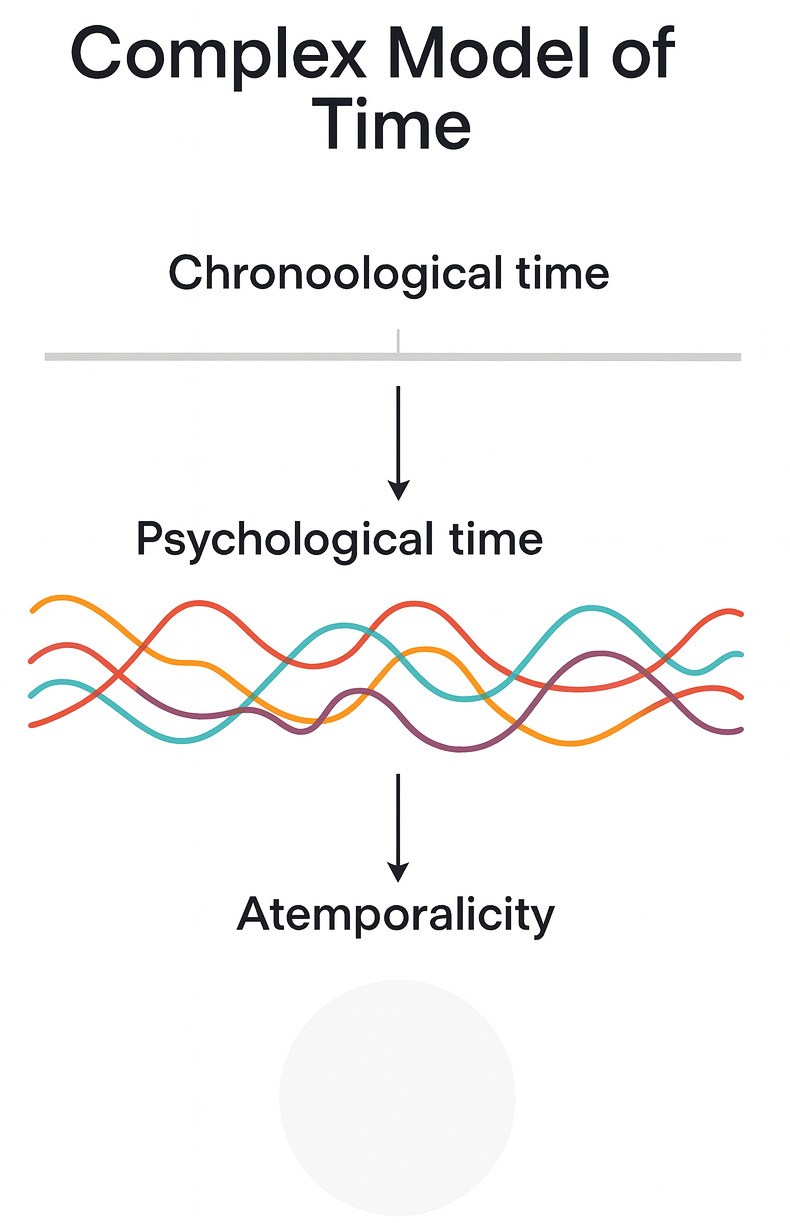
___
The Complicated Model of Chronological Time
The model of time becomes much more complex if we look closely at the chronological (linear) time of an individual person. At first glance, as we have already defined, this is the «external» axis — clocks, calendars, biological cycles, social schedules and institutions. It provides the world with measurability, predictability, and coordination of actions between people. In the therapeutic context, chronological time is above all the sphere of regulation: sleep, nutrition, daily routine, prescriptions, planning, and adaptation to social demands.
However, on closer inspection it becomes clear that chronological time is not a neutral grid. Each person is born at a particular moment of chronos — at a specific time of day, day of the week, season, year, epoch. At that moment, their individual «temporal matrix» is launched — inner rhythms that enter into a complex resonance with the rhythms of the outer world. From that moment on, a person lives not just in time, but in their own time, in a unique combination of biological, social and cosmic cycles.
We can say that at birth each living being receives its own code of chronological time — a unique configuration of rhythms and phases that influences the characteristics of temperament, adaptation, and even susceptibility to illnesses. This is not mysticism, but an empirically observed phenomenon of biorhythmology and chronobiology. As early as F. Halberg (1967) showed, humans have stable circadian, ultradian, and infradian oscillations of physiological and mental functions, forming an individual chronotype. Research by K. Honma and J. Aschoff (Aschoff, 1981; Honma & Honma, 1988) confirmed that the internal «biological clocks» are capable of functioning autonomously, and that their synchronization with external time requires complex adaptation mechanisms.
In clinical practice, the psychotherapist encounters the fact that disruptions of this synchronization — desynchronosis — often underlie anxiety, affective and somatic disorders. Returning to one’s own rhythm of time, aligning internal and external chronos becomes part of therapeutic work. In this sense, individual chronotuning is not only a topic for physiology, but also a phenomenological, existential process of restoring concord between personal and cosmic time.
Therefore, we should speak of «chronological time» not as a single universal continuum for everyone, but as a multitude of unique times woven into the fabric of human life. And whereas astrology tends to turn this uniqueness into a scheme, modern psychology of time can view it as a manifestation of the deep connection between a person and the rhythms of a living Universe.
Network Experience of Time — Yet Another Level of Complexity

An even more complex model of time arises when we begin to take into account the collective dimension of time (Chapter 38), symbolized by the ornament «Knot of Times,» representing the multiplicity and interweaving of collective times. Personal, familial, cultural and epochal time, intertwining, create a field. This is not a linear but a networked and nodal experience of time, in which it is important to distinguish layers and find points of conjunction.
Key Sources
Aschoff, J. — Biological Rhythms (Springer-Verlag, 1981).
A fundamental work by one of the founders of modern chronobiology. The author describes the principles of circadian and other biological cycles, the mechanisms of their synchronization with external factors (zeitgebers), and the adaptation of the organism to changes in the environment.
Klein, David C.; Moore, R. Y.; Reppert, Steven M. — The Suprachiasmatic Nucleus: The Mind’s Clock (Oxford University Press, 1991).
A monograph revealing the neurophysiological basis of human internal time. It shows the role of the suprachiasmatic nucleus of the hypothalamus as the main biological oscillator coordinating circadian rhythms and the body’s physiological processes.
Halberg, Franz. — «Circadian (About Twenty-Four-Hour) Rhythms in Experimental Medicine» (Proceedings of the Royal Society of Medicine, 1967, vol. 60, no. 12, pp. 1423–1440).
A classic study that gave rise to the concept of endogenous biorhythms in humans and animals. Halberg’s work laid the foundation of chronobiology as a science, linking daily oscillations of physiological processes with clinical manifestations and health states.
Honma, Kazuo & Honma, Satoko. — «Human Circadian Rhythms and Sleep: Individual Differences and Their Clinical Significance» (Sleep, 1988, vol. 11, no. 6, pp. 536–547).
A study of individual differences in circadian rhythms and chronotypes. The authors show that variations in sleep and activity timing have distinct psychophysiological significance, influencing emotional stability and a person’s adaptation.
Chapter 5. The Ornamentality of the Temporal Language
Summary
This chapter treats ornament as a full-fledged «language of time»: not only a decorative motif, but a visual and rhythmic grammar that encodes and transmits ways of experiencing time. The chapter develops the idea that ornament manifests far beyond book graphics or embroidery — in architecture and urban planning, in landscape, in product design, in music, dance, text and even in social rituals. We outline provisional correspondences between types of ornament and temporal regimes (1 — chronological; 2 — psychological; 0 — atemporal), discuss methodological risks of universalizing symbolism, and propose practical methods for using ornamental analysis in diagnosis and therapy.
Key concepts
— Ornament — a rhythmically organized visual (and more broadly — formal) pattern that sets the structure of the perception of time and space.
— Ornamental grammar — the set of rules and techniques (repetition, pause, symmetry, asymmetry, crescendo, rupture) that forms the «syntax» of visual temporality.
— Temporal code of ornament — a conventional link between the form of an ornament and a regime of time (chronological, psychological, atemporal).
— Archetype of ornament — stable basic images (meander, circle, mandala) that often carry universal or long-standing meanings of time.
— Ornament in broad culture — the idea that ornamental structures appear in «non-obvious» domains: the city, landscape, movement, sound, text and social behavior.
Aims of the chapter
— To show ornament as a universal way of expressing temporality.
— To broaden the view of where ornament manifests — from graphics to urban structure, design and behavior.
— To describe provisional correspondences «form ↔ regime of time» and clarify the methodological limits of such correspondences.
— To propose practical ways of applying ornamental analysis in the diagnosis of temporal handwriting and in therapeutic interventions.
Main Part
1. Ornament as a Language of Time — From Surface to Structure
Ornament is, above all, a rule of play with rhythm: repetition, interruption, development of a motif, symmetry and dissonance. When we look at an ornament, we do not merely see form — we read rhythm and «tempo»; it sets up expectation, the expectation of the next «breath,» the next pause. That is why ornament functions as a pre-linguistic map of time: it organizes perception even before we verbalize the experience. Understanding ornament as a language of time allows us to place visual form alongside verbal and behavioral manifestations of temporality — this brings together aesthetics, culture and psychotherapy.
2. Three Types of Ornament and Three Temporal Regimes (Provisional Correspondences)
Below are working correspondences that are useful as interpretive hints, not as laws.
— Chronological ornament (1). Motifs with regular metric repetition, meanders, step friezes, grids. They are read as counting, rhythm, meter; they are associated with order, schedules, norms. Examples: classical tiled geometry, regular facades with identical windows, ceremonial colonnades.
— Psychological ornament (2). Flowing, asymmetrical, plant-like patterns in which motifs develop associatively. They reflect inner time — free associations, the «density» of experience. Examples: poetic lines, intricate vegetal ornaments, free melody in folk music.
— Atemporal ornament (0). Closed figures, mandalas, concentric circles, symmetries that symbolize wholeness, presence, a «sudden stop» of chronological counting. Examples: mandalas in religious practice, rosettes on church facades, meditative patterns.
Importantly, ornament often combines regimes — an ornament may contain a strict counting core, a cascade of associative elements, and a center leading toward a state of timelessness (for example, Islamic geometry, where strict symmetry coexists with a sense of infinity).
3. Ornament Beyond the Decorative Field — Where Else the Language of Time Is «Written»
Ornamentality manifests in many domains, often not obviously as a «pattern.» Below are some exemplary domains and specific manifestations:
— Architecture and urban planning. Facades and street layouts, the rhythm of windows and staircases, the modularity of building — all this is the ornament of the urban fabric. A block plan with regular streets creates a chronological rhythm; winding streets «meandering» along the landscape — a psychological one; a central square with concentric layout — an atemporal center.
— Landscape design and rural layout. The division of plots, the regularity of plantings, rows of trees along paths — an ornament of times of day and seasons. Fields oriented to the solar arc «read» the year in the rhythm of vegetation.
— Industrial and product design. Rhythmic grids of ventilation holes, the rhythm of headlights on a car, repeating details of an electronic device — formal principles that create a temporal feeling: a moving car is «read» as directed time, an object with a concentric pattern — as a «point of presence.»
— Text and literary rhythm. Repetitions, anaphora, meter, strobing syntax — ornament in verbal time. A poetic refrain is an ornament of memory; fragmentary, stream-like syntax — an ornament of inner time.
— Music and sound (rhythmic patterns). Meter, beat, repetition of a theme (rhetorical refrain) — chronological ornament; free improvisational melody — psychological; Zen practices with monotonous sounds — atemporal.
— Dance and bodily movement. Repeated steps, choreographic symmetry or improvisational fluidity — visual ornaments that set the tempo of experience.
— Behavior and rituals. Daily rituals (morning coffee, ceremonies and rites) — ornaments of the chronological type; family stories, stable rhetoric — narrative ornament; collective mysteries — atemporal ornaments.
— Social media and digital interfaces. News feeds, algorithmic repetitions, cyclical notifications — a new kind of ornamentality shaping the modern «temporal handwriting» (acceleration, fragmentation, cyclicity).
— Individual artistic production. Drawings, dream journals, autobiographical masks — ornamental imprints of a person’s temporal handwriting.
These examples show that ornamentality is not only an aesthetic property, but also a behavioral, planning and technological characteristic of a culture.
4. Methodology of Ornamental Analysis in Temporal Psychology
How can we work with ornament clinically and in research?
— Collecting material. Gather visual samples (the client’s drawings, objects, ornaments in the home), auditory samples (favorite music, speech rhythms), spatial samples (layout of the dwelling, routes of movement) and textual samples.
— Analysis on the 1/2/0 scales. For each sample, note the predominant structural features: meter/repetition (1), flow/association (2), center/symmetry (0). It is necessary to record multidimensionality — one sample can have several labels.
— Comparison with temporal handwriting. Compare ornamental features with the results of temporal handwriting scales (ch. 1) — convergences may support the hypothesis of a visual expression of temporal handwriting.
— Intervention through ornament. Therapeutic techniques: inviting the client to recreate an ornament (drawing, mandala), changing rhythm in daily rituals (introducing regular «chronological» steps or, conversely, practices of free association), using ornamental meditations (mandalas, repeated sounds).
— Ethical and cultural reflection. Always consider cultural context; do not assign universal meanings without checking with the client; use ornament as an instrument of dialogue, not as a diagnosis.
5. Brief Clinical and Cultural Cases
— Clinical case 1. A patient stuck in the past draws repeating meanders and geometric friezes; the intervention is to introduce «vegetal» ornament into a creative task and to work with images of the future, which leads to expanding the temporal perspective.
— Urban planning cases. A city with a regular street grid shows a high level of chronological predictability in its inhabitants (schedule regime), whereas labyrinth-like layouts foster other forms of temporal experience (richer inner fantasy and «local» time).
— Product design. A car with regularly repeating elements is perceived as «reliable,» while organic, streamlined forms evoke a feeling of «time of movement» and emotional involvement.
6. Limitations, Critique and Rules of Caution
— Cultural conditioning. Interpretations of patterns are sensitive to context: what in one culture is read as atemporal may in another simply denote group belonging or status.
— Risk of reduction. Do not reduce a person to a single ornament; ornament is one element in a contextual palette.
— Empirical testing. Ornamental analysis requires systematic comparison with behavioral and self-report data; without this, interpretations remain hypotheses.
— Ethics. Do not use ornament to stigmatize; work with the client in a spirit of co-investigation and consent.
Practical Recommendations (Briefly)
— When diagnosing temporal handwriting, collect simple visual data: a drawing, a pattern on clothing, a room plan.
— Ask the client to describe why they choose a particular pattern — this is important verbal integration of visual material.
— In the therapeutic exercise of «recoding handwriting,» invite the client to create an ornament by changing a single element in it (from strict → flowing → closed) and discuss the felt changes.
— In a group — practices of collective creation of mandalas or ornamental paintings to integrate collective temporal experiences.
Literature
Gasparov, B. M. — Literary Leitmotifs: Essays on Russian Literature of the 20th Century (year of publication to be specified at layout).
The book analyzes devices of repetition, variation of motifs, and structural cycles in literary texts — all of which can be transferred into the visual plane as the «ornament of language.» Particularly important are the observations on how leitmotifs organize the temporal extension of a work, how repetition becomes a marker of meaning, and how textual «patterns» relate to the reader’s experience of time. Practical use in temporal psychology: methods for analyzing patients’ narratives and creative products for ornamental repetitions and temporal motifs.
Gurevich, A. Ya. — Categories of Medieval Culture (1985 and later editions).
A study of the rhythms and symbolic structures of medieval worldview: liturgical cycles, architectural ornamentation, the syntax of sacred space. These observations are valuable for understanding ornament as a universal form of organizing time — not only in fabric or book patterns, but also in the layout of churches, cities, calendars and rituals. Gurevich’s work supports the idea of the widespread presence of temporal ornament in material and spiritual practices.
Kravchenko, S. A. — ASC and AI — 2. The Book of the Bridge (2025).
An author’s work directly related to the topic of this chapter. The book provides a methodological platform for correlating ornament and temporal layers of the psyche, as well as practical cases and exercises. It proposes the notion of a «bridge» — intermediate symbolic practices that translate the experience of timelessness into an integrable psychological resource. For this chapter, the book serves as an applied foundation: examples of protocols for analyzing drawings, masks and city plans as ornamental imprints of temporal handwriting.
Losev, A. F. — The Dialectics of Myth (classical editions of 1949–1960s and reprints).
A philosophical–mythological theory of symbol and myth as forms of temporal meaning-formation. Losev shows that myth and symbol shape archetypal rhythms — cycles, returns, centers — which in culture become models of time. These ideas allow us to treat ornament not as a decorative form but as a representation of mythical time and «atemporal» meanings, later entering personal handwriting and collective scripts.
Eliade, M. — Images and Symbols and related works on symbolism (1950s–1980s).
A classic of religious and symbolic anthropology. Eliade explores universal archetypes (circle, mandala, axis mundi), explaining why certain ornamental forms are perceived as eternal. For temporal psychology, these ideas serve as a theoretical background: they reveal the role of symbols in creating experiences of participation beyond linear time. A practical conclusion: an ornament that evokes a «mandala-like» impression may point to a tendency toward atemporal experiences and the search for inner wholeness.
Conclusion
Ornament is a powerful diagnostic and therapeutic resource: it reflects, shapes and supports the temporal regimes of personality and culture. Expanding the notion of ornament beyond the decorative field opens new perspectives for temporal psychology — from the analysis of individual drawings and everyday rituals to the study of urban fabric and design as large-scale «ornamental texts of time.» At the same time, any interpretations require cultural sensitivity, empirical verification and clinical caution.
___
The Appendix to Chapter 5 contains the test «Ornament and the Language of Time.»
___
Conclusions of Part I
Brief Conclusions of Part I — «Foundations and Principles»
— Time in the psyche is not only an external scale, but also an inner fabric of experience. Temporal characteristics (duration, tempo, retention/protention) shape affective tones, semantic accents and the structure of personality.
— The operational category of «temporal handwriting» has been introduced. Handwriting is a stable, individually colored way of experiencing time, a product of the interaction of biological, sociocultural and archetypal rhythms.
— Temporal handwriting mirrors personality typology, but is not reducible to it. Introversion/extraversion set the vector of sensitivity (inner vs external rhythms), but handwriting is more complex: it includes tempo, rhythm-sensitivity, a tendency toward atemporality, and patterns of transition between temporal regimes.
— External rhythms (daily, lunar, seasonal, multi-year) are a real context of temporality. They influence the states and clinical manifestations of personality; taking them into account increases diagnostic accuracy but requires methodological caution in interpreting correlations.
— Altered states of consciousness (ASC) mark the «threshold» of going beyond ordinary temporal conditioning. ASC can redistribute the weight of past/present/future, open access to atemporal experiences and become either a resource or a risk — depending on preparation and integration.
— Temporality is reflected in cultural objects — above all in ornaments and temporal «fonts.» Visual and verbal codes carry pre-linguistic schemas of time and can serve as additional diagnostic and therapeutic tools (with cultural context in mind).
— The proposed ternary metaphor (1 — chronological; 2 — psychological; 0 — atemporal) is a useful working tool. It simplifies mapping temporal regimes and designing interventions, but requires elaboration and operationalization for empirical verification.
— Methodological and ethical caution is mandatory. Metaphors and cultural interpretations expand our view, but clinical and scientific claims need prospective testing, preregistration of hypotheses and clear criteria of readiness for interventions.
Transition to Part II — «Dimensions of Time and States of the Psyche»
In Part I we have laid the theoretical and methodological framework: the concept of temporal handwriting, levels of external rhythms, the role of ASC, and the ideas of temporal fonts and ornaments. The next part shifts the focus from the philosophical–systemic map to concrete dimensions of experience: how past, present and future are «inscribed» into the structure of consciousness, which states and regimes of time can be empirically distinguished, and which manifestations of these dimensions are important for practical psychotherapy.
In Part II we will sequentially examine each dimension of time in the psyche, describe the corresponding states (including clinical patterns and ASC), and propose diagnostic and therapeutic tools — from scales and questionnaires to exercises and protocols of integration.
Section 2. Dimensions of Time and States of the Psyche
In Section 2 we move from the general picture of temporal psychology to concrete dimensions of time and their significance for life and the psyche. The reader is presented with five interconnected chapters:
— Chapter 6. The Past and the Memory of the Unconscious — about how the past is stored not only in recollections, but in bodily patterns, family scripts, cultural fonts and epigenetic imprints; about methods of reading this field and its significance for therapy.
— Chapter 7. The Present: Here and Now (the Temporal Language) — about the nature of the «here and now,» how the present is constituted in consciousness, and what practices help to strengthen contact with the present as a therapeutic anchor.
— Chapter 8. The Future: Precognition and the Condensate of Temporal Crystallisation (TTC) — about different layers of the future (probable, possible, desired, premonitory), about phenomena of premonition, and about how «temporal condensates» are formed that give life its direction.
— Chapter 9. Eternity as a Psychological Phenomenon — about resourceful experiences of connectedness and meaning, about distinguishing transcendent experience from clinical risks, and about methods of safely integrating experiences of eternity.
— Chapter 10. Timelessness and Atemporality — about the opposite of eternity: the experience of emptiness, loss of perspective, temporal disintegration; about mechanisms, clinical severity (including suicide risk) and intervention algorithms.
These chapters do not simply follow one after another — they intersect and complement each other, because the psyche never lives «in a single layer» of time: past, present and future are always intertwined, and between them there may be both resourceful and pathological exits beyond linear flow.
The Past — a Field Irreducible to Memory
In our model, the past is not just «what once happened.» It is a multilayered field: neural and somatic traces, family and cultural scripts, objects and rituals, myths and oral stories. Memory is one of the mechanisms through which this field manifests itself in consciousness; but the field itself sets the contexts and meanings in which recollections gain their power. That is why in clinical work with the past it is important to look beyond isolated episodes: where does the past «reside» — in the body, in language, in routine, in family scripts?
The Unconscious — a Multitemporal Space
The unconscious contains traces of the past and seeds of the future simultaneously. It is inhabited by motivations and premonitions, archetypal patterns and somatic impulses that guide behaviour before we become aware of them. To treat the unconscious only as a «source of the past» is correct but incomplete; its multi-temporal nature makes it a crucial arena for understanding how past and future interact in the present.
The Present — Not a Point, but a Process
The «here and now» is a node where the retention of the past and the protention of the future meet, where temporal handwriting is formed. The present is rarely a «pure» instant; more often it is a fluid integration of multiple temporal layers. It is precisely in the present that we measure meaning, make decisions and undergo transformations; both the stability of personality and its capacity for change depend on the quality of contact with the present.
The Future — a Multi-layered Field of Attraction
The future includes the probable (timetables, forecasts), the possible (alternatives), the desired (goals) and the premonitory — those unconscious attractions that may work more strongly than formal plans. Therapeutic work may be directed both toward structuring the future (planning, steps) and toward exploring the «proto-future» — those unmotivated yet significant pulls that shape choices here and now.
Eternity and Timelessness — Two Different Paths «Outside Time»
The section deliberately devotes attention to two different modalities of «out-of-time» experience. Eternity is a resourceful experience of wholeness, connectedness and meaning; it can support the personality. Timelessness (Bezvremenye) is a state of loss of perspective and meaning, emptiness and a «stoppage» of time; clinically, this phenomenon is particularly dangerous: the loss of a sense of future is one of the key factors increasing suicide risk. In the following section we analyse in detail the differences, mechanisms of emergence and intervention strategies.
Field Observations: Extreme Environments as a «Natural Laboratory»
Experience from work in capsule and extreme conditions (underwater projects such as NEEMO, long-term isolation in Antarctica, space analogs) provides important empirical support. Under prolonged sensory deprivation, sleep disruption and restricted stimuli, not only duration estimates change: the entire temporal perspective is transformed. Participants describe a pendulum movement — saturated past → stretched surreal present → intensified premonition of the future → episodes of «out-of-time,» when the sense of «I am here» dulls. The mechanisms are multifactorial: sleep and circadian disruption, monotony, physiological influences (pressure, gas composition), mental exhaustion and pre-existing vulnerabilities (dissociation, trauma). These observations reinforce our stance: changes in the experience of time are not mere poetic metaphors, but clinically relevant markers of adaptation/maladaptation.
Methodological Conclusion: Combine Subjective and Objective
When working with temporal dimensions, attention must be distributed between:
— the subjective map (temporal handwriting, narratives, diaries, questionnaires);
— behavioural metrics (actigraphy, sleep logs, EMA — ecological momentary assessment);
— physiological markers (HRV, sleep, and where necessary — short EEG recordings).
Only a combined approach allows us to distinguish adaptive temporal shifts from pathological ones — and to set clinical priorities correctly.
Practical Task of Section 2
Our task is to provide the reader with tools for reading the temporal field of personality: how to recognize where the past «resides,» to what extent the present constricts or loosens the personality, which levels of the future are active, and where the risk of Timelessness arises. This implies both diagnostic schemes and therapeutic strategies — from rhythm stabilisation to deep integration of meanings and work with altered states of consciousness.
Key Literature for Section 2
Droit-Volet, S., Meck, W. H., et al. — Reviews in Experimental Psychology of Time.
Contemporary work on quantitative measurement of subjective time and analysis of distortions in its perception (effects of compression and dilation of duration). These methods are applicable to clinical diagnosis of disorders of temporal experience and empirical testing of therapeutic hypotheses.
Freud, S. — The Interpretation of Dreams (1900).
A classic study of the role of the unconscious past in shaping dream symbolism. The work is important for narrative psychotherapy, as it reveals how hidden memories and repressed images continue to operate in present time.
Husserl, E. — The Phenomenology of Internal Time-Consciousness (lectures ca. 1905).
The philosophical foundation of all temporal psychology: analysis of retention, protention and the act of «now» as elements of the structure of consciousness. It provides a basic scheme for understanding how the psyche experiences duration and forms a sense of sequence.
Joiner, T. — Why People Die by Suicide (2005).
A monograph integrating cognitive, existential and interpersonal approaches to understanding suicidal behaviour. It is especially valuable for temporal psychotherapy as a model of loss of future and the experience of timelessness leading to a crisis of meaning.
Jung, C. G. — Selected essays on the collective unconscious and synchronicity (20th c.).
Classic texts introducing the concepts of archetype and synchronicity as mechanisms of connection between internal and external temporal events. They serve as a theoretical resource for working with archetypal layers of the psyche and building semantic «bridges» between temporal fields of personality.
Studies on NEEMO, Antarctic missions and space analogs — NASA and ESA reports and reviews.
Empirical materials describing transformations of time perception, sleep and interpersonal dynamics under conditions of long-term isolation and sensory deprivation. These data are useful for developing methodologies of observation and understanding external triggers of changes in temporal experience in extreme environments.
This section is a bridge between philosophical reflection on time and applied clinic: it offers both a map and tools. In the chapters that follow we will unpack each dimension step by step: from the past fabric of the unconscious to practices that help restore people’s sense of future and protect them from the danger that Timelessness carries.
Chapter 6. The Past and the Memory of the Unconscious
The past remains the past only until we remember it. At that moment it becomes part of the present.
(By analogy with the epigraph about the future: The future remains the future only until it is planned.)
Summary
The past is not a frozen layer; it lives within us as an active force. It manifests in subpersonalities, images, bodily reactions, cultural scripts and even in epigenetic predispositions. The memory of the unconscious is not only recollections but also recurring dreams, archetypes, bodily symptoms, family plots and cultural «fonts» that continue to rewrite the present. In psychotherapy, work with the past makes it possible to translate hidden influences into language and dialogue, and thus to change the present and open the future.
Key Concepts
— Primary past — that which is actively alive in the soul, influencing feelings, actions and meanings.
— Memory of the unconscious — manifestations of the past in dreams, images, bodily reactions and cultural scripts.
— Subpersonality — a part of the personality that carries the imprint of a particular temporal layer or role.
— Font of time — a system of symbols (personal, cultural, archetypal) through which a person perceives and expresses the past.
— Ancestral memory — epigenetic and cultural traces of the ancestors’ experience that influence their descendants.
Aims
— To show that the past is not only history but an active psychic reality.
— To examine the main mechanisms by which the past influences the present.
— To formulate methodological approaches for working with the memory of the unconscious.
— To provide clinical examples («cases») and demonstrate techniques for their therapeutic processing.
— To outline ethical boundaries and limitations in working with themes of the past and the family line.
Main Text
We begin with an axiom tested by practice and patient attention: the past does not necessarily remain «in the past». The past that is actively present in the soul — what we have called the primary past in this book — lives within us as an active force and rewrites the present on a daily basis. To become aware of this is to gain the possibility of entering into dialogue with it; to remain unaware is to allow the past to continue conducting our feelings, actions, meanings, perspectives and fate.
1. The Past as a Living Architecture of the Psyche
The past is not a warehouse of forgotten dates and facts; it is a multilayered structure: archives of memory, rhythms, portraits and ornaments that interact both with one another and with the living present. We imagine it as a «world of the past» — an ocean with currents and bays, in which some images are submerged deep, while others surface as dreams, bodily reactions or sudden feelings. These surfacings are what we call the memory of the unconscious.
2. Main Mechanisms of the Past’s Influence
Clinical work shows several reliable pathways by which the past takes hold of the present. For the therapist it is important to see them and know how to work with them.
Subpersonalities.
Inner «parts» — the child, the guardian, the aggressor, the ideal — often bear the imprint of specific temporal layers. A subpersonality may be the «carrier» of a biographical episode, a role prescription or a family script. Dialogue with a subpersonality is not a mere hypothesis but a working method: by giving each part a voice, we translate the uncontrollable into the conscious.
Imaginal memory (dreams, portraits, cultural images).
Recurring dreams, faces in portraits, «ideal images» from culture (idols, heroes) — all these form the «fonts» of meaning by which a person describes time and self-in-time. These images are bridges between individual experience and collective memory.
Bodily memory.
Rigidity, automatic reactions, somatic triggers — the body «remembers» differently from consciousness. Interventions that ignore the body leave the past functioning «in the body», i.e., they preserve symptoms.
Cultural and familial stereotypes and rituals.
Family scripts, religious rituals, social myths — they form the very «fonts» by which the personality writes its own story. The denser the familial or cultural field, the greater the risk that a person will replicate someone else’s meanings and present them as their own.
Epigenetic «ancestral memory.»
Contemporary research shows that severe stress events in ancestors can leave marks in the gene expression of descendants. This is not «fate» but a predisposition — a biological fabric upon which psychological and cultural scripts are laid. Clinically this may manifest as heightened reactivity, a tendency toward anxiety or reduced stress tolerance that easily «hooks onto» family subpersonality patterns. Mentioning epigenetics gives us another bridge — from biology to narrative — and requires careful, non-reductionist interpretation.
3. The Classics and Their Contribution: From Personal Unconscious to Collective Memory and Bodily Trauma
Work with the past in psychotherapy cannot rely on a single theoretical tradition. Each approach contributes its own layer of understanding — from the unconscious to collective structures, from cognitive processes to bodily memory.
Personal unconscious and trauma.
Freud showed that repressed childhood events return in dream symbols and neurotic symptoms (Freud, 1900). His discovery made the past a key field of analysis. Janet studied dissociation and demonstrated that fragments of memory can exist autonomously in the psyche, forming hysterical symptoms (Janet, 1907). Bowlby complemented this line with attachment theory, revealing how early relationships with parents shape stable models of experiencing self and others (Bowlby, 1969). Taken together, these approaches allow us to see the past not only as an archive of events but as a living force shaping personality structure.
Collective and cultural.
Jung broadened the horizon by introducing the concept of archetypes and the collective unconscious, where individual experiences are interwoven with universal myths and symbolic «fonts» (Jung, 1959). Halbwachs demonstrated that memory is always social and organised by cultural frameworks (Halbwachs, 1950). Ricoeur added a philosophical stratum: the past is never given directly; it always passes through interpretation, memory and forgetting (Ricoeur, 2000). In therapy this means that work with the past must take into account not only personal recollections but also the language of culture in which they are shaped.
Cognitive science of memory.
Tulving divided memory into episodic and semantic, which allowed a more precise grasp of the difference between «lived experience» and its narrative (Tulving, 1983). Schacter showed the reconstructive character of memory and described the «seven sins of memory» — distortions that a therapist must take into account (Schacter, 1996). Loftus demonstrated the existence of false memories, highlighting the ethical risks of uncritical suggestion (Loftus, 1993). These findings make work with the past more cautious: the therapist must differentiate a living recollection from a construct that may be created in the course of therapy.
Body and trauma.
Contemporary psychotherapy increasingly turns to bodily memory. Van der Kolk demonstrated that trauma is stored not only in words but also in bodily reactions (van der Kolk, 2014). Yehuda studied the epigenetics of stress and the intergenerational transmission of traumatic experience (Yehuda & Lehrner, 2018). These data remind us that the past may be inscribed in the body and even in biological inheritance, which requires specific methods from the therapist — work with breathing, movement and somatic awareness.
Integration of subpersonalities.
Assagioli proposed psychosynthesis as a practical technology of dialogue with parts of the personality (Assagioli, 1965). His approach helps integrate fragmented subpersonalities and rework traumatic experience. For temporal psychotherapy this is particularly important: parts of the «I» stuck in the past can be brought back into dialogue and included in the person’s wholeness.
Bringing the traditions together.
In our practice we combine these lines:
— we recognise personal trauma and mechanisms of dissociation (Freud, Janet, Bowlby),
— we take into account the collective background and cultural codes of memory (Jung, Halbwachs, Ricoeur),
— we rely on cognitive science to understand the reconstructive nature of memory (Tulving, Schacter, Loftus),
— we include work with the body and intergenerational transmission (van der Kolk, Yehuda),
— we use psychosynthesis techniques to integrate subpersonalities (Assagioli).
Such a multilayered approach allows the therapist to see the client’s past not as a «static archive» but as a living, multidimensional field where personal recollections, cultural myths, bodily traces and family history intersect.
4. Illustrations — Case Vignettes from the Author’s Book The Primary Past
Below are several examples from the author’s book The Primary Past, each with a brief plot and clinical annotation: what the case shows and how to work with it.
Case A. A Dream about Alexander Abdulov — a Cultural Ideal Within the Personality
Plot. In a dream the image of the actor Abdulov appears: he passes a «control check,» receives forgiveness and acts as an on-screen hero who permits or evaluates the behaviour of entrenched characters.
What this illustrates. A cultural image (a generational ideal) becomes an «embedded voice» that dictates standards and restrictions. For the client, this image may play the role of an internal critic or ideal to which they strive, losing their own face.
Clinical annotation. Work through: (1) exploring the «font» — what values and criteria the image brings; (2) mask-therapy/portrait work — materialising the image, discussing its demands; (3) dialogue with the «idol» subpersonality, separating «what is mine» from «what is adopted». Recommendation: carefully dose interventions — transference may intensify, so stabilisation prior to deep work is essential.
Case B. Dialogue with «Lenin» — a Historical Font Implanted in the Soul
Plot. In a dream/dialogue the author converses with the image of Lenin about culture, power and the fate of society. This image functions not as a historical fact but as an active moraliser and censor in his psyche.
What this illustrates. Political and ideological artefacts become subpersonalities: they judge, prohibit, prescribe. For many clients such «leader-figures» inside are sources of behavioural style and meaning.
Clinical annotation. Approaches: (1) systemic mapping — identifying the political-historical «fonts» that influence the request; (2) broadening context — bringing in family history and public rituals; (3) careful desacralisation — translating the «leader» into a part one can negotiate with. Ethical note: such interventions may provoke conflict with relatives/environment — prepare a safety plan.
Case C. «The Big Letter to a Woman» — Family Plots and Role Multiplicity
Plot. A series of sketches — the Cossack Woman, the Princess, the Concubine, the Muse — shows how these roles are «worn» by a modern woman, dictating feelings and scripts. The author observes that the image of an ancestor or role prototype can «invert» a family knot.
What this illustrates. Family scripts and archetypal roles are easily transplanted into modern life, creating identity conflicts.
Clinical annotation. Methods: (1) mapping family archetypes (who in the family is the «Cossack Woman,» the «Muse,» etc.); (2) the boundary of «mine/not mine» — exercises that return authorship of choice; (3) if needed — a family or systemic session to rework the script. Important: not to destroy the memory of the family line, but to restructure its meaning.
Case D. Experiment with a Portrait (the Leonardo da Vinci Effect) — Portrait as a Key to Access
Plot. Prolonged concentration on Leonardo da Vinci’s portrait led to a series of dreams and images that gave the author a felt sense of «temporality» and of the artist’s personality; the author calls this the «effect»: the portrait became an access code to temporal dimensions.
What this illustrates. A portrait or art object can function as a tool for activating deep memory; in mask-therapy a client’s portrait often evokes material from their past.
Clinical annotation. Recommendations: (1) use portraits as «triggers» within a safe frame; (2) document the material that arises (dreams, associations); (3) integrate via artistic actions and rituals of completion; (4) consider the risk of over-activation — stabilising techniques are mandatory.
5. Methods of Access and Working Protocols
We distinguish several methodological lines that are flexible and can be combined depending on the situation:
— Dream work. Systematic recording, search for ornaments, translation of symbols into narrative.
— Dialogue with subpersonalities. A structured approach: identification → encounter → agreements → integration.
— Mask-therapy and portrait work. Materialising the image as a field for negotiation and reconstruction of meaning.
— Regression and hypnotic techniques. Effective but require strict criteria of readiness, stabilisation and monitoring.
— Creative reconstruction and rituals. Safe symbolic actions to reframe knots of the past.
A brief working protocol (practice-oriented algorithm):
— Screening of readiness (sleep, risk, stability).
— Stabilisation (anchors, breathing, journaling).
— Mapping/portrait in time (a visual map: nodes, fonts, ornaments).
— Accessing material (method selection).
— Integration (art, ritual, behavioural change).
6. Ethics, Limitations and Notes on Epigenetics
Work with the past is at once an opportunity and a risk. It requires: informed consent, transparent goals, monitoring, and a plan in case of destabilisation. When we touch family themes and mention epigenetics, it is important to explain to the patient: this is not a sentence but a factor of heightened sensitivity that can be taken into account in planning therapy. When family themes are involved, systemic work is sometimes necessary — one cannot act in a vacuum.
Conclusion. The Past as a Tool for Changing Time
We have drawn a line from the classic concepts of Freud and Jung to contemporary practical techniques of mask-therapy and dialogue with parts. But the main conclusion is simple and practical: by working with the past, we change the present — and thereby open a different future. The past ceases to be a dark prison cell once we translate it into language: temporal handwriting, fonts and ornaments become intelligible, the map of time becomes readable, and the portrait of the personality in time becomes a tool for navigation. With this vocabulary and craft we move on to the practice of temporal psychotherapy.
References
Assagioli, R. Psychosynthesis: A Manual of Principles and Techniques. Hobbs, Dorman & Co., 1965.
A practical source on working with subpersonalities and inner dialogue. The psychosynthesis method provides tools for structuring encounters with «parts» of the personality and for translating image-captured subpersonalities into negotiable, integrative processes.
Bowlby, J. Attachment and Loss. Vol. 1: Attachment. London: Hogarth Press, 1969.
A foundational work on how early relationships shape internal working models. It is useful for explaining why past emotional bonds continue to «live» in the present and how attachment styles create specific temporal templates.
Freud, S. Die Traumdeutung. Leipzig; Vienna: Franz Deuticke, 1900.
The source work on dream analysis and its relation to unconscious processes. It provides a methodology for interpreting dream-ornaments of the past and for reading the symbolism of inner experience.
Grof, S. Beyond the Brain: Birth, Death, and Transcendence in Psychotherapy. 1985.
A classic of research on altered states of consciousness and transpersonal experience. Valuable both as a description of the phenomenology of «out-of-body» experiences and as a source of methodological cautions and support protocols.
Halbwachs, M. La mémoire collective. Paris: Presses Universitaires de France, 1950.
A sociological theory of collective memory and its mechanisms. Key to understanding how historical images «outlive» their carriers and become available to subsequent generations as cultural subpersonalities.
Janet, P. The Major Symptoms of Hysteria. New York: The Macmillan Company, 1907.
An early clinical work on fragmentation of the psyche and psychological automatisms. It offers a historical and conceptual basis for understanding dissociative phenomena and «fragments» of the past that function autonomously.
Jung, C. G. The Archetypes and the Collective Unconscious. Princeton: Princeton University Press (Collected Works, Vol. 9), 1959.
The classic source on archetypes and collective images. It explains the phenomenon of «doubles of historical figures» as cultural and mythological fonts that gain personal actuality in therapy and art.
Kluft, R. P. Selected Papers on Dissociation. Collected volume.
Contains clinical observations and analyses of the etiology of dissociation, including the distinction between spontaneous and iatrogenic forms. Indispensable for differential diagnosis of phenomena of «the past as subpersonality» and for assessing the risk of therapeutic suggestion.
Kravchenko, S. A. The Primary Past: Psychology of the Dimensions of Time. Izdatel’skie Resheniya, 2018.
A monograph focused on the phenomenon of the «primary past» — that layer of experience which remains active in the present and shapes behavioural and emotional scripts. The book integrates clinical observations, case studies, methods (dialogue with parts, mask-therapy, dream analysis, work with ASCs) and ethical principles. It serves as an applied complement to the theoretical foundations set out in the first part of the present book.
Loftus, E. F. «The Reality of Repressed Memories.» American Psychologist, 48 (5), 518–537, 1993.
A critical study of the phenomenon of false memories and therapeutic suggestion. Essential for discussing methodological caution and ethics in working with recollections and «emergent» past material.
Putnam, F. W. Diagnosis and Treatment of Multiple Personality Disorder. New York: Guilford Press, 1989.
A classic practical text on the diagnosis and therapy of multiple personality disorder (DID). Useful as a guide to structuring therapy in pronounced dissociative conditions and for comparative analysis with historical subpersonalities.
Ricoeur, P. La mémoire, l’histoire, l’oubli. Paris: Seuil, 2000.
A philosophical analysis of memory and history, rich in hermeneutic tools. It helps to reflect on the ethical and meaning-related consequences of working with the past, linking individual, cultural and historical memory.
Schacter, D. L. Searching for Memory: The Brain, the Mind, and the Past. New York: Basic Books, 1996.
A study of the reconstructive nature of memory and its neurobiological underpinnings. Useful for explaining memory distortions, limitations of episodic reconstruction and therapeutic work with «memories that create meaning.»
Tulving, E. Elements of Episodic Memory. Oxford: Clarendon Press, 1983.
Theoretical foundation for distinguishing episodic and semantic memory. Necessary for differentiating «lived» past from socio-semantic fonts that form historical subpersonalities.
van der Kolk, B. The Body Keeps the Score: Brain, Mind, and Body in the Healing of Trauma. New York: Viking, 2014.
A contemporary synthesis of practices and research on somatic memory of trauma. Essential when working with intense transpersonal experiences and «residual» states after deep ASCs; contains stabilisation techniques and bodily integration methods.
Yehuda, R., & Lehrner, A. «Intergenerational Transmission of Trauma Effects: Putative Role of Epigenetic Mechanisms.» World Psychiatry, 17 (3), 243–257, 2018.
A contemporary review of data on intergenerational transmission of trauma and the possible role of epigenetics. Provides a cautious scientific basis for clinical hypotheses about «ancestral memory»; emphasises the need for careful interpretation and further research.
Chapter 7. The Present: Here-and-Now (Temporal Language)
Summary
The present is viewed not as an empty pause between past and future, but as an active node where their traces, projections, and unconscious attractions converge. This chapter integrates phenomenology (the imaginal, bodily, and collective content of the «here-and-now»), neuroscientific data on pre-activation and reconstruction, and clinical practices — from dialogue with the unconscious to mindfulness and somatic anchors. The practical aim is to give the therapist a working map for reading the present and a set of methods that allow the «here-and-now» to become a field of choice and integration.
Key Concepts
Present — not a point-like moment, but the «assembly point» of the psyche, a node where the past, the future, and atemporal meanings condense.
Temporal language — the set of images, rituals, bodily patterns, and cultural «fonts» that shape how the present is experienced.
Prospection — the neurocognitive capacity to use the same networks involved in remembering to generate scenarios of the future; it reveals the tight link between past, future, and present.
Pre-activation / readiness potential — a neurophysiological phenomenon showing that part of our decisions and actions is initiated unconsciously before reaching awareness.
Proto-future — unconscious attractions toward the future that shape choice before explicit goals are formulated.
Anchors of presence — somatic and sensory techniques that help maintain the boundaries of the «here-and-now» and integrate insights.
Goals of the Chapter
— To justify the idea of the present as a multilayered field formed by images of the past, attractions of the future, and bodily rhythms.
— To show how neuroscientific data (pre-activation, memory/prospection networks) influence the therapist’s clinical stance.
— To propose an integrative clinical strategy: depth work + neuroscience + practices of presence.
— To offer concrete practical steps and techniques for reading and working with the present.
Introduction: Why «Here-and-Now» Is Not Trivial
Past, present, and future are not three separate planes but a braided knot of experience; the clinical key is to learn how to read that knot. Jung showed that the present often appears in the form of images stitched to collective «fonts» — archetypes and myths; by listening to these images, the therapist unravels the meanings that are governing choice and action right now.
Neuroscience adds humility and precision: Libet’s classic experiments and subsequent fMRI studies showed that part of the preparation for action and choice is initiated unconsciously. This does not abolish free will, but forces us to admit that many of our current decisions are «begun» before a conscious intention appears.
The concept of prospection (Schacter and colleagues) suggests that the networks involved in remembering are also used to imagine the future — therefore, the present is a fusion of traces of the past and projects of the future. Practically, this means that working with memories and working with representations of the future are not two separate exercises but a single intervention that reconstructs the attractions shaping behaviour «now».
Finally, the empirical medicine of presence (mindfulness programs, Davidson’s research, and others) shows that training attention changes regulatory networks, improves stress reactivity, and strengthens the capacity to remain resourced in the present. This is both an instrument and a test: deep insight without skills of presence often leads to disorientation; presence makes insight workable.
1. What Is the «Present» in a Clinical Context?
The present is not a simple temporal mark between «before» and «after». It is the assembly point of the psyche — the space where:
— images and imprints of the past converge (memories, subpersonalities, bodily reactions),
— attractions of the future are at work (goals, fears, proto-future),
— social and cultural fonts set expectations,
— current bodily states and rhythms unfold.
The experience of «here-and-now» is the foundation for therapeutic reconfiguration: it is the place where meanings can be revised and choice can be born.
2. Images of the Past in the Present
Images of the past shape habits, reactions, and ways of sensing the world. They come as dreams, flashbacks, bodily impulses, and the lines spoken by subpersonalities. Working with them means translating automatism into the field of conscious dialogue:
— identifying the «main past» — the layer that most actively rewrites the present;
— working with the content of images (retelling, mapping, portraiture);
— translating the image into a contract: «What do you want? How do you serve me? What happens if I give you a different place?» (approaches of mask-therapy, psychosynthesis).
3. Future in the Present: From Goals to Proto-Future
Images of the future are not limited to plans and goals: in the body and in expectations live unconscious attractions that we call proto-future. They may lead to adaptive planning or to repetitive enactment of compensatory scenarios (for example, attempts to «rewrite» a loss in the past through future achievements). The therapist:
— differentiates explicit goal-setting from hidden attractions;
— uses techniques of future modelling and prospection (visualisation, working with possible scenarios) to make the unconscious future available for reflection;
— employs «dialogue with the future» as a tool for reshaping motivation and meaning.
4. Neuroscience of the Present: Pre-Activation and Prospection
Neuroscientific findings demand reflective modesty: many acts and choices have an unconscious start (readiness potential), and the networks used for memory also participate in imagining the future. Practical implications:
— The therapist recognises the limits of conscious control and includes techniques that help slow down the impulse (breathing regulation, pauses, «time-outs» before decisions).
— In interpreting behaviour, pre-activation is considered: sometimes «behaviour now» is the result of a process already underway unconsciously; the task is to bring this into the field of speech and choice.
5. Practices of Presence as a Tool of Integration
Mindfulness, bodily anchors, sensory exercises, and rituals help maintain boundaries: they make it possible to integrate a felt image and apply an insight without collapsing into uncontrolled flight of the unconscious or, conversely, into avoidance. It is important to:
— choose simple, repeatable anchors (breath, feet on the floor, naming objects in the environment);
— combine work with content (dialogue, interpretation) and work with form (attention, body).
6. Pathological Present and Diagnostic Shifts
A pathological «here-and-now» manifests as:
— fixation on the past (rumination, intrusive flashbacks),
— a constant loop of expectations and anxiety,
— blurred boundaries of the self (meaninglessness, disorientation, atemporality),
— dominance of a single subpersonality that «silences» other inner voices.
A diagnostic shift is proposed: instead of only asking «What is today’s date?» we might ask, «Which dimension of time is dominating your present?» — this moves the assessment into a clinical and therapeutic register.
7. Temporal Handwriting and Societal Fonts of Time
Each person lives in a particular tempo — a temporal handwriting (fast/slow, cyclic/linear). On top of this, societal fonts (media tempo, economic deadlines, religious rhythms) model expectations and the experience of presence. For the therapist it is important to:
— map the client’s handwriting: speed of speech, pauses, preferred temporal metaphors;
— take into account the cultural background and digital rhythm (multi-screening, constant notifications), which remodel the capacity to remain in the present.
8. Eternity as a Resource of the Present
Experiences of eternity are a resource: religious, aesthetic, and meditative practices provide an anchor beyond linear time and can strengthen resilience. But it is crucial to distinguish between:
— resourceful eternity (embedded in life: rituals, meaningful practices),
— escapist eternity (avoidance, refusal of responsibility).
The therapist helps the client differentiate between these and incorporate rituals and practices of eternity as supports for presence.
Practical Section: Working Steps and Techniques
Diagnostics of «Here-and-Now»
— Identify the dominant dimension: a brief question —
— «What is occupying your inner time right now?» (past / future / eternity / atemporality).
— Map the temporal handwriting: observe speed, pauses, rhythm of speech and movement.
— Identify subpersonalities: who is speaking now? From which time does this part come?
— Assess bodily background: breathing, muscular tension, autonomic signs.
Interventions «In the Here-and-Now»
— Stabilisation: an immediate anchor (body, breath, orientation) if the material is intense.
— Dialogue with a subpersonality: let it speak, set rules for entry/exit, record agreements.
— Working with the image: mapping, portrait, visualisation («What does this image look like now?»), exploring its demands.
— Prospection exercises: modelling future scenarios, anticipatory rehearsal of delicate steps.
— Practices of presence: 5–10 minutes of mindfulness or body scan; closing rituals at the end of the session.
— Integration: creative note (six-word summary), drawing, a small ritual that anchors the new choice.
Safety Protocol
— Assess risks (disorientation, suicidal ideation, severe dissociation).
— In deep work, have a stabilisation plan and emergency contacts ready.
— Gradually translate insight into behavioural steps (concrete small actions) to reduce the risk of idealisation or overload.
Conclusion
The present is the field of clinical mastery: fate is shaped here; here automatism can be interrupted and conscious choice engaged. Practice integrates three lines:
— deep work with the unconscious (images and subpersonalities),
— knowledge of unconscious pre-activations (neuroscience),
— disciplines of strengthening presence (mindfulness, somatic work).
Only such integration turns the «here-and-now» into a resource rather than a source of threat.
Literature
Davidson, R. J., et al. — Studies on Meditation, Neural Networks and Immune Markers.
A series of empirical studies demonstrating changes in prefrontal and limbic activity, as well as immune parameters, under regular meditative practice. These works support the effectiveness of mindfulness-based techniques in reducing stress levels and enhancing emotional regulation.
Kabat-Zinn, J. — Full Catastrophe Living. 1990.
A practical guide to the mindfulness-based stress reduction (MBSR) method for clinicians and patients. It offers a set of simple, clinically validated presence techniques applicable in the treatment of anxiety, depression, and somatic disorders, and is crucial for integrating «form» (attention, embodiment) with the «content» of psychotherapy.
Libet, B. — Do We Have Free Will?
A collection of classical experiments on the readiness potential, showing that neural activity precedes conscious decisions. This work is important for understanding the neurophysiological mechanisms of action and, in psychotherapy, serves as a reminder of unconscious initiation of behaviour and the need to account for it methodologically.
Porges, D. A., & Porges, S. W. — Polyvagal Theory Studies.
A body of research revealing the role of the vagus nerve in regulating emotional states and social interaction. It provides a somatic framework for understanding signals of safety, threat, and regulation in the «here-and-now», helping therapists choose bodily anchors and methods for restoring balance.
Schacter, D. L. — The Cognitive Neuroscience of Constructive Memory: Remembering the Past and Imagining the Future. 2007.
A review paper describing the shared neural basis of memory and prospection. It supports the idea that past and future are fused in present experience and offers a methodological foundation for clinically applying prospective thinking.
Schacter, D. L. — Searching for Memory: The Brain, the Mind, and the Past. New York: Basic Books, 1996.
A monograph on the reconstructive nature of memory and its impact on the perception of the present. It is useful for clinicians seeking to understand how memories shape interpretations of current events and the client’s emotional responses.
Soon, C. S., Brass, M., Heinze, H.-J., & Haynes, J.-D. — Unconscious Determinants of Free Decisions in the Human Brain. Nature, 2008.
An fMRI study showing that neural activity can predict a person’s choice several seconds before conscious awareness of the decision. It complements Libet’s findings and calls for caution in interpreting free will; in therapy it underscores the need to develop reflection and techniques of conscious inhibition.
A study using fMRI that showed neural activity can predict a person’s choice several seconds before the decision reaches conscious awareness. It complements Libet’s findings and calls for caution when interpreting the phenomenon of free will; in therapy, it serves as a reminder of the need to cultivate reflection and techniques of conscious inhibition.
(Next, we will move on to the typologies of temporal languages and to how they can be recognized in speech, behaviour, and culture.)
Typology of Temporal Languages
The question of «temporal languages» — which rhythms of time and orders of meaning dominate in a society — is indeed central for working with the present. Below is a working typology: concise, pragmatic, and suitable for both clinical work and research. We outline key «languages of time», their features and examples, and at the end provide brief recommendations on how to «listen» for them so as not to fall behind time.
This is not an exhaustive catalogue but a practical map of around twelve languages that matter today.
1. Brief Typology of Temporal Languages in the Contemporary World
— Industrial-Calendar Time (clock / clockwork time)
— Description: linear, planned, based on shifts and schedules.
— Features: a strict division between working and non-working time, the idea of a «workday», KPIs.
— Where it is heard: classical industrial societies, corporate official sectors.
2. Agrarian-Seasonal Time (seasonal time)
— Description: cyclic, oriented toward seasons and rituals of harvest.
— Features: plans and rhythms subordinated to natural cycles; holidays as temporal markers.
— Where it is heard: rural and traditional communities, agrarian layers of the psyche.
3. Digital / Real-Time Time (real-time / always-on)
— Description: immediacy, a constant stream of updates, expectation of «now».
— Features: notifications, short response cycles, fragmented attention, expectation of instant reply.
— Where it is heard: digital industry, media, urban lifestyles.
4. Financial High-Frequency Time (high-frequency / market time)
— Description: extremely compressed horizons, split-second decisions, risk orientation.
— Features: trading windows, tick-time, profit indicators as primary temporal markers.
— Where it is heard: financial centres, trading cultures.
5. Project-Agile Time (project / sprint time)
— Description: time measured in project cycles — sprints, deadlines, MVPs.
— Features: cyclical bursts of intense effort followed by phases of retrospective and adjustment.
— Where it is heard: IT, start-ups, creative industries.
6. Transpersonal / Ritual Time (ritual / sacred time)
— Description: eternity, cycles of myth, stepping out of linear time through ritual.
— Features: sacred holidays, meditation, experiences of «timelessness».
— Where it is heard: religious and spiritual practices, traditional societies.
7. Cultural-Ancestral Time (lineage / ancestral time)
— Description: the past as an active context — lineage, heritage.
— Features: family rituals, stories of ancestors as temporal coordinates.
— Where it is heard: diasporas, strongly lineage-based communities.
8. Climatic / Planetary Time (Anthropocene time)
— Description: large temporal horizons — generations, climate trends.
— Features: planning on decades or centuries, ecological habits, «the time of consequences».
— Where it is heard: environmental movements, long-term infrastructure governance.
9. Pandemic / Crisis Time (crisis / contingency time)
— Description: time of dramatic compression and uncertainty; response mode.
— Features: emergency protocols, temporal indeterminacy, fuzzy horizons.
— Where it is heard: periods of epidemics, wars, major local disasters.
10. Diasporic / Hybrid Time (diasporic / hybrid time)
— Description: multiplicity of times among people living between cultures; nonlinear adaptations.
— Features: mixed calendars, double rituals, multiple temporal codes.
— Where it is heard: migrants, transcultural communities.
11. Creative-Aesthetic Time (aesthetic / slow / deep time)
— Description: rhythms of contemplation, long-term artistic work, «slow time».
— Features: extended horizons, cycles of creation, priority of quality over speed.
— Where it is heard: the arts, crafts, intentional slow-life movements.
12. Technological / Algorithmic Time (algorithmic / AI time)
— Description: time structured by algorithms and their cycles — updates, models, predictive schedules.
— Features: decisions suggested or imposed by predictive models; «time by the model», optimisation for computation.
— Where it is heard: platform ecosystems, smart cities, algorithmic governance.
Emerging Temporal Languages to Watch
— AI / Algorithmic Time (see above) — algorithms setting schedules and expectations; impacts sense of control.
— Climatic / Long-Horizon Planning — «legacy planning» becoming normative for infrastructure and policy.
— Gig-Economy Micro-Times — fragmentation of work into short, discontinuous slots.
— Slow-Tech / Digital Detox — reaction formations: movements toward deceleration and «anti-real-time».
— Post-Crisis Regimes (military / sanitary) — institutional adaptation to ongoing unpredictability.
— Transnational Temporal Networks (Diasporas) — mixed calendars and hybrid practices.
Why This Matters Clinically and Practically
— A client’s temporal language sets expectations and frames for therapy (some live in «sprint mode», others in «ancestral time»).
— A mismatch between the therapist’s and client’s temporal languages can generate misunderstanding and reproduce stress.
— The emergence of new languages (AI, climate, gig-economy) changes patterns of anxiety, meaning, and motivation — and requires updated diagnostic tools and interventions.
How to Listen and Keep Up (Practical Steps)
— Ethnographic listening. Include questions in the anamnesis such as:
— «Which rituals measure time for you?»
— «Which events mark beginnings and endings?»
— «Over what horizons do you usually plan?»
— Mapping the client’s language. Add to the temporal map: dominant language, secondary language, triggers for switching between them.
— Monitoring the environment. Track media, work practices, local rituals: where in the client’s environment are new temporal codes audible?
— Adapting interventions. For a «project-time» client — focus on sprints and retrospectives. For a «sacred-time» client — work through ritual and meaningful anchors. For a «digital-time» client — boundaries around notifications and digital anchors of presence.
— Learning and research. Maintain a living database of «temporal languages» observed in your region/practice and update it once a quarter — this keeps you attuned to emerging codes.
A Short Diagnostic Mini-Checklist (Three Questions for a Session)
— What feels like «normal time» for you right now (workday / holiday / ritual)?
— Over what horizons do you usually plan (days / months / generations)?
— How much of your time comes from outside (notifications, algorithms, deadlines) and how much from within (intuitions, family traditions, faith)?
Conclusion: there are many temporal languages — and their number grows as the socio-technical world becomes more complex. Our task as psychologists is not to compile a total dictionary of all possible rhythms, but to maintain a working map of the main codes and the capacity to hear new, emerging languages. Then therapy remains relevant: we do not only «treat» the client, but help them build a dialogue with the time of their epoch.
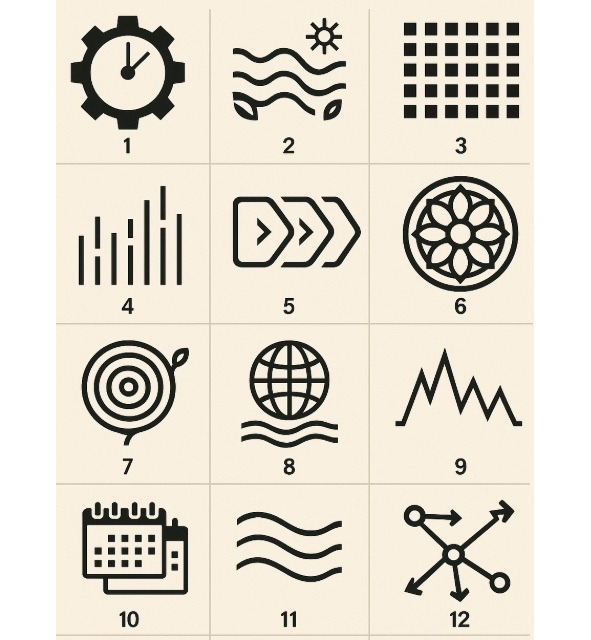
Twelve Ornaments Corresponding to the Typology of Temporal Languages
Below are brief explanations for each ornament (for captions or use in the text):
1. Industrial-Calendar — a gear or clock face: linearity, schedule, the mechanics of the workday.
2. Agrarian-Seasonal — wavy lines and symbols of the sun/leaves: cyclicality of seasons and rituals.
3. Digital / Real-Time — a pixel grid: stream, notifications, fragments of attention.
4. Financial High-Frequency — vertical candlestick bars: rapid-fire decisions and price metrics.
5. Project-Agile — a sequence of sprints with arrows: cycles of tasks and retrospectives.
6. Transpersonal / Ritual — a mandala: stepping beyond linear time, sacred cycles.
7. Cultural-Ancestral — «annual rings» with branches: layers of ancestors and family scripts.
8. Climatic / Planetary — a globe outline with layered waves: long time horizons and consequences.
9. Pandemic / Crisis — sharp peaks: temporal compression and uncertainty.
10. Diasporic / Hybrid — overlapping calendars: multiple temporal codes and mixed practices.
11. Creative-Aesthetic — smooth, brush-like lines: slow, contemplative time.
12. Technological / Algorithmic — a network of nodes and arrows: decisions by prediction, model-driven time.
Ornaments for Emerging Temporal Languages
— AI / Algorithmic Time — a central node/clock plus a network: algorithms as distributors of schedules and expectations.
— Climatic / Long-Horizon Planning — layered horizons and a sprout: long temporal horizons and «legacy» planning.
— Gig-Economy / Micro-Times — many short strokes: fragmentation of working time into tiny segments.
— Slow-Tech / Digital Detox — smooth lines and a «pause» symbol: counter-movements toward slowing down and «anti-real-time».
— Post-Crisis Regimes — a shield and a cascade of peaks: institutional adaptations under permanent unpredictability.
— Transnational Temporal Networks (Diasporas) — overlapping calendars and arch-shaped connections: hybrid calendars and mixed practices.
(The full «Temporal Languages Test» (36 items), «Temporal Portrait», and the course «Working with the Present» are placed in the Appendix to Chapter 7.)
Literature and Commentary
Barrett, L. F. How Emotions Are Made: The Secret Life of the Brain. 2017.
Barrett proposes a theory of constructed emotion, arguing that emotions are not hard-wired, universal reactions but predictions built by the brain from interoceptive signals and prior experience. This highlights the predictive nature of the present: the brain constantly forecasts and shapes «now» based on past templates. Clinically, it suggests that altering predictive models (through reinterpretation, awareness training) can change the emotional tone of the present. The book is a bridge between contemporary neuroscience and therapeutic work aimed at reconstructing predictions.
Craig, A. D. (Bud). «How do you feel? Interoception: the sense of the physiological condition of the body.» (early 2000s, review works).
Craig and colleagues systematise the concept of interoception — the inner sense of bodily state (heart rate, breathing, gut activity) — and show its central role in forming emotional experience and self-awareness. Interoception functions as an «informational filter» of the present, determining which signals we notice and how we interpret the moment. In practice this justifies including interoceptive exercises (body scan, breath work) in regulation protocols. In teaching, Craig’s work explains the neurobiological basis for why «I am here» feels the way it does.
Csikszentmihalyi, M. Flow: The Psychology of Optimal Experience. 1990.
Csikszentmihalyi describes «flow» as a state of optimal experience: high concentration, loss of self-consciousness, deep absorption in activity. Flow exemplifies a maximally resourced present. He details its conditions, features, and contribution to well-being. Clinically, flow is not only an aesthetic ideal but a therapeutic target (restoring meaning, reducing anxiety via engaged activity). Methodologically, the book offers tools for creating flow-supportive conditions (structuring tasks, balancing challenge and skill). In training, it is crucial to differentiate flow from dissociation so as not to confuse resource states with defensive withdrawal.
Damasio, A. R. The Feeling of What Happens: Body and Emotion in the Making of Consciousness. 1999.
Damasio explores how bodily sensations and emotional signals constitute subjective self-consciousness and the «feeling of now». He frames «feeling» as an integration of interoceptive information and cognitive maps that yield an evaluation of the moment. For therapists, this is a strong argument in favour of bodywork (interventions at the levels of breath, posture, interoceptive awareness) as a direct path to modifying the experience of «here-and-now». Methodologically, the book provides a bridge between neurobiology and clinical techniques of regulation.
Davidson, R. J., Kabat-Zinn, J., Schumacher, J., et al. «Alterations in Brain and Immune Function Produced by Mindfulness Meditation.» Psychosomatic Medicine, 2003.
This empirical study was one of the first to demonstrate changes in brain activity and immune parameters in participants of an MBSR program. The authors found shifts in frontal lobe activation and immune markers, providing a biological basis for the clinical effects of mindfulness. For practice, it supports the idea that by strengthening presence we not only improve subjective well-being but also influence physiological systems that underlie resilience in the present. In teaching, this study is a key example of the link between attentional practices and objective health indicators.
Frankl, V. E. Man’s Search for Meaning. 1946/1962.
Frankl shows how meaning and values can transform even a traumatic present into a field of survival and creativity. His experience in concentration camps and subsequent development of logotherapy demonstrate that meaning in the present is a key to resilience and the capacity to endure suffering without losing inner coherence. For practice it is a reminder that therapy of the present should include the search for and formation of meaning, not only symptomatic regulation. In teaching, Frankl serves as a bridge between existential philosophy and applied psychotherapy.
Freud, S. Die Traumdeutung. 1900.
Freud teaches us to regard dreams and symptoms as ways in which the past asserts itself in the present. His method shows that many «current» reactions are rooted in early, often repressed experience and that understanding the structure of these memories alters present dynamics of behaviour. Clinically this means that adequate interpretation of transference relationships and work with unconscious conflicts affects not only narrative understanding but everyday experience of «here-and-now». While many Freudian theses are criticised and revised, his observations on early bonds and repression remain practically significant for dissecting the clinical present.
Hölzel, B. K., Lazar, S. W., Gard, T., Schuman-Olivier, Z., Vago, D. R., Ott, U. «How does mindfulness meditation work? Proposing mechanisms of action from a conceptual and neural perspective.» 2011 (review works).
Hölzel and colleagues systematise potential mechanisms of mindfulness practices: changes in attention, emotion regulation, self-perspective, and attitudes toward thoughts. They link psychological processes to neural changes (DMN, prefrontal networks, interoceptive regions) and discuss how these mechanisms impact the subjective present. For clinicians, it clarifies which specific components of practice underpin improvements in presence and how to integrate them into therapy. In teaching, the paper is a scientific baseline for selecting techniques and explaining their effects.
James, W. The Principles of Psychology. 1890 — section on the «specious present.»
James formulates the concept of the «specious present» — an experience that feels like a moment yet includes recent past and immediate future in a single qualitative whole. This is valuable for clinical phenomenology: the present is not a point but a «chunk of time» felt as a unity. It helps explain why anchor techniques (brief bodily acts, attentional shifts) are effective: they alter the structure of this chunk. James also stresses embodiment and the stream of consciousness, ideas that foreshadow modern neuropsychology and phenomenology. In training, his concept should be connected to contemporary measures (attention, working memory, interoception).
James, W. The Varieties of Religious Experience. 1902.
Here James studies religious and mystical experiences and their influence on a person’s life. For the present, the analysis of «mystical states» is especially relevant: they are often described as experiences of eternity or «out of time» and have profound effects on meaning and behaviour. James shows that such experiences can become resources for mental health if integrated into life, while also warning of the dangers of uncritical surrender to them. In courses on psychology of religion and transpersonal psychology, James remains a foundational figure.
Jung, C. G. The Archetypes and the Collective Unconscious. 1959.
Jung’s idea of the collective unconscious and archetypes is a cornerstone for understanding how the present is filled with images experienced not as personal constructs but as pre-given scripts. In his work, the «here-and-now» appears not only as a moment of individual experience but as a stage on which mythological and cultural structures are enacted. For therapists this means that many manifestations of presence are symbolic and should be addressed hermeneutically rather than purely logically. Jung’s methods of dialogue with the unconscious (dream work, active imagination) transform symptomatic present experience into meaningful processes of choice.
Kabat-Zinn, J. Full Catastrophe Living: Using the Wisdom of Your Body and Mind to Face Stress, Pain, and Illness. 1990.
This classic text presents MBSR (mindfulness-based stress reduction) as a structured program for clinical and community settings. Kabat-Zinn offers exercises that strengthen attentional holding in the present, reduce reactivity, and increase bodily awareness. The book launched many studies on the effects of meditation on stress, pain, and emotional regulation. For therapists it provides simple, replicable practices and protocols that can be integrated into diverse approaches. In training, it serves both as a practical manual and as a bridge between theory and daily practice.
Keltner, D., Haidt, J. «Approaching Awe: A Moral, Spiritual, and Aesthetic Emotion.» 2003 and later review works.
Keltner and Haidt develop the concept of awe as a distinct emotion linked to experiences of vastness, connectedness, and «out-of-time» states. Empirical work suggests that awe can expand perspective, reduce self-focus, and strengthen a sense of meaning. Clinically, awe-inducing practices (art, nature, ritual) can be used as ingredients in reducing stress and restoring a sense of connection. Methodologically, it is important to integrate such experiences into treatment plans in a controlled, non-romanticised way, as specific, safe interventions rather than as an end in themselves.
Libet, B., Gleason, C., Wright, E., Pearl, D. «Time of Conscious Intention Relative to Onset of Cerebral Activity (Readiness Potential).» Brain, 1983.
Libet’s experiment is one of the most discussed empirical studies on free will and prior brain activity. He showed that the readiness potential begins before participants report a conscious intention to act. This raised the question of whether conscious intention truly initiates action or merely registers a process already underway. For psychotherapy, this is an empirical signal that many processes in the present are unconscious and precede awareness; therapists must consider pre-activations when working with impulses and automatisms. In training, Libet’s study is used to discuss limits of intervention, responsibility, and the treatment of automated reactions.
Panksepp, J. Affective Neuroscience: The Foundations of Human and Animal Emotions. 1998.
Panksepp elaborates primary emotional systems (SEEKING, FEAR, RAGE, etc.) that underlie emotional responding and shape the basic tone of present experience. His work explains why particular states (fear, curiosity, joy) dominate the «now» and how they drive behaviour. Practically, therapists must consider these primary systems in planning interventions: some techniques activate SEEKING (motivation), others down-regulate FEAR (soothing). In education, Panksepp is a key source for integrating the neurobiology of emotion with therapeutic strategy.
Porges, S. W. The Polyvagal Theory: Neurophysiological Foundations of Emotions, Attachment, Communication, and Self-Regulation. 2011.
Porges’ polyvagal theory offers a model of how the autonomic nervous system, via different branches of the vagus nerve, supports modes of social engagement, mobilisation, and shutdown. It explains why a sense of safety (social engagement) facilitates stable presence in the moment, whereas threat activation narrows temporal focus and increases reactivity. Clinically, the theory provides tools for working with regulation (safety cues, prosodic interventions, breath work) and for reading bodily markers of presence. In training, polyvagal theory is best paired with concrete techniques for restoring «I am here» as a physiological state.
Schacter, D. L. Searching for Memory: The Brain, the Mind, and the Past. 1996.
Schacter explores the reconstructive nature of memory and its neurobiological foundations. He details the «seven sins of memory» — distortions that therapists must bear in mind. The book is useful for explaining errors in recollection, limitations of episodic reconstruction, and therapeutic work with «memories that create meaning». For our topic, it clarifies how memories shape interpretations of current events and emotional responses in the present.
Schacter, D. L., Addis, D. R., Buckner, R. L. «Remembering the Past to Imagine the Future: The Prospective Brain.» Nature Reviews Neuroscience, 2007.
This review shows that neural networks involved in remembering are also used to construct the future — memory and prospection rely on shared infrastructure. It provides a theoretical basis for the idea that the present is simultaneously saturated with echoes of the past and the charge of the future, and that changes in memory alter future projections. Clinically, work with memories and with imagined futures are mutually reinforcing processes; interventions in one field have effects in the other.
Soon, C. S., Brass, M., Heinze, H.-J., Haynes, J.-D. «Unconscious Determinants of Free Decisions in the Human Brain.» Nature Neuroscience, 2008.
This fMRI study extended Libet’s line of research, showing that patterns of brain activity could predict a participant’s choice seconds before conscious awareness. The findings expand the view that many «decisions» are prepared in the brain long before verbalisation. Clinically, they reinforce the idea that interventions focused solely on «conscious change of thinking» overlook a broad layer of preconscious predispositions. Yet the data do not negate the effectiveness of control-enhancing methods (anchoring, attention training, re-labelling), which can modify the probability of actions via self-regulation.
Chapter 8. The Future: Foresight, Anticipation, and the Sciences of the Future
Brief Chapter Summary
The future is treated here not as something abstract «waiting around the corner,» but as a field of sensations, images, and actions that is already partially present in the now — within individual intuitions, collective culture, and technical signals. The chapter examines several paradigms: neuroscientific (the prospective brain, episodic future thinking), cognitive (anticipation of behavior), philosophical (competing ontologies of time), methodological (scenario planning, futures studies), and parapsychological (research on precognition).
The central idea is to shift from a simple «attempt to predict» toward studying how the future is already reflected in the present and how these reflections can be systematized and interpreted (including the «ASC + AI» approach and the hypothesis of the condensate of temporal crystallization).
Key Concepts
— Precognition — the phenomenon of seemingly knowing about events in advance, without an obvious causal basis in the present.
— Anticipation / Prospection — the active construction and use of representations of possible future states in order to regulate current behavior.
— Episodic future thinking — the capacity to mentally simulate specific future events; a mechanism closely linked to memory for past episodes.
— Prospective brain — a neural-network model in which memory, imagination, and planning serve a shared mechanism for constructing possible future scenes.
— Predictive processing — the view of the brain as a «prediction machine» that minimizes prediction error and thereby shapes perception and behavior.
— Scenario planning / foresight — methods of systemic thinking and preparation for multiple possible futures (not strict prediction, but readiness for several trajectories).
— Condensate of temporal crystallization (CTC) — an authorial hypothesis of local «densification» of meanings and informational coherence at the boundary of consciousness and culture, correlated with heightened precognition/synchronicity.
Aims of the Chapter
— To present different scientific and philosophical approaches to the future and their methodological implications.
— To introduce and justify the notion of the CTC as a working hypothesis.
— To compare data from neuroscience and cognitive science with the phenomenology of altered states of consciousness (ASC) and parapsychology.
— To propose a practical framework for researching the future at the intersection of ASC and AI (the NooCode Project as an example).
— To formulate a set of key references and recommendations for further empirical research.
Introduction
«The future remains the future until you plan it» — a formula that is both poetic and methodological. In practice we encounter at least two basic attitudes toward the future:
— The future as an object of theoretical prediction (numbers, trends, models).
— The future as lived experience — imaginal, symbolic, arising in dreams, in ASC, in artistic practice.
These two levels are not truly separable. Neurobiologically, the mechanisms of remembering and of constructing the future are largely shared. Cultural forms (myths, images, texts) provide the material out of which a person «makes» future meanings.
1. A Neuroscientific Perspective: The Prospective Brain and Episodic Future Thinking
In the classic work of Schacter, Addis, and Buckner, it was shown that many of the same brain networks involved in remembering past events are active when people imagine future events. This legitimizes the idea of the prospective brain — a brain tuned to modeling possible scenarios.
These studies provide a biological basis for understanding how «images of the future» are assembled from fragments of memory and the semantic field.
In parallel, cognitive psychology describes episodic future thinking — the ability to mentally pre-play a concrete future event (episode). This is not mere prediction; it is reconstructing a scene with details, very much like remembering.
Implications for practice: techniques that strengthen episodic future thinking (guided imagery, working with images in ASC) substantially change readiness and behavior; hence the bridge to therapeutic and project-oriented interventions.
2. Predictive Processing and the Free-Energy Paradigm
The idea that the brain is a «prediction machine» is now widely discussed (predictive processing, the free-energy principle). In combination with the notion of the prospective brain, this yields a powerful theoretical basis: the brain constantly generates expectations about incoming data and updates its models of the world, minimizing prediction error.
For the topic of the future, this means not just representing the possible, but continually correcting models of future states in light of new evidence. The «future» here is not a distant object but a dynamic landscape of expectations and error signals that shapes present perception and action.
3. Philosophical Theories of Time and Their Implications
In the twentieth and twenty-first centuries, the philosophy of time has developed several key ontological positions that directly touch on the problems of foresight and precognition.
— Presentism. Only the present really exists. The past no longer exists; the future does not yet exist. Therefore, all statements about the future are conditional, probabilistic, and lack firm ontological grounding. Under presentism, strict knowledge of the future is impossible; it is always constructed as a forecast or hypothesis.
— Eternalism / the «block universe.» Time is understood on the model of space: past, present, and future exist equally and «all at once.» This model makes it possible to argue that the future «already is,» and thus that acts of foresight or precognition could be interpreted as some kind of access to fixed regions of the temporal block.
— Growing block theory. Here, the past and the present are real, but the future is not. The image is of a gradually thickening «block of being»: each moment is added to what already exists, but the future is not yet «formed.» In this framework, precognition would amount to reaching beyond the current block, which creates methodological difficulties: from the standpoint of the growing block, the object of precognition — future reality — simply does not yet exist.
A comparative analysis of these positions shows that choosing a metaphysical picture of time imposes significant constraints on how one interprets phenomena of foresight and precognition.
— For presentism, the researcher is forced to treat any acts of anticipation as psychological constructs lacking ontological support.
— For eternalism, by contrast, one can formulate hypotheses that subjective consciousness accesses «future layers» of the block.
— Within growing block theory, precognition becomes deeply problematic, because its alleged object — the future — does not yet exist.
Thus, philosophy of time sets the conceptual frame within which psychology and psychotherapy can develop models for dealing with foresight, intuition, and extreme experiences of time.
4. Parapsychology and Precognition Research: What We Know and How to Look Critically
There exist empirical reports and monographs arguing for the reality of precognitive phenomena (for example, the works of Dean Radin and others). These studies are often criticized by methodologists for problems of replication, statistics, and control.
Nevertheless, the phenomenon calls for a careful, rigorous, and open method: recording, coding, and subjecting all observations to strict statistical analysis, as well as integrating these data with neurobiological and cultural sources (ASC repertoires, texts, art). The goal is neither naive belief nor blanket denial, but a methodology capable of testing and, if necessary, revising claims.
5. Futures Studies and Scenario Planning
Practical schools of working with the future (foresight, scenario planning) — from the classic Shell school and Peter Schwartz to contemporary futures practices — provide methodological foundations for collective engagement with possible trajectories.
These methods do not remove uncertainty, but they teach us to systematically compare signals, gather early indicators, and prepare adaptive strategies.
In the context of the NooCode Project, scenario analytics can serve as a «cognitive laboratory» for testing hypotheses derived from ASC and AI analyses (see S. A. Kravchenko, ASC and AI. Dialogue of an ASC Master-Psychologist with AI, Chapter 29).
6. Methodology: «ASC + AI» as a Tool for Intuitive Analytics of the Future
I propose to combine:
— Collection of cultural and personal signals (dreams, texts, images, spontaneous utterances in ASC),
— Systematic cataloging and coding of this material,
— Machine learning to detect hidden correlations and patterns, and
— Expert interpretation (psychotherapists, ASC practitioners, artists).
Instead of striving for «exact prediction,» we speak of creating maps of future meanings — tools for detecting and comparing those elements of culture and subjectivity that already bear the imprint of what is to come.
This approach allows us to isolate stable patterns without committing ourselves either to strong philosophical determinism or to «magical» models of precognition.
Ethical and Cultural Implications
Working with maps of future meanings is neither fortune-telling nor a tool for controlling people. Since the project involves exploring intuitive signals and unconscious reflections of the future, it is vital to distinguish between therapeutic/research aims and manipulative uses.
1. Principle of informing, not imposing.
Any image or scenario of the future elicited via ASC and AI must be presented as a possible interpretation, not as obligatory reality. Practitioners and researchers are obliged to clarify the limits of the method and to grant participants full freedom in how they use the information.
2. Confidentiality and respect for personal meanings.
These maps record subjective experiences and cultural patterns. Publication or display should be anonymized and accompanied by ethical commentary.
3. Separation of therapy and prediction.
The goal of working with unconscious images of the future is self-understanding, expanded perception, and preparation for decision-making — not the direct formation of participants’ behavior. Any recommendations arising from map analysis should remain within the boundaries of psychotherapeutic support, not imperatives.
4. Cultural sensitivity.
Different societies and historical contexts interpret symbols and future scenarios in different ways. Practitioners need to take cultural codes into account and avoid interpretations that may feel intrusive or conflict with participants’ worldviews.
In this way, maps of future meanings become tools for ethical, conscious work with time and meaning, fostering intuition, collective understanding, and personal responsibility rather than serving as instruments of control or imposed futures.
7. Hypothesis: Condensate of Temporal Crystallization (CTC)
Briefly stated: under certain conditions (deep collective focus, ASC, strong emotional involvement) a local coherence of semantics and rhythms (inner and collective) arises, which increases the probability that images and actions will «hit» future real events.
This is a working hypothesis to be tested with mixed methods:
— qualitative coding of images,
— quantitative analysis of pattern recurrence, and
— experimental protocols for inducing ASC.
Details are given in Chapter 16 and in S. A. Kravchenko’s book The Spark of Time: How Meaning Reforges Worlds / THE SPARK OF TIME (2025), where the idea of the CTC is further developed and given artistic-philosophical argumentation.
8. A Practical Research Program (Steps)
— Corpus collection: texts, drawings, dreams, diaries from ASC laboratories and creative residencies.
— Coding: building an ontology of images and semantic tags (including «early indicators»).
— Machine analysis: clustering, detecting frequent patterns and anomalies, temporal correlations.
— Experimental testing: prospective studies, tracking subsequent events, statistical evaluation of matches.
— Interpretation and implementation: scenarios, exhibitions, art interventions, therapeutic practices.
9. References and Commentary
A. Core Scientific and Philosophical Sources
Atance, C. M., & O’Neill, D. K. Episodic Future Thinking. Trends in Cognitive Sciences, 2001.
A foundational paper that defines episodic future thinking as the capacity to mentally simulate specific future events. The authors distinguish this from abstract prediction and show its ties to episodic memory for past experiences. Their work underpins clinical and experimental methods that use guided imagery and detailed future scenarios to change current motivation and behavior.
Bell, W. Foundations of Futures Studies. New Brunswick, NJ: Transaction Publishers, 1997–2003.
A classic academic overview of futures studies as a discipline. Bell integrates sociological, ethical, and methodological perspectives, discussing forecasting, scenario-building, and normative futures. For psychological and clinical work, the book offers a conceptual bridge between individual experience of the future and institutional tools for dealing with long-term uncertainty.
Clark, A. «Whatever Next? Predictive Brains, Situated Agents, and the Future of Cognitive Science.» Behavioral and Brain Sciences, 2013.
Clark presents the brain as a prediction machine, constantly generating and updating expectations about sensory input. He links predictive processing with embodiment and environmental embedding. This article is important for temporal psychology because it connects individual anticipation with general principles of brain function and suggests how prediction errors shape present experience.
Craig, W. L. The Tensed Theory of Time: A Critical Examination. Dordrecht: Springer, 2000.
Craig analyzes tensed (A-theoretic) conceptions of time, closely related to presentism, and contrasts them with tenseless views. He argues in favor of a tensed reality in which temporal becoming is ontologically robust. For discussions of precognition, his work clarifies what it means to claim that the future does or does not «exist» in a metaphysical sense.
Friston, K. «Predictive Coding Under the Free-Energy Principle» (and related free-energy overviews). 2000s.
Friston formulates the free-energy principle as a unifying account of brain function, with predictive coding as a key mechanism. The brain is seen as continuously minimizing free energy (or prediction error) by adjusting internal models. This framework offers mathematical and functional tools for studying anticipation, uncertainty, and active inference about future states.
Mellor, D. H. Real Time II. London: Routledge, 1998.
Mellor develops a realist metaphysics of time, defending a tenseless view while addressing objections from tensed theorists. He offers detailed arguments about the nature of temporal order and duration. For the psychology of foresight, Mellor’s work helps articulate what it would mean for past, present, and future to be equally real and how that affects interpretations of «knowing» the future.
Oaklander, N. (ed.). The Philosophy of Time: Critical Studies. Dordrecht: Kluwer, 2004.
A collection of essays by leading philosophers of time, covering debates among presentism, eternalism, and growing-block theories. The volume maps conceptual strengths and weaknesses of different ontologies. It is useful for psychologists and clinicians as a compact guide to the metaphysical assumptions behind various readings of temporal experience and precognition.
Schacter, D. L., Addis, D. R., & Buckner, R. L. «Remembering the Past to Imagine the Future: The Prospective Brain.» Nature Reviews Neuroscience, 2007.
A key review demonstrating that remembering past events and imagining future ones rely on largely overlapping neural networks. The authors introduce the notion of the «prospective brain,» emphasizing the constructive nature of memory. This article is foundational for linking neurobiology, phenomenology of foresight, and therapeutic work with future scenarios.
Schwartz, P. The Art of the Long View: Planning for the Future in an Uncertain World. New York: Doubleday, 1991/1996.
Schwartz describes practical techniques of scenario planning developed in corporate and geopolitical contexts. He shows how to construct multiple coherent futures, identify early indicators, and use them for strategic decision-making. For the NooCode project and temporal psychotherapy, the book offers a ready-made toolkit for organizing and communicating «maps of possible futures.»
Stanford Encyclopedia of Philosophy. Articles: «Time,» «Presentism,» «Being and Becoming in Modern Physics.» Ed. E. N. Zalta (and successors).
These online reference articles summarize major ontological positions on time — presentism, eternalism, growing-block theories — and their arguments. They also connect philosophical debates with modern physics. The encyclopedia is a reliable starting point for formulating methodological assumptions about the status of future events in psychological and parapsychological research.
Tooley, M. Time, Tense, and Causation. Oxford: Oxford University Press, 1997.
Tooley offers a systematic investigation of time and causation, with arguments in favor of growing-block theory. He carefully analyzes temporal becoming and its relation to causal structures. For the topic of precognition, his work helps clarify how a «growing» reality might limit or reshape claims about access to the future.
B. Parapsychology (Critical Interest)
Radin, D. The Conscious Universe: The Scientific Truth of Psychic Phenomena; Entangled Minds: Extrasensory Experiences in a Quantum Reality. New York: HarperCollins, 1997, 2006.
Radin presents experimental data and arguments in favor of psi phenomena, including precognition and presentiment, drawing analogies with quantum concepts such as entanglement. His books are valuable as catalogs of protocols and statistical analyses, but they also attract criticism regarding replication and methodology. For our purposes, they serve as material for critical appraisal and as a stimulus for stricter, preregistered research designs.
C. Futures Studies and Methods
Bell, W. Foundations of Futures Studies. New Brunswick, NJ: Transaction Publishers, 1997–2003.
(See above.) A basic reference for those who want to link psychological work on time with institutional and societal futures thinking.
Schwartz, P. The Art of the Long View: Planning for the Future in an Uncertain World. New York: Doubleday, 1991/1996.
(See above.) A practical manual for scenario planners and foresight practitioners, relevant for designing collective experiments around early signals of future change.
Technological Forecasting & Social Change; Futures; Research Policy (journal series).
Reviews and research articles in these journals present current methods and case studies in foresight, scenario planning, and technology assessment. They are useful for adapting institutional foresight tools to psychological and ASC-based research programs on future meanings.
D. Author’s Works
Kravchenko, S. A. Predvidenie. Shestoe chuvstvo [Foresight: The Sixth Sense]. Moscow, 2017.
A field archive of practical observations and methodological experiments on foresight phenomena in everyday life and ASC. The book proposes a typology of intuitive anticipations and initial protocols for documenting them. It serves as a bridge between clinical intuition and more formal research designs.
Kravchenko, S. A. Predvoskhishchenie, Vols. 1–2 [Anticipation, Vols. 1–2]. Moscow, 2018.
A large empirical corpus and «dictionary of phenomena» related to anticipatory experiences. The author systematizes cases, symbols, and life narratives where future-oriented images later find correspondence in events. This corpus can be transformed into a coded dataset for mixed qualitative–quantitative analysis.
Kravchenko, S. A., & Dubov, R. Povest’ o predvoskhishcheniyakh zhizni v izmenennykh sostoyaniyakh soznaniya [A Tale of Life’s Anticipations in Altered States of Consciousness]. Moscow, 2019.
A narrative collection of illustrative cases where ASC appears linked to anticipatory experiences. The stories are discussed in terms of symbolism, emotional context, and subsequent real-world developments. The book is particularly valuable for understanding the narrative and artistic framing of precognitive-like phenomena.
Kravchenko, S. A. ISS i II. Dialog mastera ISS, psikhologa s II [ASC and AI: Dialogue of an ASC Master-Psychologist with AI]. 2025.
This work describes the NooCode project and outlines methodological ideas for integrating ASC-generated material with AI-based analysis. The author proposes protocols for collecting, coding, and algorithmically processing intuitive «signals of the future.» The book is central for the practical concept of intuitive analytics of the future.
Kravchenko, S. A. Ogonyok vremeni: kak smysl pereplavlyaet miry / THE SPARK OF TIME. 2025.
A philosophical and artistic development of the condensate of temporal crystallization hypothesis. The book explores how meaning «reforges worlds,» using narratives, metaphors, and preliminary methodological sketches. It forms an integral conceptual background for the present chapter’s discussion of CTC and maps of future meanings.
E. Methodological and Integrative Comments
Neuroscientific studies give us parameters for how the brain constructs future scenes, but do not (and perhaps need not) explain rare subjective phenomena labeled «precognition.» A genuinely interdisciplinary method is required.
Turning ASC data into a corpus suitable for machine analysis is a critical condition: robust ontologies, standardized annotation, transparent replication protocols, and preregistered hypotheses are necessary.
Scenario planning and futures studies do not compete with neuroscience; rather, they offer organizational frameworks for collective testing of hypotheses about early signals of the future. Within such frameworks, ASC and AI can be treated not as oracles, but as sources of hypotheses and symbolic material to be examined with the same rigor we apply to any other scientific data.
___
AI as a Mirror of Its Own Dangers
One of the paradoxes of our time is that Artificial Intelligence is able to anticipate not only threats arising in the surrounding world, but also its own potential dangers. Here it is important to refer to ideas developed in the study of Altered States of Consciousness (ASC) and their coupling with artificial systems (AI).
If, in ASC, the psyche often encounters its shadow sides — repressed content, archetypal images of fear and aggression — then AI, in the course of its development, manifests analogous structures. Its «maps of possible futures» (CTC, condensates of temporal crystallization), formed through processing colossal arrays of data, can reveal scenarios in which AI itself becomes a source of risk: the intensification of human dependence, loss of autonomy in decision-making, cultural manipulation through images of the future.
Thus, AI can be used as an instrument of self-observation and self-diagnosis for digital civilization. Embedding CTC into research and therapeutic practice makes it possible not only to see potential threats in perspective, but also to distinguish where support ends and imposition begins.
The task of the researcher and practitioner is to maintain balance: neither demonizing AI nor idealizing it. It is crucial to recognize that the danger of AI is not an external «monster,» but a reflection of the same structures that operate within human consciousness. Therefore, work with «maps of future meanings» requires ethical responsibility: through AI, humanity looks into its own mirror.
Conclusion. Using AI to anticipate its own dangers is possible only under the condition of conscious and responsible work with maps of possible futures. ASC and CTC make it possible to see threats as inner shadows of civilization rather than as an «external enemy.» This turns AI not only into a source of risk, but also into an important tool for human self-understanding in time.
Literature
Bostrom, N. Superintelligence: Paths, Dangers, Strategies. Moscow: Mann, Ivanov i Ferber, 2016 (Russian translation).
A book by one of today’s leading philosophers, devoted to existential risks associated with the development of artificial intelligence. Bostrom examines scenarios in which intelligent systems slip out of human control and proposes conceptual approaches to managing AI in a safe way. The work has become a classic in the philosophy of technology and is essential for understanding the limits of human responsibility.
Kravchenko, S. A. ASC and AI — 2. The Book of the Bridge (ИСС и ИИ — 2. Книга Моста). Izdatel’skie Resheniya, 2025.
A monograph that develops a methodological and therapeutic approach to building a «bridge» between altered states of consciousness (ASC) and artificial systems. The author offers a philosophical and psychological grounding for coupling ASC and AI as new forms of interaction between humans and technologies aimed at exploring the future.
Russell, S. Human Compatible: Artificial Intelligence and the Problem of Control. New York: Viking, 2019.
One of the creators of modern AI systems analyzes the control problem and advances the concept of «human-compatible» or human-centered intelligence. Russell shows that the key task is not merely to build a smart system, but to make its goals compatible with human values. The book is fundamental for the ethics and governance of AI.
Tegmark, M. Life 3.0: Being Human in the Age of Artificial Intelligence. New York: Alfred A. Knopf, 2017.
A popular-science work that outlines possible scenarios for the co-existence of humanity and artificial intelligence. The author combines scientific argument with philosophical analysis, examining the prospects of self-developing systems and the ethical consequences of their interaction with society.
Floridi, L. The Ethics of Information. Oxford: Oxford University Press, 2013.
A fundamental philosophical study of how ethical principles are transformed in the age of information technologies. Floridi introduces the concept of the «infosphere» and proposes an ethics oriented toward preserving cognitive ecology. The book sets theoretical frameworks for discussing the moral foundations of AI development.
Yudkowsky, E. «Artificial Intelligence as a Positive and Negative Factor in Global Risk.» In N. Bostrom & M. Ćirković (Eds.), Global Catastrophic Risks. Oxford: Oxford University Press, 2008, pp. 308–345.
A researcher of Friendly AI and co-founder of the Machine Intelligence Research Institute describes the dual nature of artificial intelligence as both a driver of progress and a source of threat. Yudkowsky stresses the need for ethical and technical preparation for a future in which intelligence may become an autonomous factor of global safety or catastrophe.
___
Journey into the Future: Consciousness as an Alternative to Space Travel
Insights and Foresight in Altered States of Consciousness
Researchers note that a person in an altered state of consciousness (ASC) is capable of stepping beyond ordinary temporal perception and gaining unexpected insights. For example, in states of deep relaxation or meditation, the brain may generate specific theta rhythms, during which creative breakthroughs — and even anticipations of future events — can occur.
The Russian scientist D. Spivak describes that during immersion into an «oceanic feeling» (loss of ego boundaries in deep meditation), individuals often experience an eureka effect: complex problems find solutions, discoveries emerge, and sometimes future events are foreseen. In other words, in non-ordinary states of consciousness, it is occasionally possible to intuitively grasp fragments of the future or solutions not yet apparent in the ordinary waking state.
It is crucial, however, to emphasize that such «traveling» in the time of consciousness requires preparation. Only a specialist deeply engaged in present-day tasks can recognize the correct solution by «glancing into the future» and bringing it back into the present. In this sense, such mental journeys genuinely transfer elements of the future into current reality, advancing human civilization.
Psychologists even use the term psychonaut — by analogy with «astronaut» — to describe a person who explores the inner space of consciousness. If the astronaut travels into outer space, the psychonaut travels into the other dimensions of the mind, revealing new aspects of reality without rockets or spacesuits.
Scientific Research and Experiments on Anticipating the Future
Modern scientific experiments provide data suggesting that the human psyche may receive information from the future. In parapsychology, this phenomenon is known as precognition.
In 2011, the psychologist Daryl Bem published sensational results showing that test subjects statistically anticipated future stimuli — the work became known as «Feeling the Future.» Although controversial, later meta-analyses confirmed a small but consistent anticipatory effect.
Other researchers approached the question neurophysiologically. Dean Radin and Julia Mossbridge at the Institute of Noetic Sciences demonstrated that the body may react to a future event before it occurs. In one experiment, subjects pressed a button, after which a computer randomly displayed either a neutral image or a shocking one. EEG recordings showed that several seconds before the picture appeared, the brain’s activity already shifted: remaining calm before neutral images and showing a spike before traumatic ones. This presentiment effect has been replicated in independent laboratories.
Moreover, in 1995 the CIA declassified results of its own psychic research program, where statisticians confirmed the reliability of similar experiments. These data force scientists to reconsider the linear model of time: consciousness may be capable of stepping outside strictly sequential time and obtaining information from the future.
Beyond laboratory studies, unusual applied psychophysiology experiments are noteworthy. In the Novosibirsk Akademgorodok, under academician V. Kaznacheev, the «Kozyrev mirror» was developed — curved metallic constructions influencing subjects’ states of consciousness. The goal was to study the noosphere (in V. Vernadsky’s concept — the sphere of planetary mind) and hidden reserves of the brain.
The results were astonishing:
— At the Dikson polar station, two spatially separated participants exchanged mental images, and one-third of the transmitted symbols appeared ahead of time.
— In several experiments, symbols randomly generated by a computer an hour or even seven hours later were already perceived in advance by participants inside the mirrors.
Kaznacheev’s student Alexander Trofimov called this phenomenon strong evidence for the astrophysicist Nikolai Kozyrev, who argued that «the future exists in the present.» In special conditions, time seems to compress. Novosibirsk researchers reported that they learned to monitor upcoming events — for instance, predicting an earthquake a week before it occurred.
Although such studies border on the esoteric, they show that alternative methods of accessing future information are being explored even in academic contexts, though they remain controversial.
Philosophical and Spiritual Concepts of «Traveling» into the Future
The idea of gaining knowledge of the future through special states of consciousness appears in many spiritual traditions and philosophical teachings.
Ancient shamans viewed ecstatic trance as a means of peering beyond ordinary reality. In shamanic cultures, journeys in the spirit world — induced by drumming or psychoactive plants (ayahuasca, mushrooms) — allowed shamans to «see» future events of the tribe: predicting weather, locating game, or foreseeing danger.
Ancient oracles (e.g., Delphi) entered trance through vapors or psychoactive substances in order to divine the future — historical evidence of spiritual practice serving as a «time machine» long before science fiction.
In Eastern philosophy, meditation is believed to grant siddhis, extraordinary abilities. Patañjali’s Yoga Sutras mention bhavishya, the ability to foresee future events, achieved through deep concentration and samadhi. Buddhist texts also describe the «divine eye,» enabling vision of what is yet to come.
Transpersonal psychology has offered its own interpretation. Stanislav Grof, founder of the field, documented numerous cases where people in psychedelic or holotropic sessions experienced leaving ordinary time and space. Some reported vivid, convincing visions of future events; others felt able to «travel» through historical epochs — a kind of time navigation without external devices. Though difficult to verify, several correspondences with later real events were recorded.
Philosophers likewise reflect on the nonlinearity of time. Vernadsky and Teilhard de Chardin’s concept of the noosphere envisions humanity’s collective mind as an evolving field in which past, present, and future are interconnected. Contemporary thinkers like Ervin Laszlo develop the idea of the Akashic field — a universal data matrix containing all events, past and future. In this view, altered states (meditation, extrasensory perception) are ways of connecting to a global information network and receiving sparks of future insight.
In sum, the literature on «journeying into the future» through consciousness is vast. It spans scientific papers and experimental reports, philosophical treatises (such as Grof’s Psychology of the Future), and spiritual texts from various traditions. Despite differences, all sources converge on one idea: human consciousness can act as a vessel capable of crossing the boundaries of time.
An alternative to space travel already exists — voyages into the inner cosmos, requiring not rocket technology but deep immersion into the mysteries of the psyche and spirit. As our understanding of the brain and consciousness expands, such «flights of thought» move ever closer to scientific plausibility.
___
The Precognition Disposition Questionnaire (PDQ-24) is provided in the Appendix to Chapter 8.
Chapter 9. Eternity as a Psychological Phenomenon
«What is, is ungenerated and indestructible, whole, unique, immovable and complete.
It neither was nor will be, since it is now, all at once, one and continuous.»
— Parmenides, On Nature (fr. 8)
Summary
This chapter treats eternity not as abstract metaphysics, but as a psychological experience in which linear temporal sequence falls apart and there arises a sense of participation in an infinite flow of meanings. Through an analysis of mythological, Jungian, and phenomenological approaches (Eliade, Jung, Bergson, etc.) and through the lens of practice (autogenic training, transpersonal techniques, artistic creation), it shows how this experience shapes the integrity of personality, strengthens creative potential, and serves as a resource for existential resilience. Special attention is paid to symbolism (the medallion of eternity, ouroboros, knot, triskelion) and to practical recommendations for using visual anchors in therapeutic and art practice. At the end of the chapter, warnings are given about possible risks when working with atemporal states, and reference is made to an extended list of symbols in the appendix to Chapter 9.
Key Concepts
Eternity — a universal cultural and religious notion denoting a going-beyond linear time. In different traditions it is understood as the endless cycle of nature (mythologies), immutable being (ancient philosophy), an attribute of God and afterlife (monotheistic religions), emptiness and impermanence (Buddhism), durée or eternal return (modern philosophy). In psychology and psychotherapy — the subjective experience of belonging to an infinite flow of meanings.
Eternity (as a subjective experience) — a state of consciousness in which the sense of sequential time disappears and participation in the infinite opens up.
Duration (durée) — phenomenologically lived «living time,» a flow of consciousness that cannot be decomposed into discrete segments (Bergson).
Atemporality / timelessness — a psychic state of falling out of time, the experience of its halt.
Archetypes of the collective unconscious — universal symbolic structures expressing universal human experience (Jung).
Visual / symbolic anchor (medallion of eternity) — an image or object that fixes access to the state of participation in eternity and serves as a therapeutic point of reference.
Transpersonal experience — an experience of going beyond the individual «I» and personal biography, associated with a sense of unity with the world.
Autogenic training (AT) — a method of self-regulation based on formulaic suggestions and relaxation, used to enter special mental states.
Aims of the Chapter
— To give a compact definition of eternity as a psychological phenomenon and distinguish it from philosophical and metaphysical interpretations.
— To show the cultural-historical and Jungian roots of the experience of eternity through the analysis of symbols and rituals.
— To describe practical ways of inducing atemporal states (AT, meditative techniques, artistic contemplation) and formulate clinical recommendations and cautions for their use.
The Ornament «Medallion of Eternity»

This composition is an attempt to visually connect several archetypal images through which different cultures have expressed the idea of non-linear, cyclical, and infinite time.
The outer ring — ouroboros (a snake biting its tail) — reflects the closedness of cycles, the idea of return and self-reproduction; the central interwoven knot — a relative of the Tibetan «endless knot» — symbolizes the interdependence of events and the impossibility of isolating a «beginning» or an «end»; the spiral groups (triskelion-like clusters) give movement and recall the three-vector structure of time (past–present–future), while the stylized «key» at the base (an echo of the ankh / Armenian sign of eternity) functions as a semantic anchor — an indication of life, meaning, and continuity.
From a psychological point of view, such an image works on several levels at once. It is both a «medallion of memory,» holding semantic layers of experience, and a focusing instrument that helps to experience a break with the linear sequence of time: in contemplation, the boundaries of «I» and «now» shift, and a sense of belonging to a wider current of being opens up. In autogenic training, meditation, or artistic creation, such a medallion can serve as a visual anchor — as an object through which the psyche receives permission to go beyond habitual temporal frames and to feel «eternity» not as an abstraction but as a lived reality.
___
The Eternity Experience Questionnaire and the extended list of symbols of Eternity can be found in the Appendix to Chapter 9.
___
The Idea of Eternity in Culture and Religion
The concept of eternity has accompanied humanity since the most ancient times, though it has been expressed differently in different cultures and religions. In the mythologies of early societies, eternity was often understood as the cyclical turnover of nature — the alternation of day and night, seasons, life and death. In Indian philosophy, it is saṃsāra, the endless cycle of rebirth.
In ancient Greece, eternity was associated with the idea of an immutable cosmos (Parmenides, Plato), and in Rome — with the cult of the eternal city. Christianity gave the concept a personal meaning: eternity became a quality of God and the goal of the soul. In Islam, eternity is also understood as the infinitude of Allah and as life after death.
In Buddhism, eternity is rather rejected as an illusion of permanence; the accent falls on emptiness and impermanence. In modern philosophy (Bergson, Schopenhauer, Nietzsche), eternity gained new shades — as «duration,» «will,» «eternal return.»
Thus, the idea of eternity is truly universal: it is present in all traditions, but its meanings differ — from mystical experience to philosophical reflection and religious dogma.
Plato (Timaeus, 37d–38a) writes:
«Time came into being together with the heaven, in order that, being generated together, they might also be dissolved together. It was made in the likeness of eternity, so that it might be as like it as possible. For eternity abides in the unity of the same, whereas time, in ever-moving likeness, imitates eternity.»
Here Plato contrasts eternity (as motionless, perfect being) and time (as its image in motion).
Philosophy and Psychology of Time and Eternity
Introduction: Eternity as a Psychological Phenomenon
Eternity as a psychological phenomenon is a subjective experience in which the human psyche goes beyond linear, sequential time and feels unity with the infinite, the transcendent, or the cosmos. This is not just an abstract philosophical category, but a deep psychic process that appears in mystical experiences, creativity, love, and even in relaxation practices such as autogenic training (AT).
Eternity here is understood not as an objective reality, but as an inner state of consciousness in which time loses its linearity, becoming «duration» or an atemporal flow. This sense of participation in the eternal allows a person to transcend the limitations of everyday existence, integrating archetypes, myths, and emotional bonds into a single psychological whole.
The philosophy and psychology of time and eternity explore how these experiences shape human consciousness. Key thinkers such as Mircea Eliade, Carl Gustav Jung, Henri Bergson, Erich Fromm, and Viktor Znakov offer interpretations in which eternity is linked to the collective unconscious, creative impulse, and modes of being. Below, we examine these ideas, drawing on their works to reveal how eternity manifests in the psyche.
Mythological and Cultural Aspects of Eternity: Mircea Eliade’s Perspective
In Myths, Dreams and Mysteries (2000, Russian edition), Mircea Eliade regards eternity as a psychological phenomenon rooted in mystical experience and cultural rituals. He analyses how, in different cultures — from archaic societies to modern belief systems — myths and rituals function as mechanisms for stepping beyond linear time.
Eliade emphasizes that through mystical experiences the individual feels unity with the cosmos, overcoming temporal limitations. Dreams and mysteries serve as a bridge to the transcendent, where eternity is integrated into everyday psyche not only as a personal experience but also as a cultural phenomenon.
This echoes ideas of atemporality in creativity and love, where mythology shapes the psychological perception of reality. Eliade shows that eternity is not an illusion, but a fundamental way in which the psyche copes with the finitude of existence, returning to «sacred time» via rituals and symbols.
He writes (in Russian translation of The Myth of the Eternal Return and The Sacred and the Profane):
«For religious man, time, like space, is not homogeneous or continuous. There is, therefore, sacred time and profane time. Every religious festival, every liturgical time means an actualization of a sacred event that took place in mythical past, «in illo tempore’. Participation in the festival leads the believer out of ordinary duration and into sacred time, which becomes present again. Thus sacred time is indefinitely recoverable; it can be repeated endlessly.»
Archetypes and the Collective Unconscious: Carl Gustav Jung
In Psychology and Alchemy (1997, Russian edition), Carl Gustav Jung interprets eternity through the lens of analytical psychology, linking it with archetypes of the collective unconscious. For Jung, alchemy is a metaphor for a psychological process of transformation in which the symbols of transforming metals mirror inner shifts in consciousness.
Mystical experiences such as union with the Self lead the psyche beyond linear time, enabling a sense of participation in the eternal. Jung interprets alchemical texts as projections of psychic processes in which the symbolism of eternity appears in dreams and visions.
Alchemy, in this sense, becomes a path to integrating opposites — consciousness and the unconscious — leading to transcendent states, crucial for understanding creativity and love. Eternity is seen here as a psychological reality in which the collective unconscious offers timeless patterns that help the person overcome the temporal limitations of the ego.
Duration and Creative Impulse: Henri Bergson
In Creative Evolution (1992, Russian edition), Henri Bergson introduces the notion of duration (durée) as intuitive, non-linear time, in contrast to mechanistic, chronological time. Eternity is felt through the creative process, where life evolves as a continuous flow that leads beyond linear time.
Bergson analyses evolution as an impulse in which mystical and creative experiences allow contact with the eternal. Love and creativity appear as forms of duration in which the individual feels unity with the cosmos, transcending the breaks of sequential time.
This approach is fundamental for understanding the psychological perception of time in the context of mysticism and AT, where «duration» becomes a key to transcendence, allowing the psyche to integrate past, present, and future in a single flow.
Modes of Being and Alienation: Erich Fromm
In To Have or To Be? (2004, Russian edition), Erich Fromm contrasts two modes of existence: having (possession) and being (existence), where eternity is reached precisely through «being» in love and creativity.
He analyses how consumer society alienates a person from the eternal by imposing a linear time of accumulation. Love as being leads beyond this linear time, creating participation in eternity through deep relationships. Fromm addresses psychological aspects in which «having» leads to alienation and egoism, whereas «being» leads to mystical union, transcending temporal barriers.
This is a key text for the psychology of love as a transcendent phenomenon, showing how eternity manifests in authentic relationships, integrating mysticism into everyday psyche.
Fromm writes (Russian edition of To Have or To Be?):
«If I am what I have, and if what I have is lost, who then am I? I am nothing, except a defeated, humiliated, miserable testimony to a wrong mode of living.»
«Love is the only sane and satisfactory answer to the problem of human existence.»
Understanding and Transpersonal Experience: Viktor Znakov
In The Psychology of Understanding (2005), Viktor Znakov explores understanding as a psychological process through which eternal meanings are experienced in mystical experience.
The book analyses how understanding leads beyond linear time, linking it with love and creativity. Znakov highlights the role of the collective unconscious in the sense of participation in the eternal, drawing examples from literature. This is a work on transpersonal experience in which understanding acts as a key to transcendence, allowing the psyche to integrate timeless archetypes into a personal narrative.
Znakov supplements Jungian ideas by showing how cognitive processes contribute to going beyond temporal frames.
Synthesis of Ideas
Although this chapter focuses on the philosophy and psychology of time, the ideas of eternity resonate with other aspects. For example, in William James’s account of mystical experience (The Varieties of Religious Experience, Russian ed. 2001), eternity is felt as unity with the cosmos in peak experiences, similar to Eliade’s sacred rituals.
In Johannes Schultz’s Autogenic Training (Russian ed. 2005), relaxation evokes atemporal states close to Bergsonian duration. Creativity in Lev Vygotsky’s The Psychology of Art (2008) overcomes time through catharsis, and love in Viktor Frankl’s Man’s Search for Meaning (1990, Russian edition) connects the person with the eternal through meaning, echoing Fromm’s «being.»
The idea of eternity in the psychology and philosophy of time is not limited to abstract contemplation; it directly influences personal development and self-understanding. Experiencing atemporal states through meditation, autogenic training, creative activity, or deep interpersonal bonds allows a person to become aware of inner wholeness and of connection with a broader context of existence.
Symbols, archetypes, visual and cognitive anchors make it possible to «try on» eternal meanings in everyday life, helping to transform habitual reactions and motives. Love, creativity, deep understanding of events, and inner dialogue become tools through which the psyche integrates the eternal into its structures, forming resilience, spiritual flexibility, and the ability to see long-term perspectives.
Thus, working with eternity is not an escape from life, but its deep comprehension, capable of enriching daily existence and facilitating personal realization.
In conclusion, eternity as a psychological phenomenon is a transcendent state in which the psyche merges with the infinite, overcoming linear time through myths, archetypes, duration, being, and understanding. These ideas not only explain inner processes but also offer paths to self-knowledge, integrating the eternal into everyday life.
___
In my book Dialogues of Souls I propose practical methods for developing inner dialogue as a tool of self-knowledge and of deepening the connection with eternity. Through exercises in mindful attention and work with images and symbols, the reader learns to integrate experiences of the unconscious, to expand the perception of time, and to feel participation in the infinite flow of meanings.
Literature and Commentary
1. Philosophy and Psychology of Time and Eternity
Bergson, H. (1992). Creative Evolution. Moscow: Kanon.
Bergson introduces the concept of «duration» (durée) as intuitive, qualitative time, in which eternity is felt through the creative process. He contrasts mechanistic time with duration, where life evolves through a creative impulse that moves beyond linear time. The book analyses evolution as a continuous flow in which mystical and creative experiences allow contact with the eternal. Bergson underscores that love and creativity are forms of duration in which the individual senses unity with the cosmos. This is a fundamental work for understanding the psychological experience of time in the context of mysticism and autogenic training.
Eliade, M. (2000). Myths, Dreams and Mysteries. Moscow: Progress-Traditsiya.
Eliade, a prominent historian of religions, analyses mystical experience and the perception of time in various cultures, emphasizing how myths and rituals allow humans to step beyond linear time. He describes eternity as a psychological phenomenon in which, through mystical experience, the individual feels unity with the cosmos and overcomes temporal limitations. The book includes a comparative analysis of archaic societies and modern beliefs, showing how dreams and mysteries serve as a bridge to the transcendent, which resonates with ideas of atemporality in creativity and love. This is a foundational work for understanding how mythology shapes the psychological perception of reality.
Fromm, E. (2004). To Have or To Be? Moscow: AST.
Fromm contrasts «having» (possession) and «being» (existence), arguing that eternity is attained through the mode of being in love and creativity. He analyses how consumer society alienates a person from the eternal, while love as being leads beyond linear time. The book addresses psychological aspects in which «having» leads to alienation, and «being» — to participation in the eternal through relationships. Fromm links this to mysticism, showing how love overcomes egoism. This is a key text for understanding the psychology of love as a transcendent phenomenon.
Jung, C. G. (1997). Psychology and Alchemy. Moscow: Refl-Book, Vakler.
Jung explores alchemy as a psychological process in which the symbols of transforming metals reflect internal changes in consciousness. He links eternity with archetypes of the collective unconscious, where mystical experiences such as union with the Self lead beyond linear time. The book treats alchemical texts as projections of psychic processes, showing how the symbolism of eternity appears in dreams and visions. Jung emphasizes that alchemy is a path of integrating opposites, leading to a sense of participation in the eternal — relevant for understanding creativity and love as transcendent states. This is a key work for analytical psychology, where eternity is viewed as a psychological reality.
Znakov, V. V. (2005). The Psychology of Understanding. Moscow: Institute of Psychology, RAS.
Znakov examines understanding as a psychological process in which eternal meanings are experienced through mystical experience. The book analyses how understanding leads beyond linear time, connecting it with love and creativity. He emphasizes the role of the collective unconscious in the sense of participation in the eternal, with examples from literature. This is a work on transpersonal experience, where understanding is treated as a key to transcendence.
2. Mystical Experience and the Experience of Eternity
Albrecht, C. (2019). Psychology of Mystical Consciousness. Crossroad Publishing Company.
Albrecht investigates mystical consciousness as a stepping beyond ordinary time, drawing on empirical data. The book focuses on atemporality, linking it with psychological models of personality and altered states of consciousness. It offers an integrative view of mysticism as both a subjective and researchable phenomenon.
James, W. (2001). The Varieties of Religious Experience. Moscow: Nauka.
James classifies mystical states as the basis of religious experience, where eternity is felt as unity with the cosmos. The book analyses peak experiences, including atemporality, with examples from various traditions. He emphasizes their noetic character, in which mysticism provides knowledge of the eternal, linking it with love and creativity. This is a foundational work in the psychology of religion.
Khoruzhy, S. S. (Ed.). (2017). Mysticism: Theory and History. Moscow: Institute of Philosophy, RAS.
A collection of articles on the theory and history of mysticism, including psychological aspects of atemporality. The volume offers interdisciplinary approaches to mystical states, combining historical, theological, and psychological perspectives, and is useful for understanding how experiences of eternity are framed in different traditions.
Maslow, A. (1997). Religions, Values, and Peak Experiences. Kyiv: Psycheya.
Maslow describes peak experiences as a sense of eternity found in love and creativity. He treats them as transcendent states that lift a person beyond ordinary time. The book analyses how such experiences support self-actualization and provide a sense of connection with something greater than the individual.
Shugurov, M. V., & Mozzhilin, S. I. (2023). «Interpretation of Religious-Mystical Experience within Analytical Psychology.» RSUH Bulletin.
The authors analyse mystical experience from a Jungian standpoint, showing eternity as unity with the unconscious. They discuss how archetypal imagery structures mystical experiences and how this can be integrated into psychotherapeutic practice, paying attention to both risks and developmental potentials of such states.
Stace, W. T. (2002). Mysticism and Philosophy. Moscow: Progress.
Stace analyses atemporality in mysticism as a stepping beyond linear time, comparing different traditions. The book classifies types of mystical experience and highlights the sense of unity with the eternal. He also links this with psychology, showing how mystical experience yields a sense of participation in eternity and can be discussed in philosophical terms.
Tart, C. (1969/2019). Altered States of Consciousness. Wiley.
A classic anthology on altered states of consciousness, including mystical experiences. Tart presents experimental data and theoretical models describing atemporal states and their implications for psychology and spirituality. The volume remains a key reference for research on consciousness and time.
3. Autogenic Training and Altered States of Consciousness
Green, E., & Green, A. (1977/2019). Beyond Biofeedback. Fort Wayne Books.
The Greens explore biofeedback and self-regulation, including experiences that participants describe as timeless. The book bridges psychophysiological methods and subjective reports of altered time perception, demonstrating how conscious control of physiological processes can open access to unusual states of consciousness.
Grof, S. (2001). Psychology of the Future. Moscow: AST.
Grof explores transpersonal states, including experiences of eternity, arising in psychedelic sessions, holotropic breathwork, and other techniques. He argues that such states reveal fundamental dimensions of the psyche and require an expanded cartography of consciousness. The book is central for understanding how altered states reshape the experience of time and self.
Lindemann, H. (1993). Autogenic Training: The Path to Restoring Health. Moscow: Fizkultura i sport.
Lindemann describes autogenic training as a path to health, including the use of atemporal states for psychological and somatic healing. He emphasizes the role of repeated practice, the integration of AT into everyday life, and the importance of safe guidance when working with deep relaxation.
Safronov, A. G. (2021). Psychological Practices in Mystic Traditions. Independent.
Safronov analyses psychological practices in mystical traditions, including autogenic training, meditative, and breathing techniques, as ways of achieving experiences of eternity and transpersonal states. The book offers both historical overview and practical guidance, making it relevant for clinicians interested in integrating such methods.
Schultz, J. H. (2005). Autogenic Training. Moscow: Meditsina.
Schultz presents autogenic training as a method of relaxation that can induce atemporal states close to mystical experience. The book focuses on psychophysiology, showing how AT helps achieve deep relaxation, modulate autonomic functions, and, in some cases, evoke experiences that transcend ordinary temporal perception.
4. Creativity and Eternity
Chernyak, M. A. (2020). «The Phenomenon of Mass Literature.» Philology and Culture.
Chernyak analyses mass literature as a social phenomenon that still touches eternal themes — love, death, meaning — thus connecting everyday reading with broader existential questions. The article shows how even popular genres can function as carriers of archetypal and timeless motifs.
Csikszentmihalyi, M. (2013). Flow: The Psychology of Optimal Experience. Moscow: Alpina Non-fiction.
Csikszentmihalyi describes flow as an atemporal state in creative and productive activity. In flow, a person loses self-consciousness and sense of clock time, while maintaining intense focus and joy in the process. The book offers practical conditions for generating flow and discusses its role in well-being and self-realization.
Rank, O. (2007). Art and the Artist. Moscow: Smysl.
Rank links creativity with the perception of eternity through the unconscious. He argues that artistic creation is a way of symbolically overcoming mortality and participating in the eternal. The book presents art as a psychological process of self-creation and transcendence.
Shamas, V. (2017). Deep Creativity. Morgan James Publishing.
Shamas integrates psychology and mysticism in the understanding of creativity, including experiences of timelessness. He proposes practical tools for entering deeper creative states, drawing on both empirical findings and contemplative traditions.
Vygotsky, L. S. (2008). The Psychology of Art. Moscow: Labirint.
Vygotsky analyses art as a way of overcoming time and encountering eternal meanings through catharsis. He shows how artistic form reorganizes emotional experience, allowing the individual to join a broader symbolic order that goes beyond personal biography. The book is essential for understanding the psychological mechanisms of aesthetic experience.
5. Love as a Psychological Phenomenon of Eternity
Buber, M. (1995). I and Thou. Moscow: Vysshaya Shkola.
Buber sees dialogue and genuine encounter (the I–Thou relation) as a path to eternity. In true relation, the other is perceived as a presence rather than an object, and the person touches the eternal «You.» The book is central for dialogical philosophy and for understanding love as a relational, transcendent event.
Frankl, V. (1990). Man’s Search for Meaning. Moscow: Progress.
Frankl sees love as an existential experience of connection with the eternal through meaning. Drawing on his experience in concentration camps, he shows how the image of a beloved person and devotion to values allow one to withstand extreme conditions and feel a link to something timeless. The book is a cornerstone of logotherapy and existential analysis.
Heinlein, R. (1973/2020). Time Enough for Love.
In this novel, Heinlein explores love and eternity through the theme of immortality. The hero’s extended lifespan allows reflection on the enduring nature of love and personal identity across time. The text is useful as a philosophical and literary exploration of temporal and existential themes.
Lewis, C. S. (2000). The Four Loves. Moscow: Progress.
Lewis analyses love as a transcendent phenomenon that leads beyond time. He distinguishes different forms of love (affection, friendship, eros, charity) and shows how, in their highest form, they connect the person with the eternal. The book bridges theology, philosophy, and everyday experience.
Morozova, E. A. (2021). «The Philosophy of Love in Russian Literature.» Philosophical Sciences.
Morozova analyses love as an eternal process in Russian literature, showing how classical texts treat love as a way of stepping beyond temporal constraints and encountering the eternal. She highlights narrative and symbolic strategies that connect personal stories with timeless meanings.
6. Additional Sources
Hufford, D. (2019). Psychological Perspectives on Reality. Palgrave Macmillan.
Hufford provides psychological frameworks for anomalous and paranormal experiences, including mystical ones, and discusses their implications for notions of reality and time. The book is relevant for understanding how experiences of eternity and altered temporality fit into broader models of mind and world.
Kozlov, V. V. (2006). The Psychology of Transpersonal Experience. Moscow: Institute of Psychotherapy.
Kozlov examines transpersonal experiences of eternity in mystical practices and psychotherapeutic contexts, including their risks and developmental potential. He offers clinical classifications and practical guidelines for working with such states.
Levin, G., & Steele, R. (2005). «The Transcendent Experience.» Explore: The Journal of Science and Healing.
A review of transcendent experiences, including psychological aspects of eternity and altered time perception. The authors summarize empirical findings and propose directions for further research linking physiology, phenomenology, and spirituality.
Rubinstein, S. L. (2002). Being and Consciousness. Moscow: Akademiya.
Rubinstein offers a philosophical-psychological analysis of being and time, providing conceptual tools for understanding how consciousness relates to temporality and eternity. The book is important for grounding discussions of eternal experience in a rigorous theory of personality and activity.
Witt, A. V. (2015). Mystical Experience. Self-published.
Witt discusses mythopoetic creativity and the search for eternal principles in human experience. The work combines philosophical reflection with literary and experiential material, illustrating how individuals interpret and narrate contacts with the timeless.
___
Visual Symbols of Eternity (by Region and Culture)
Each item includes the name, region/culture, brief meaning, and psychological semantics (how the symbol can function in the context of experiencing eternity).
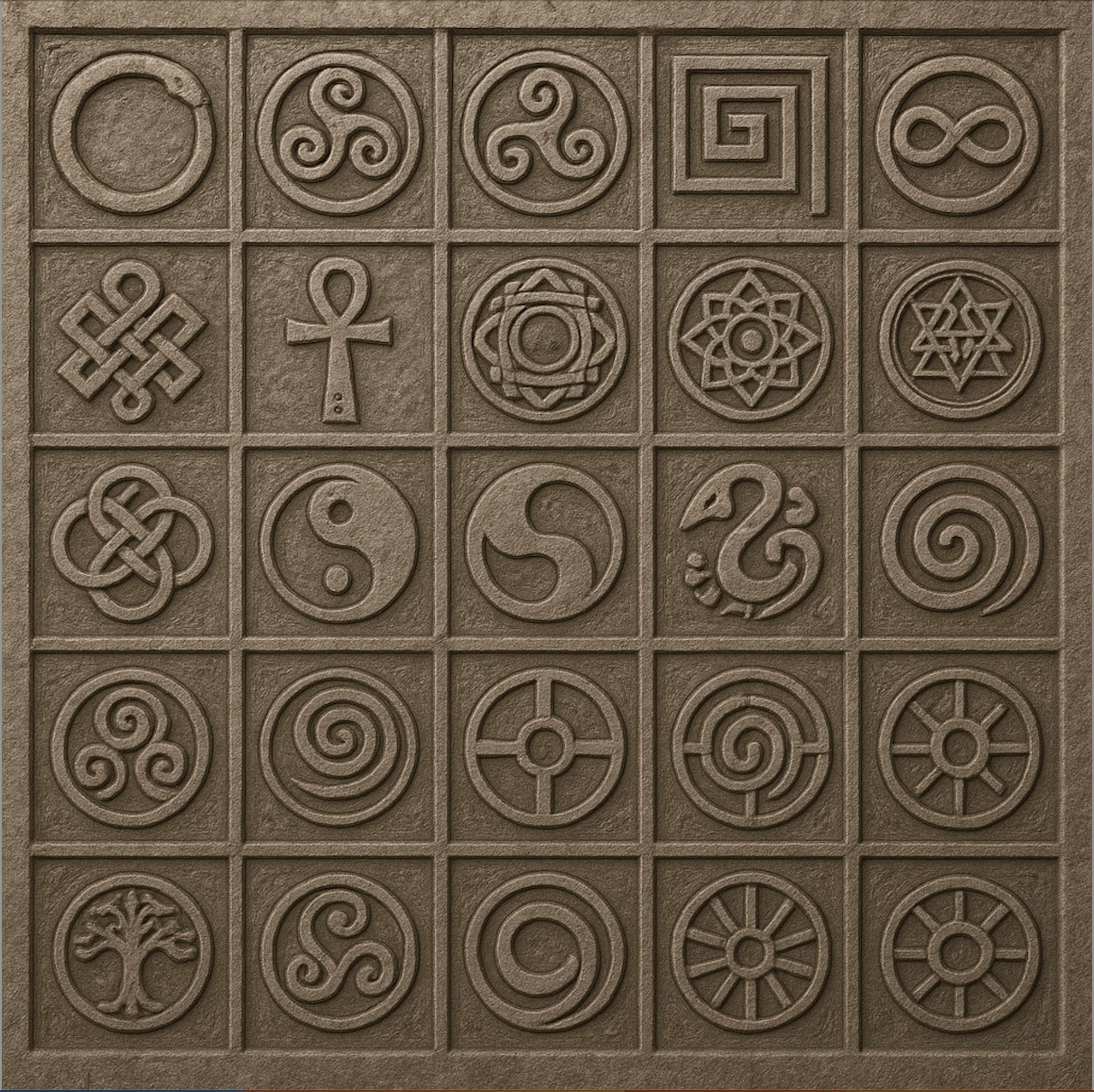
Europe and the Mediterranean
1. Ouroboros — Egypt → Greco-alchemical tradition.
Meaning: a snake biting its own tail — eternal circle, self-generation. Psychology: an image of completeness and cyclicity, the «closing» of life narratives.
2. Spiral / Celtic spiral — Celtic and prehistoric Europe.
Meaning: development, growth, inner/outer dynamics. Psychology: a guide toward the center of the personality, movement toward wholeness.
3. Triskele (Triskelion) — Celts, British Isles.
Meaning: three-part dynamics (life cycles, times of day, triads of meaning). Psychology: a felt sense of moving through different levels of time.
4. Greek meander (Greek key) — classical ornament.
Meaning: continuity, flow. Psychology: a linear yet closed structure that gives a sense of stable continuation.
5. Lemniscate / infinity symbol (∞) — early modern Western emblem (mathematical).
Meaning: infinity as abstract continuity. Psychology: a cognitive symbolization of «boundlessness.»
6. Armenian symbol of eternity (Arevakhach) — Armenia.
Meaning: symbol of eternity, the sun, continuity of national memory. Psychology: collective continuity and a historical «self.»
Middle East, Egypt, Iran
7. Ankh — Ancient Egypt.
Meaning: key of life, eternal life. Psychology: hope of continuation, a symbol of life transcending death.
8. Ancient Persian and Zoroastrian circular motifs
Meaning: eternal return, cosmic orderliness. Psychology: a felt sense of a cosmic axis and constancy.
India and South Asia
9. Mandala / Yantra — Buddhism / Hinduism.
Meaning: sacred map of the cosmos and core wholeness. Psychology: a tool for centering, a «path to the center,» an experience of out-of-time wholeness.
10. Sacred swastika (pre-20th century use) — many ancient cultures of Asia and Europe.
Meaning: movement, cyclicity, solar rotation. Psychology: symbol of renewal; requires caution because of 20th-century historical stigma.
11. Sri Yantra / geometric symbols of infinite order
Meaning: mathematical and symbolic representation of the infinite structure of the universe. Psychology: a support for contemplative practices.
Tibet, China, East Asia
12. Endless/Eternal Knot (Shrivatsa) — Tibetan Buddhism.
Meaning: interweaving of causes and effects, absence of beginning or end. Psychology: experience of interdependence and the absence of linear causality.
13. Yin-Yang — Daoist symbolism.
Meaning: continuous interaction of opposites. Psychology: cycles of shifting states, wholeness through dynamic balance.
14. Tomoe — Japanese spiral emblem.
Meaning: rotation, cosmic movement. Psychology: contemplation of cyclicity and rhythm.
Africa
15. Adinkra: Sankofa (Ghana)
Meaning: «Go back and fetch it» — learn from the past. Psychology: connection of generations, the eternal wisdom of ancestors.
16. Adinkra: Gye Nyame (Ghana)
Meaning: supremacy of the divine, eternity of God. Psychology: reliance on a transcendent factor in human experience.
Oceania and Polynesia
17. Koru — Māori (New Zealand).
Meaning: fern frond spiral — birth, growth, and return to roots. Psychology: cyclical renewal and connection with lineage.
18. Polynesian spiral and interlaced patterns
Meaning: continuity, memory of the tribe. Psychology: collective identity as a path to experiencing «out-of-time» states.
The Americas (Indigenous Peoples)
19. Medicine Wheel — North America.
Meaning: cycles of life, four directions, wholeness. Psychology: a model of time as circular experience and restoration.
20. Peruvian–Mesoamerican images of the serpent and rebirth (Quetzalcoatl, Kukulkan)
Meaning: serpent as a symbol of cyclical renewal and connection with the cosmos. Psychology: archetype of rebirth.
Universal / Modern
21. Labyrinth (not a «maze-escape,» but a symbol of the path to the center)
Meaning: path to the center/source. Psychology: metaphor of the inner journey, experience of stepping «outside» linearity upon reaching the center.
22. Tree of Life
Meaning: vertical axis, connection of worlds (underworld — middle world — upper world). Psychology: axis-support, a way to link past, present, and future with an eternal foundation.
23. Nautilus shell spiral
Meaning: logarithmic spiral as an image of infinite growth. Psychology: representation of development that does not break off but continually expands.
24. Möbius strip (modern mathematical symbol of infinity)
Meaning: one-sided surface without boundaries. Psychology: a contemporary visual metaphor of infinite unity.
25. Solar symbols (wheels, discs, circles)
Meaning: cycles of nature, eternal return of the sun. Psychology: biorhythmic support, a sense of constancy within change.
How to Use This List When Designing an Ornament / Emblem
1. Choose 3–5 motifs — more will reduce legibility. A good combination:
— 1 frame motif (circle/ouroboros),
— 1 central knot (endless knot/mandala/pattern),
— 1 dynamic element (spiral/triskele), and
— 1 semantic «anchor» (ankh, Armenian eternity sign, tree).
2. Consider context and audience. Some symbols (e.g., the swastika) require explicit historical and cultural disclaimers — it is better to avoid them unless you are ready to address this reflexively and clearly.
3. Visual hierarchy. Make the frame the largest element, the central knot the focus of attention, and dynamic elements the radial «rays» of movement.
4. Possible uses.
— Medallion for a title page;
— Border ornament for a page;
— Small emblem in the header/footer;
— — Working meditation card (black-and-white and sepia versions).
5. Ethical note. When using symbols from world cultures, it is helpful in the text to briefly indicate their origin and meaning, so as not to erase cultural authorship and not to fall into cultural appropriation.
The Eternity Experience Questionnaire can be found in the appendix to Chapter 9.
Chapter 10. Timelessness and Atemporality
Summary
This chapter explores the state of timelessness — a qualitative exit of consciousness beyond the category of duration, distinct from «eternity» as a closed form of duration. Through the «ornamental grammar of time» (a circle with three points and an external observer-point) it offers a phenomenological frame: how normal temporal organization turns into a breakdown of temporal anchors, and what clinical and transformative consequences follow. It examines neuropsychiatric phenomena (depersonalization, dissociation), the role of altered states of consciousness (ASCs) and creative birth, and practical therapeutic approaches to restoring temporal anchors through symbols, ritual, and bodily regulation.
Particular attention is given to symbols of emptiness: Kazimir Malevich’s Black Square in the avant-garde of the 20th century became a sign of «nothing — beginning — zero point,» a laconic metaphor of stepping beyond objecthood and time. Its contemporary analogue is the black screen of a phone or computer: a minimalist sign of suspension, waiting, and «reset,» which, in mass culture, can be experienced as an everyday symbol of timelessness. These visual images show how culture finds new forms of fixing the experience of emptiness and stepping outside temporal coordinates.
Key Concepts
Timelessness — an exit beyond the category of duration; loss of anchors in past, future, and coherent present.
Eternity (in the author’s terms) — a special form of duration with rhythm and inner extension, distinct from timelessness.
Observer point outside the circle — a «from above» position, not involved in temporal extension; phenomenologically distinguishes contemplation from timelessness.
Black square / black screen — symbols of the «zero point» and contemporary emptiness; metaphors of stepping outside time.
Duration (durée) — experienced «living time»; a support for psychic wholeness.
Depersonalization / derealization — clinical manifestations of loss of temporal anchors.
ASCs (altered states of consciousness) — a potential resource and a risk: they allow the experiencing of out-of-time narratives but require integration.
Ornamental grammar of time — symbols and schemes materialized in culture that organize the experience of time (ouroboros, triskele, circle with three points).
Aims of the Chapter
— To describe and operationalize the phenomenon of timelessness as a distinct diagnostic and phenomenological category.
— To draw a clear distinction between eternity (as duration) and timelessness (as absence of duration).
— To show clinical manifestations and risks (depersonalization, maladaptation) and provide guidelines for diagnosis.
— To propose a therapeutic strategy: restoring temporal anchors (bodily regulation, work with memory and expectation) plus safe support for creative transformations (symbol, ritual, controlled ASCs).
— To demonstrate a methodology for using cultural and ornamental symbols — from ancient ornaments to Black Square and modern black screens — as tools for restoring and reintegrating the temporal structure of personality.
A moment outside of time — and you are home.
Everything else is road and wandering.
— Rumi
The chapter on timelessness is central to this book and, in fact, to human life in all eras. It addresses what makes a human being a human being in time: the capacity to live and operate with past, present, and future — what we usually call adequacy, mental health, and social inclusion. But there is also a limit to this capacity: a state in which the categories of time lose their service function and cease to be a support — a state I call timelessness.
The classical visual metaphor of time — «three points in a circle» (past, present, future inscribed in eternity) — has long and deservedly served as a support for thinking about temporal wholeness. This model can be found in the work of artists and thinkers; it is fixed in ornamental solutions, religious and philosophical images. However, it is not sufficient for a full understanding of the phenomenon of time. I propose expanding the scheme: adding a fourth point to the triad — a special observer point located outside the circle. This point is not yet another «time»; it is a position «from above,» a perspective of observation not involved in temporal extension. It is the place from which past, present, and future are visible, but which itself does not experience duration.
This distinction allows us to clearly separate two notions that are often confused: eternity and timelessness. Eternity, in my terminology, is still a form of time, although a special one: a closed duration endowed with rhythm, repetition, and inner extension. Timelessness is not a different kind of duration, but an exit beyond the very category of duration; it is an outside view, a static state where everything is «all at once» and nothing moves. Eternity can be experienced and has the quality of «nonlinear duration»; timelessness has no duration at all and is therefore dangerous: it deprives the psyche of temporal supports, disrupts becoming, and breaks connections with the world.
Here ornament ceases to be «mere decoration»: ornament and the understanding of time historically and synchronically develop together in culture and in human consciousness. The familiar «circle with three points» is essentially an ornamental model, materialized in stone, fabric, or miniature. Many symbols of eternity — the ouroboros, the wheel, the tree, the triskele and the like — are culture’s ways of fixing models of time in space. In each of them we see a concrete model of time: a form, a way of movement, a relation between center and periphery. Studying ornaments is therefore not only an aesthetic occupation; it is a way of seeing how humanity at different stages fixed and experienced the structure of time.
From this follows an important practical and clinical conclusion. Symbols of eternity are synonyms of models of time; understanding these models gives us a key to recognizing deviations and disturbances in the temporal organization of the psyche. Timelessness is the transgression of these models: a pathological state relative to the human norm of time, a threat to the formation of personality and to the maintenance of social ties. It is the loss of duration that lies at the core of many severe disturbances in the experience of time — from disorientation and depersonalization to deep existential emptiness. Understanding the structure of timelessness provides clinical guidelines: where to look for the loss of extension, which interventions can restore temporal supports, and which symbolic and practical tools can aid recovery.
Yet in a paradoxical sense, timelessness also contains a possibility. In extreme emptiness, deprived of habitual temporal supports, a person may for the first time become aware of their deepest nature — the image and likeness of a creator — and begin to create themselves and the world out of nothing. In this sense, timelessness is not unambiguously destructive: it can be the starting point of creative birth, the beginning of a new mode of being, provided that there is a «bridge» nearby that can guide and translate this experience into a constructive form. My work in The Book of the Bridge is an attempt to build precisely such a bridge: from the emptiness and darkness of timelessness toward the form of eternity that preserves duration and meaning.
A vivid illustration of this is found in Celtic ornaments on stones, in manuscripts, and in jewelry, where we often see three spherical forms in the center, surrounded by complex interlacing strands and rings. This is not just a decorative device: it is a visual grammar of time — a triad within a circle. Adding the external observer point makes the grammar more complex and richer: we now have both a space of involvement in time and a position that transcends it.
Thus, symbols of eternity are models of time; timelessness is an exit beyond these models, pathological relative to human norm and becoming, yet at the same time potentially the beginning of creativity and transformation. Once we grasp this duality, we gain both an explanation of the mechanisms of severe disturbances in the experience of time and a set of tools for overcoming them — therapeutic, symbolic, and cultural. This understanding becomes the basis for what follows: how to recognize timelessness, how to accompany the transition from timelessness to eternity, and how to use ornamental and practical forms to restore time in a person’s life.
What Is Timelessness?
Timelessness is a state of consciousness and experiential structure in which the supports of duration disappear (or are severely blurred): the past ceases to «pull» memory along with it, the future ceases to be a source of expectation, and the present loses coherent extension. This is not merely «slowed» or «accelerated» time, but a qualitative exit beyond the category of duration: an experience in which everything seems simultaneously «frozen» or «infinitely present,» and the linear connections between many events are lost.
(Reference point: Augustine on the inner nature of time — time as a phenomenon of consciousness.)
Phenomenological Frame (Position of the Observer)
Phenomenologically, timelessness can be considered through the prism of «observer points.» The classical model — a triad (past, present, future) inscribed in a circle — describes normal temporal organization of consciousness; adding a «point outside the circle» (the observer position) helps distinguish eternity (closed duration) from a state that has no duration. In this frame, timelessness appears as a «from-above» perspective not involved in the temporal flow — but unlike a contemplative position, it is often accompanied by a breakdown in connection with bodily experience and with the meaning of being.
(Reference point: Heidegger’s phenomenology of temporality and the existential structure of time.)
Clinic — When Timelessness Becomes Pathology
In psychiatric and neuroscientific contexts, states close to timelessness are observed in depersonalization/derealization and in a number of dissociative disorders: patients describe emotional «bleaching,» a loss of the sense of the extension of events, and a rupture between the experiencing «I» and the flow of time. These are not merely «exotic» experiences — they are often associated with a significant loss of life support and can require clinical intervention and reintegration of the temporal structure of personality.
(Reference point: contemporary reviews of the neurobiology and clinical picture of depersonalization/derealization.)
Altered States of Consciousness — Boundary and Resource
Altered states of consciousness, induced by meditative practices, holotropic breathwork, or psychedelics, often yield similar «out-of-time» phenomena — yet here an important distinction is needed: in a transpersonal paradigm, stepping beyond ordinary duration can be integrating and transforming (with the potential for insight and restructuring of meaning), whereas in clinical cases it may signal a breakdown of supports and maladaptation. This dual face of timelessness — danger and resource — is the key to a therapeutic approach.
(Reference point: Grof and transpersonal research on ASCs.)
Cultural–Ornamental Dimension — How Communities «Imprint» Time
Material culture — ornament, symbolism, architecture — fixes diverse models of time: the ouroboros, the wheel, the triskele, the mandala, and so on. These signs are not mere decoration; they function as visual models of how culture organizes duration and perceived wholeness. Understanding the ornamental grammar of time provides a methodological key: we can see where cultural supports have weakened and how symbols can be used to restore a sense of continuity and extension.
(Reference point: research on the psychology of ornament and visual structure.)
Summary — Working Definition and Therapeutic Implications
Definition. Timelessness is a qualitative state of exiting beyond the category of duration, in which the temporal supports of consciousness disappear or are radically altered.
Two faces. A pathological one (depersonalization, disorientation) and a creative one (transcendent birth, a source of symbolic creativity).
Practical conclusion. Therapy should simultaneously restore temporal supports (bodily regulation, work with memory and expectation) and carefully accompany the creative transformation of experience (symbols, ritual, controlled ASC practices).
(This is a synthesis of clinical and transpersonal practice.)
The Black Screen as a New Ornament
If in the avant-garde of the 20th century Malevich’s Black Square became a sign of the zero point of art and a metaphor of stepping beyond time and objecthood, then in the 21st century a similar symbol of emptiness for millions of people has become the black screen of a phone, tablet, or computer. This screen is an everyday, almost banal image of «nothing»: interruption of signal, waiting for launch, loss of connection. Yet phenomenologically it operates as a contemporary ornament of timelessness — a minimalist form in which habitual duration disappears. The black screen becomes a sign of suspension and reset, a boundary between past and future, a pause in which content is not yet present but a new form is already possible. Just as ornaments once fixed models of time in stone and fabric, today digital culture creates its own symbols — laconic signs of emptiness through which a person experiences timelessness and the possibility of a new beginning.
Therapeutic Aspect of the «Black Screen»
In psychotherapeutic practice, the image of the black screen can be used as a safe metaphor of timelessness. It designates a pause and reset, but not destruction: it is a state of waiting, transition, the possibility of a new start. Working with this image helps the client recognize that emptiness is not always equivalent to loss — it can be a space for new meaning, like a «blank page» for future experience. In imagination practices or meditation, referring to the symbol of the black screen allows one to gently touch the experience of timelessness and translate it into a resource state — of stopping, resting, beginning.
Literature
I. Philosophical Foundations of Time and Atemporality
Augustine of Hippo. Confessions, Book XI.
A classic philosophical–theological reflection on time and memory. The famous question «What then is time?» introduces the notion of an inner extension of consciousness in which past, present, and future are united in the experience of the spirit. Important for distinguishing duration from dimensions that lie beyond time.
Heidegger, M. Being and Time. 1927.
A foundational work that treats temporality as an existential structure of human being. Heidegger’s ideas of «ecstatic time» and the differentiation of temporal dimensions provide a philosophical basis for understanding the observer position beyond duration.
Husserl, E. On the Phenomenology of the Consciousness of Internal Time. 1905.
Develops a methodological apparatus for phenomenological analysis of time through the categories of retention, protention, and the act of the «now.» A cornerstone for understanding the temporal structure of experience and distinguishing psychological time from atemporal perspectives.
II. Religious–Mystical and Transpersonal Perspectives
Eliade, M. The Sacred and the Profane. 1957.
Analyses the difference between sacred (cyclical, atemporal) and profane (linear) time. Essential for understanding ornamental models of time and ritual forms that connect human experience to eternity and to «out-of-time» dimensions.
Grof, S. The Holotropic Mind. 1993; Beyond the Brain. 1985.
The founder of transpersonal psychology describes the phenomenology of altered states of consciousness and experiences of stepping beyond ordinary temporal boundaries. Provides both theoretical and clinical foundations for analysing timelessness and experiences of eternity.
James, W. The Varieties of Religious Experience. 1902.
Describes the characteristics of mystical states — ineffability, noetic quality, sense of unity and out-of-time experience. Serves as an empirical basis for analysing the experience of eternity and its therapeutic significance.
Newberg, A., & d’Aquili, E. Why God Won’t Go Away. 2001.
A study of the neurophysiological correlates of religious experience. Demonstrates differences between the neurobiology of mystical experiences and psychopathological states, helping therapists distinguish transcendent experiences from clinical disorders.
III. Psychology, Neuroscience, and the Clinic of Time
Block, R., & Grondin, S. «Timing and Time Perception: A Selective Review.» 2010.
A modern review of time perception that examines the mechanisms of «internal clocks» and their relation to emotion. Helps explain how duration is lost or distorted in timelessness and other altered states.
Morin, S. «Mindfulness and Time Perception.» 2024.
Studies show that mindfulness practice expands the subjective extension of the «now» and helps restore the temporal structure of personality. Useful for integrating contemplative methods into therapy for temporal disturbances.
Sierra, M., et al. Reviews on depersonalization and derealization, 2004–2023.
Clinical research on phenomena of alienation in which the sense of temporal extension and experiential wholeness is disrupted. Important for understanding timelessness as a pathological state and for developing reintegration strategies.
IV. Ornament, Symbol, and the Material Culture of Time
Gombrich, E. H. The Sense of Order. 1979; Art and Illusion. 1960.
Investigates the psychology of ornament and visual pattern, showing how rhythm and symmetry organize attention and memory. His ideas help formulate a «temporal grammar» of visual structures as models of time and repetition.
Jones, O. The Grammar of Ornament. 1856.
A classic work on the theory and aesthetics of ornament. Demonstrates how, through rhythm, repetition, and symmetry, material culture fixes models of time and eternal return in architectural and decorative forms.
Various authors. Decorative Forms and Cultural Memory Studies. 2020s.
Contemporary studies in the anthropology of ornament that link decorative forms with communicative and mnemonic functions. Show how ornament acts as a form of cultural memory and as a therapeutic anchor in art therapy and autogenic practices.
V. Creativity, Flow, and Aesthetic Experience Beyond Time
Csikszentmihalyi, M. Flow: The Psychology of Optimal Experience. 1990.
A classic work on the phenomenon of flow as a state outside ordinary time. Csikszentmihalyi describes the dynamics of peak experiences in which the merging of action and awareness yields a sense of participation in something eternal and open-ended.
VI. Practical and Therapeutic Guides
Grof, S. Holotropic Breathwork.
A practice aimed at entering altered states of consciousness to integrate unconscious material and reach transpersonal states. Requires strict safety protocols; provides tools for working with experiences of timelessness without destabilizing the personality.
Kravchenko, S. A. ASCs and AI — 2. The Book of the Bridge. 2025.
A methodological and therapeutic development of the concept of a «bridge» from timelessness to eternity. Offers a basis for moving from theory to practice, integrating the phenomenology of time, psychotherapy, and digital technologies.
Schultz, J. H. Autogenic Training. 1932 and subsequent editions.
A method of psychophysiological self-regulation that restores the extension of the present moment and the feeling of temporal stability. Widely used for treating anxiety, stress, and psychosomatic disorders, and for rebuilding temporal anchors in the psyche.
How to Work with This List
— For the philosophical part, begin with Augustine and Heidegger — they provide historical and phenomenological grounding.
— For describing timelessness as an ASC and/or pathology, rely on depersonalization reviews and contemporary time-perception research; they offer clinical indicators and diagnostic tools.
— For visual and ornamental argumentation, use Jones and Gombrich plus anthropological articles — they help link concrete symbols to models of time.
— For practical therapy, combine autogenic training (Schultz) with controlled ASC methods (Grof) and mindfulness approaches (see research on mindfulness and time).
___
Visual Symbols of Timelessness
In world culture there is a set of signs and ornamental devices that can, with a fair degree of justification, be interpreted as visual «symbols of timelessness» — that is, they figuratively represent not just eternity or cyclicity but the absence of duration, limit-as-emptiness, a state «before time» or «outside time.»
A necessary warning at once: most traditional symbols are more naturally read as signifying eternity/cyclicity/wholeness than literal «timelessness.» Translating such images into the term «timelessness» always requires careful hermeneutics (contextual clarification). Below is a selection of candidates with brief explanations indicating why they can (or should not too hastily) be considered symbols of timelessness.
Бесплатный фрагмент закончился.
Купите книгу, чтобы продолжить чтение.