
Бесплатный фрагмент - The Widow’s Daughter and the Invisible Prince
The Fairy Tale
That morning, the sun peered into King Leopold’s bedchamber with particular lack of ceremony. It glided over velvet and gold leaf, striking right into the mirror before which the King stood. Mirrors, it must be said, are honest folk, and at times quite cruel; they do not know how to flatter, even if a monarch stands before them.
Leopold was lathering his cheek with fragrant foam when suddenly his hand froze. Amidst his thick hair — dark as a raven’s wing — glistened a treacherous silver thread. The first gray hair.
“Winter,” the King said softly to his reflection. “Winter is coming to my head, yet spring has still not arrived in my house.”
He set down his razor and looked out the window. The kingdom was in bloom, shepherds drove their flocks, and children laughed in the city streets. But within the castle itself, there was silence — that distinct, ringing silence found only where there is no childish laughter and the patter of little feet. Leopold realized that his throne, that magnificent chair upholstered in silk, was in truth the loneliest thing in the world. To whom would he pass the orb and scepter? Who would wear the crown when his head finally turned white as snow?
He summoned the doctors. Oh, how importantly they puffed out their cheeks! They brought mixtures bitter as wormwood and sweet as honey. Sages arrived with thick books in which the dust of ages lay thicker than wisdom. Priests came, raising their hands to the heavens. But the heavens remained silent, and the cradle remained empty. The King felt fear — cold and clammy as a swamp fog — filling his heart. A kingdom without an heir is a tree without roots; the first storm will topple it.
And then one day, when hope had nearly melted away like wax on a stove, a strange man appeared at the castle gates. His name was Malvus. No one saw where he came from; it seemed he had woven himself out of road dust and evening shadows.
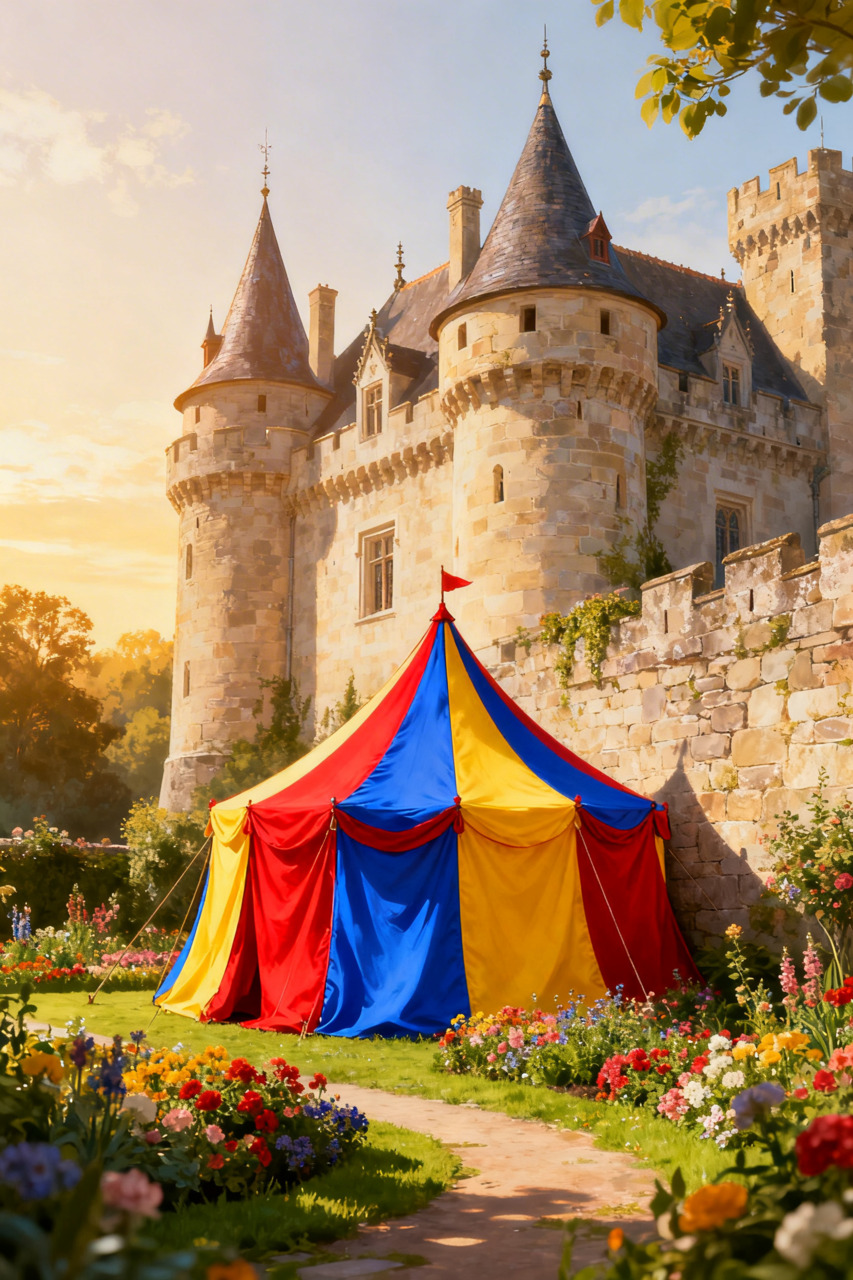
Malvus did not ask for a room at the inn. Right beneath the walls of the royal castle, there where the wild rose bloomed, he pitched his tent. Though one could hardly call it a tent: it was a strange, pointed little tower of motley cloth, topped with a weathervane that spun even in the stillness.
“Be gone!” the guards shouted at him, banging their halberds. “This is no place for vagabonds!”
But Malvus only smiled, and in that smile was something that made the brave soldiers feel ill at ease.
“I need to see the King,” he said in a voice like the creaking of an old tree. “And the King will want to see me.”
The guard tried to drive him away, but every time they approached the tent, their legs turned to cotton and their spears became heavier than mountains. They were forced to report to Leopold. The King, who was now clutching at straws, ordered the wanderer to be let in.
Malvus entered the throne room without bowing, as if he were an equal among equals. His cloak was threadbare, but his eyes burned with a young and frightening fire.
“I know your sorrow, Sire,” the mage said, wasting no time on empty greetings. “You fear that your name will vanish like a footprint in the sand.”
From the folds of his cloak, he produced an apple. It was golden, yet not made of metal; it was alive, warm, and glowing from within with a soft light.
“Here is the solution,” Malvus whispered. “Cut it in half. Eat one half yourself, and give the other to Queen Eleanor. And let her, as she tastes it, wish with all her heart for a child.”
Leopold reached out, but the mage pulled the apple back.
“Everything has a price, Your Majesty. Magic is a scale. If the cup of joy is filled, the cup of debt must not remain empty.”
The mage produced a scroll written on parchment so thin it seemed transparent.
“The terms are simple,” the sorcerer continued. “If a daughter is born, she is mine. I will take her forever. If a son is born, he shall belong to us both. One year he will live in your palace, the next in my tower.”
King Leopold looked at the mage, then at the golden apple. Despair and pride battled within his soul. A daughter? he thought. I need an heir, a son! And if it is a son… Who is this drifter to dictate terms to a King? I will sign, and then… I have guards, I have an army. Who would dare take a lion’s cub from the lion?
Oh, how often we deceive ourselves, thinking we can outwit fate!
“I agree,” the King said firmly, and without trembling, he signed the parchment. The letters flared red and faded away.
That very evening, the King and Queen ate the golden apple. It was sweet, yet it left a strange aftertaste on the tongue — as if honey had been mixed with sea salt, joy with a coming tear.
Time marched on, as is its duty. Soon, Queen Eleanor blossomed like a rose after the rain. Joy returned to the castle, the tapestries seemed brighter, and the servants more brisk. And when the hour struck, a child cried out in the royal cradle.
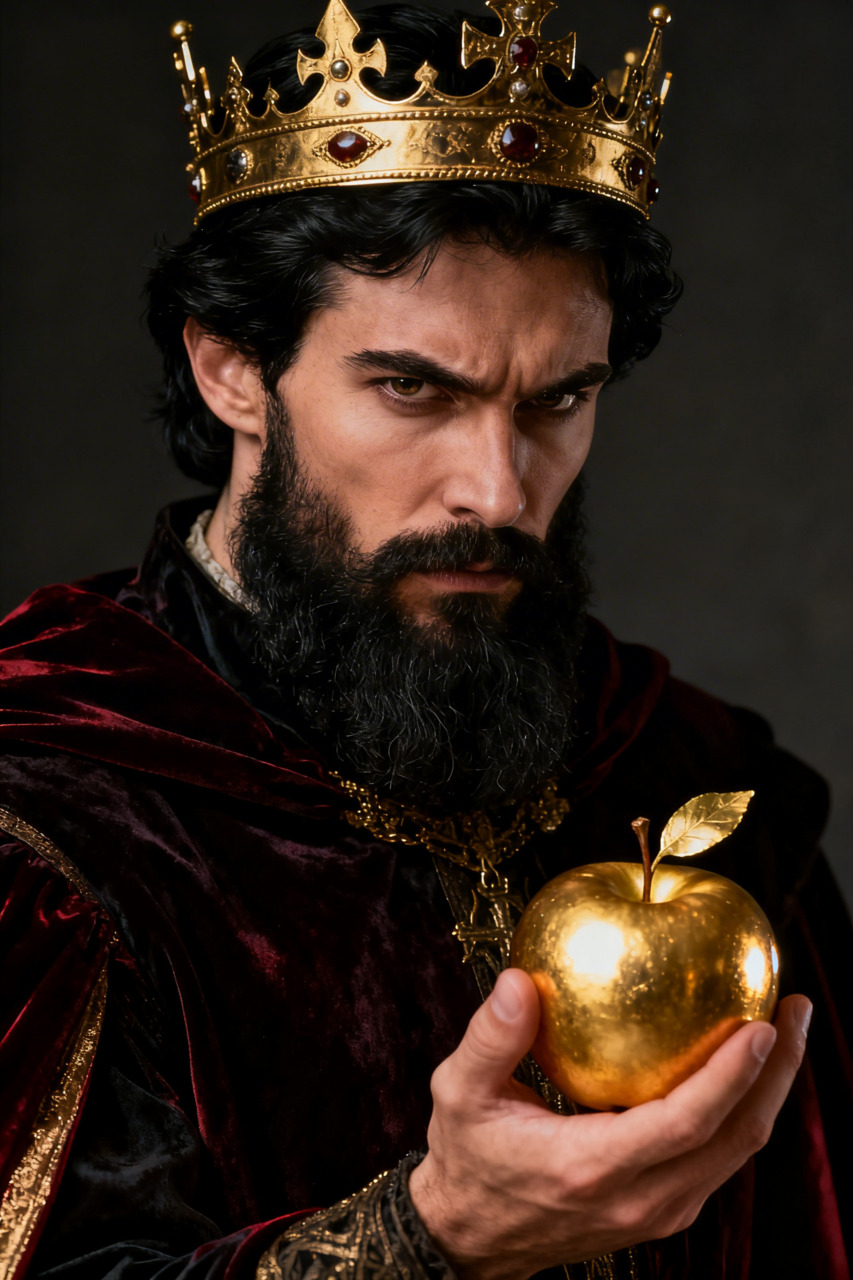
It was a boy. Strong, healthy, with eyes as blue as the summer sky.
Leopold was happy. He held his son in his arms and laughed, looking out the window where, far away on the horizon, the wind chased a tumbleweed. He had completely forgotten about the strange motley tent and the fact that the signed contract was not merely paper, but a shadow that would now follow his son closely at his heels.
Time is a strange healer; it stitches up wounds, yet it buries memory under shifting sands. Prince Adrian grew, and it seemed the sun itself had kissed him at birth. What a fine youth he was! His eyes burned with a lively intelligence, and his heart was as soft as wax for another’s misfortune, yet as hard as steel against injustice.
By the time he turned fifteen, he was the pride of the kingdom. When Adrian mounted a horse, it seemed rider and steed were one, flying faster than the wind. His arrows never missed their mark and sang like birds in flight. And when he took up his lute, even the court ladies — whose hearts were usually coated in powder and etiquette — would secretly wipe away tears, so tender was his music. He read books in languages even the sages had long forgotten, and he laughed so clearly that the echo in the throne room would begin to dance.
Fifteen years flew by like fifteen days. There was neither hide nor hair of the strange mage Malvus. The winds had blown away the traces of his patchwork tent, and the rains had washed away the fear. King Leopold, looking upon his magnificent son, began to think that the visit from long ago had been nothing but a bad dream, a trick of the mind.
“Who would come to collect a debt after so many years?” he told himself, stroking his graying beard. “That scrap of paper must have long since crumbled in that old drifter’s pocket, and he himself surely perished in some ditch.”
Ah, Your Majesty! The memory of kings is short, but the memory of magic is eternal.
And so, on a day when the roses in the garden were blooming with particular splendor, the familiar pointed tower rose once again by the castle wall. It appeared as suddenly as if it had sprung from the earth, like a toadstool after rain.
Malvus stood at the gates. He hadn’t changed a bit; time, it seemed, flowed around him. He wore the same threadbare cloak, the same piercing gaze.
“I have come for what is mine,” he said simply, when brought before the king.
Leopold went pale. He ordered chests brimming with gold to be brought out; he offered the mage fertile lands, herds of the finest horses, even a dukedom.
“Take everything!” the king cried, forgetting his pride. “Just leave me my son!”
Malvus merely shook his head. His laugh sounded like the rustling of dry leaves.
“You wish to buy off time with metal? Foolish king. For fifteen years he was your sun, your joy. Now the scales have tipped. For the next fifteen years, he belongs to me. That is the bargain.”
“No!” shrieked Leopold, reaching for his sword.
But Malvus clapped his hands. His tower shuddered, shimmered with haze, and vanished as if it had never been. And in that same instant, the royal chambers where Prince Adrian sat reading by the window became empty. All that remained was an open book and a light breeze turning the pages.
Grief came to the castle, and this time it was gray and bleak, like an autumn sky. Leopold sent messengers to all corners of the world. Knights in shining armor galloped north, south, east, and west, but they returned on weary horses, heads hung low. No one had seen the patchwork tower; no one had seen the prince.
Queen Eleanor aged in a single night, and the king wandered the corridors like a shadow, muttering under his breath. The mirrors in the castle were draped with cloth, for no one wished to see their own reflection anymore.
Prince Adrian’s chambers were ordered to be left untouched. Everything remained exactly as it was the moment he vanished: the lute in the corner, the quill forgotten in the inkwell, the doublet thrown over the back of a chair. Only the dust, soft and fluffy, slowly tucked the objects under a gray blanket.
But soon, the servants began to whisper.
“Someone is walking in there,” said the old washerwoman, her eyes wide.
“I heard a sigh, heavy as a tombstone,” the gatekeeper added.
People began to give the prince’s tower a wide berth. At night, strange sounds truly did drift from behind the locked door: the creak of a floorboard, a quiet, barely audible moan, or a rustling, as if someone invisible were searching for something lost.
“It is a ghost!” whispered the superstitious maids. “The prince’s soul has returned and can find no rest!”
The rumors reached the king. A wild spark of hope flared in his heart. What if his son had returned? What if he simply couldn’t get out? Leopold rushed to the room himself, but his legs would not obey him, and his hands trembled so violently that the key missed the keyhole. Fear of the unknown proved stronger than love.
Then the king announced:
“One hundred gold coins to the man who spends the night in the prince’s room and tells me in the morning what is happening there!”
One hundred gold coins! For that money, one could buy a house with a garden and live in ease for the rest of their days. Brave men stepped forward — burly guardsmen, seasoned mercenaries, boastful hunters.
They entered the room with a swagger, lit candles, and rested their hands on the hilts of their swords. But no sooner did the clock on the main tower strike midnight than the door would fly open, and the brave souls would tumble out head over heels, pale as a sheet, their lips trembling.
“What? What did you see in there?” the king would shake them by the shoulders.
But they could explain nothing.
“There… there…” they stammered, teeth chattering. “There is no one there… but it is so crowded… and someone is watching… from inside your own self…”
None of them saw monsters; none of them saw ghosts in white sheets. But what they encountered in that silence was more terrifying than any dragon. It was an emptiness that knew how to speak.
Far from the royal castle, where the city ended and the vegetable gardens and wastelands began, stood a crooked, dilapidated hut. The wind roamed through it as freely as it did in the street, and swallows nested in the chimney — the only wealth possessed by the widow Greta and her daughter, Anna.
They lived poorly, so poorly that a church mouse would have seemed a wealthy gentlewoman by comparison. Anna was a girl as thin as a reed, with large gray eyes where sadness often hid. They had little firewood and even less food. Often, they went to sleep having supped only on fairy tales and hope — though, as everyone knows, hope may warm the soul, but it cannot fill the belly.
And so, the news of the hundred gold coins eventually drifted down to their crooked little alleyway. One hundred gold coins! For Anna and her mother, this was not merely money — it was life itself. It meant warm bread every morning, new shoes without holes, and firewood crackling merrily in the hearth.
“Mother,” Anna said one evening, when her stomach was rumbling louder than the stove. “A hundred gold coins will save us. I will go.”
Widow Greta threw up her hands. “Come to your senses, child! Soldiers with mustaches sharp as pikes went there, and even they fled! What will you do, my little bird?”
“The soldiers had something to lose — their pride,” Anna answered quietly, darning yet another hole in her apron. “But we are perishing anyway. Hunger is scarier than any ghost, Mother. If God exists, He won’t let me be harmed. And if not… then what is the difference where I die — here on cold straw, or there on velvet featherbeds?”
The widow wept, kissed her daughter on the forehead, and crossed her with a trembling hand.
Anna arrived at the castle. The guards in their gilded armor might have laughed at her patched dress, if anyone in the castle still knew how to laugh. King Leopold simply waved his hand; he no longer cared. Let even a cat spend the night in that tower, if only the secret might be revealed.
Anna was let into the Prince’s room. Oh, what treasures were there! Soft carpets in which her feet sank, paintings in heavy frames… But the girl looked only at the table. There, at her request, supper had been left: a roast chicken, white bread, and a jug of apple cider.
When the heavy door slammed shut behind her and the key turned in the lock, Anna did not tremble. She sat down and began to eat. How delicious bread tastes when you haven’t eaten it for a week!
Night fell. The shadows in the corners grew long and predatory. The silence pressed against her ears like a heavy quilt. Anna’s eyes began to close — a full stomach lulls one to sleep — but she could not sleep. To rouse herself, she poured a full goblet of the foamy cider.
Suddenly, right behind her back, came a groan. Heavy, drawn-out, as if anguish itself had found a voice.
Anna’s hand jerked. The goblet tipped, and the golden cider splashed onto the floor, spreading in a sticky puddle. Her heart fluttered like a trapped bird, but Anna remembered her mother’s hungry eyes and stubbornly straightened her back.
“Well, why are you moaning so?” she said loudly into the void. Her voice trembled, but she tried to sound cheerful. “If you are a spirit and want to scare me — don’t bother, I’m already scared. And if you are a person — come out, there is enough chicken for two. I’m not greedy.”
There was no answer. The silence grew even thicker. To keep from going mad with her own fear, Anna began to say whatever came into her head:
Бесплатный фрагмент закончился.
Купите книгу, чтобы продолжить чтение.