
Бесплатный фрагмент - Тренинг по грамматике английского языка
Практический курс от простого к сложному
Предисловие
Дорогие читатели,
Изучение английского языка часто кажется сложным, особенно когда речь идёт о грамматике. Моя цель в этой книге — показать, что грамматика может быть понятной, логичной и увлекательной, независимо от вашего возраста и уровня подготовки.
Каждая глава построена так, чтобы вы изучали материал поступательно и последовательно: сначала вы знакомитесь с правилом на русском языке, затем видите его применение в примерах и коротких историях на английском, и, наконец, закрепляете знания с помощью упражнений. Такой подход позволяет постепенно формировать уверенность в языке, избегая перегрузки и путаницы.
Особое внимание уделено ясности объяснений и практическому использованию грамматики. В каждой главе вы найдете полезную лексику и мини-советы по запоминанию слов и конструкций. Истории и упражнения созданы так, чтобы вы могли применять грамматику в реальной речи, а не только заучивать правила.
Эта книга создана для широкой аудитории — она подходит как школьникам и студентам, так и взрослым, которые изучают английский язык впервые или возвращаются к нему после перерыва. Материал изложен доступно и последовательно, что позволяет использовать книгу как учебник для школы, самостоятельного обучения или дополнение к курсам английского языка. Каждый читатель сможет найти здесь подходящий темп обучения и практические примеры, которые помогут закрепить грамматику в повседневной речи и письме.
Я надеюсь, что эта книга станет для вас не только справочником, но и надёжным помощником на пути к свободному и уверенно построенному английскому языку. Поступательное и последовательное обучение позволит вам шаг за шагом укреплять знания и говорить и писать правильно и уверенно.
Present Simple — Habits and Facts
Grammar Focus
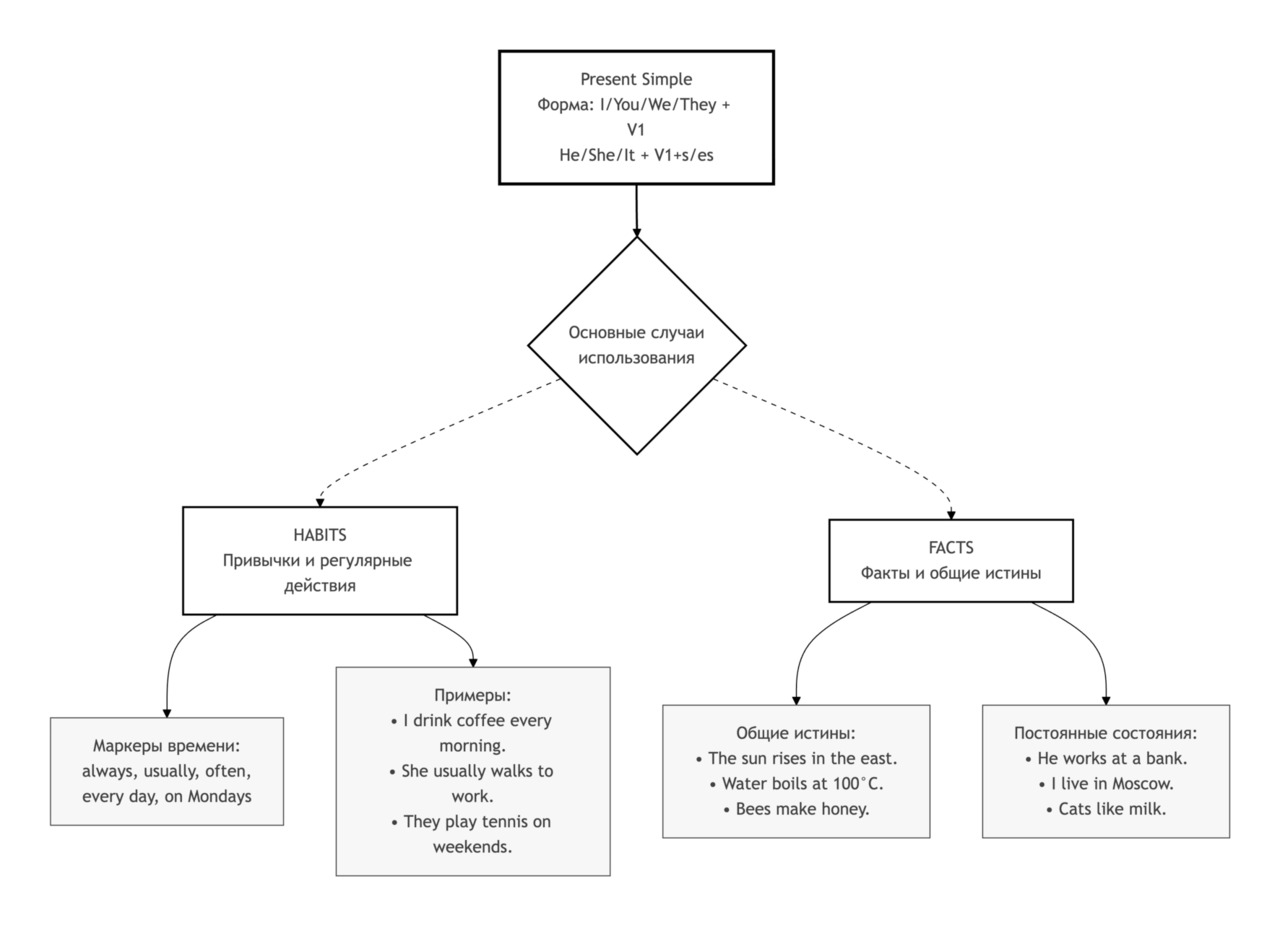
Present Simple используется для:
Регулярных действий, привычек и распорядка.
Общих истин и фактов (научных, общеизвестных).
Постоянных состояний и качеств людей или предметов.
Образование:
Для I / You / We / They: основная форма глагола.
I read books every evening. — Я читаю книги каждый вечер.
Для He / She / It: добавляем -s / -es.
She reads books every evening. — Она читает книги каждый вечер.
Типичные ошибки:
Пропуск -s / -es для 3-го лица единственного числа:
Wrong: He like pizza.
Correct: He likes pizza.
Использование Present Continuous вместо Present Simple для привычек:
Wrong: I am going to school every day.
Correct: I go to school every day.
Советы:
Ключевые слова для привычек: always, usually, often, sometimes, never, every day/week.
Для 3-го лица всегда проверяйте, нужно ли добавить -s / -es.
Story
A Typical Day
Anna lives in a small town. She wakes up at 6:30 every morning. She brushes her teeth and eats breakfast with her family. Her father drinks coffee, and her mother makes toast.
After breakfast, Anna goes to school. She walks with her brother and they talk about their lessons. Anna studies English, math, and history. She enjoys English the most because she likes reading stories in English.
In the afternoon, Anna returns home. She does her homework and sometimes helps her mother in the garden. In the evening, she reads a book or watches a short program on TV. She usually goes to bed at 9:00.
Anna’s dog, Max, always waits for her in the evening. Max loves walks, food, and playing with Anna. Everyone in the family likes Max because he is friendly and funny.
Useful Words and Expressions
wake up — просыпаться
brush teeth — чистить зубы
eat breakfast — завтракать
make toast — готовить тосты
drink coffee — пить кофе
go to school — идти в школу
walk — идти пешком
talk about — говорить о
study — учиться, изучать
enjoy — получать удовольствие
do homework — делать домашнюю работу
help — помогать
in the afternoon — днем
in the evening — вечером
read a book — читать книгу
watch TV — смотреть телевизор
usually — обычно
sometimes — иногда
every morning — каждое утро
love — любить
Exercises
Exercise 1: Fill in the blanks (Present Simple)
Anna ___ (wake) up at 6:30 every morning.
Her mother ___ (make) toast for breakfast.
She ___ (walk) to school with her brother.
Anna ___ (enjoy) reading English stories.
Max ___ (love) walks and food.
Exercise 2: Multiple Choice
Choose the correct answer:
He ___ coffee every morning.
a) drinks
b) drink
c) drinking
They ___ to school together.
a) walk
b) walks
c) walking
Anna ___ TV in the evening.
a) watches
b) watch
c) watching
Exercise 3: Questions about the story
Answer 2–3 sentences each:
What does Anna do in the morning?
Who walks to school with Anna?
Which subject does Anna enjoy the most?
How does Anna spend her afternoon?
Why does the family like Max?
Answer Key
Exercise 1:
wakes
makes
walks
enjoys
loves
Exercise 2:
a) drinks
a) walk
a) watches
Exercise 3:
In the morning, Anna wakes up, brushes her teeth, and eats breakfast with her family.
Anna walks to school with her brother.
Anna enjoys English the most because she likes reading stories in English.
In the afternoon, Anna does her homework and sometimes helps her mother in the garden.
The family likes Max because he is friendly, funny, and loves playing with them.
Mini tips:
Чаще встречайте и используйте слова always, usually, sometimes, never — они помогают запомнить Present Simple.
Для закрепления: рассказывайте о своей повседневной жизни простыми предложениями на английском.
Повторяйте короткие истории, отмечая все глаголы в Present Simple.
Present Continuous — Actions Happening Now
Grammar Focus
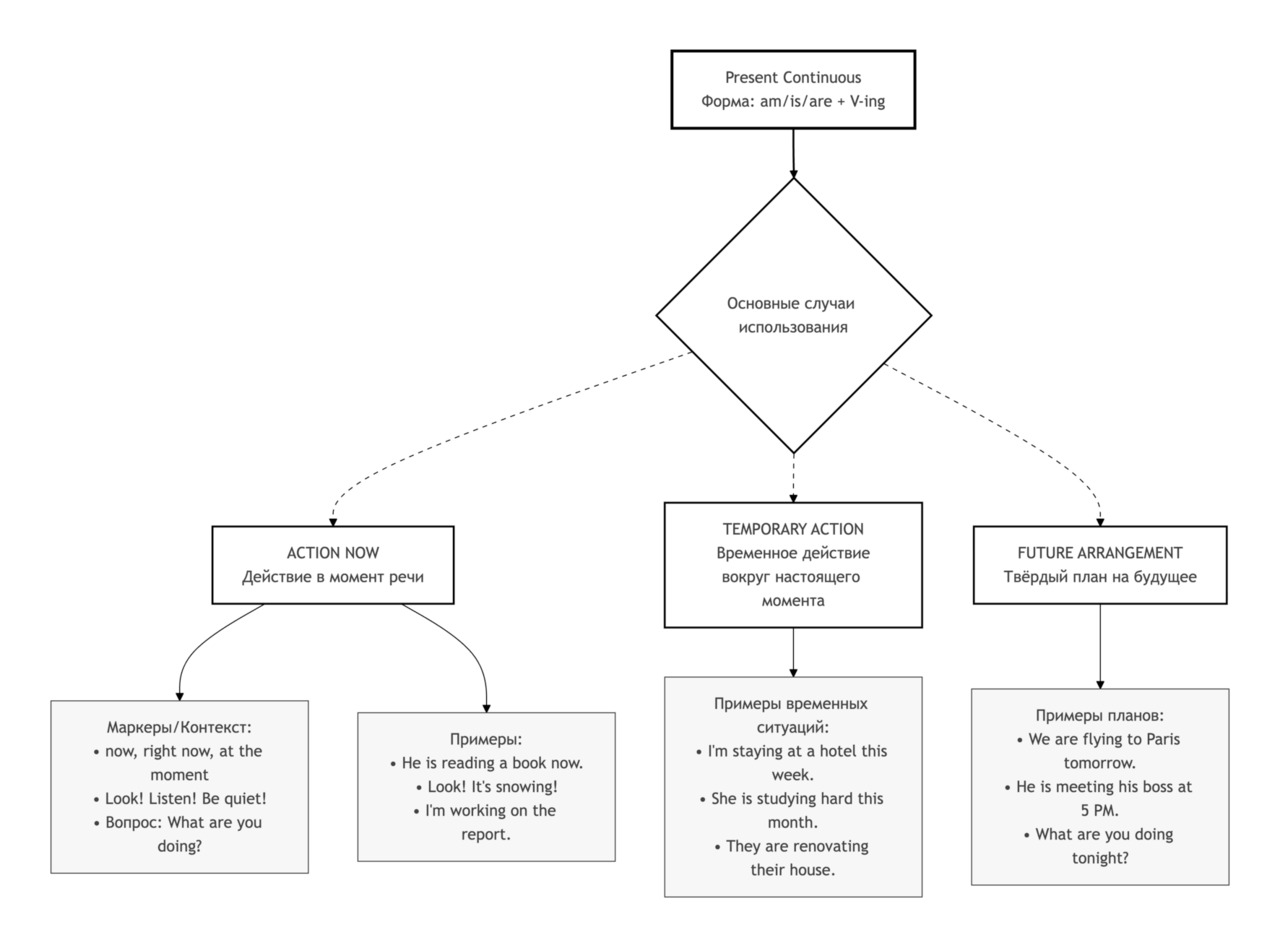
Present Continuous используется для:
Действий, происходящих прямо сейчас.
Временных действий, которые происходят вокруг момента речи.
Запланированных действий в ближайшем будущем.
Образование:
I am + V-ing
I am reading a book. — Я читаю книгу.
He / She / It is + V-ing
She is watching TV. — Она смотрит телевизор.
You / We / They are + V-ing
They are walking in the park. — Они гуляют в парке.
Типичные ошибки:
Забудьте добавлять -ing:
Wrong: She watch TV now.
Correct: She is watching TV now.
Использование Present Simple вместо Continuous для действия, происходящего прямо сейчас:
Wrong: I read a book now.
Correct: I am reading a book now.
Неправильное сочетание формы глагола с подлежащим:
Wrong: I is watching TV.
Correct: I am watching TV.
Советы:
Обратите внимание на слова-маркеры: now, at the moment, currently, today.
Для 3-го лица единственного числа нет изменения формы глагола — только is + V-ing.
Story
A Busy Morning
It is Monday morning. Peter is sitting at his desk and drinking coffee. His sister, Lisa, is reading a magazine in the living room. The cat, Whiskers, is sleeping on the sofa.
Peter’s mother is cooking breakfast in the kitchen. She is making eggs and toast. Peter’s father is talking on the phone in the office.
Outside, the neighbors are walking their dogs. The sun is shining, and the birds are singing. Peter’s little brother is drawing pictures at the table.
At this moment, Peter is typing an email. Lisa is listening to music. Everyone is busy, but the house is full of laughter and energy. It is a typical morning in Peter’s home.
Useful Words and Expressions
sit at the desk — сидеть за столом
drink coffee — пить кофе
read a magazine — читать журнал
sleep — спать
cook / make breakfast — готовить завтрак
talk on the phone — говорить по телефону
walk the dog — выгуливать собаку
shine — светить
sing — петь
draw pictures — рисовать
type an email — печатать письмо
listen to music — слушать музыку
at the moment — в данный момент
now — сейчас
currently — в настоящее время
busy — занятый
everyone — все
typical — типичный
house — дом
laughter — смех
Exercises
Exercise 1: Fill in the blanks (Present Continuous)
Peter ___ (sit) at his desk and ___ (drink) coffee.
Lisa ___ (read) a magazine.
Whiskers ___ (sleep) on the sofa.
Peter’s mother ___ (cook) breakfast.
Peter ___ (type) an email.
Exercise 2: Multiple Choice
Choose the correct answer:
She ___ a song now.
a) sings
b) is singing
c) sing
They ___ in the park at the moment.
a) walk
b) are walking
c) walks
I ___ my homework currently.
a) do
b) am doing
c) does
Exercise 3: Questions about the story
Answer 2–3 sentences each:
What is Peter doing at his desk?
Where is Lisa and what is she doing?
What is Peter’s mother cooking?
What are the neighbors doing outside?
How is the house during the morning?
Answer Key
Exercise 1:
is sitting, is drinking
is reading
is sleeping
is cooking
is typing
Exercise 2:
b) is singing
b) are walking
b) am doing
Exercise 3:
Peter is sitting at his desk and drinking coffee. He is also typing an email at this moment.
Lisa is in the living room reading a magazine. She is also listening to music at some points.
Peter’s mother is cooking breakfast. She is making eggs and toast.
The neighbors are walking their dogs outside. The sun is shining and the birds are singing.
The house is busy but full of laughter and energy. Everyone is doing something different.
Mini tips:
Слова-маркеры now, at the moment, currently помогают быстро понять, что нужно использовать Present Continuous.
Чтобы закрепить, описывайте вслух, что делают люди вокруг вас прямо сейчас.
Сравнивайте с Present Simple: привычки → Present Simple, действия сейчас → Present Continuous.
Present Simple vs Present Continuous
Grammar Focus
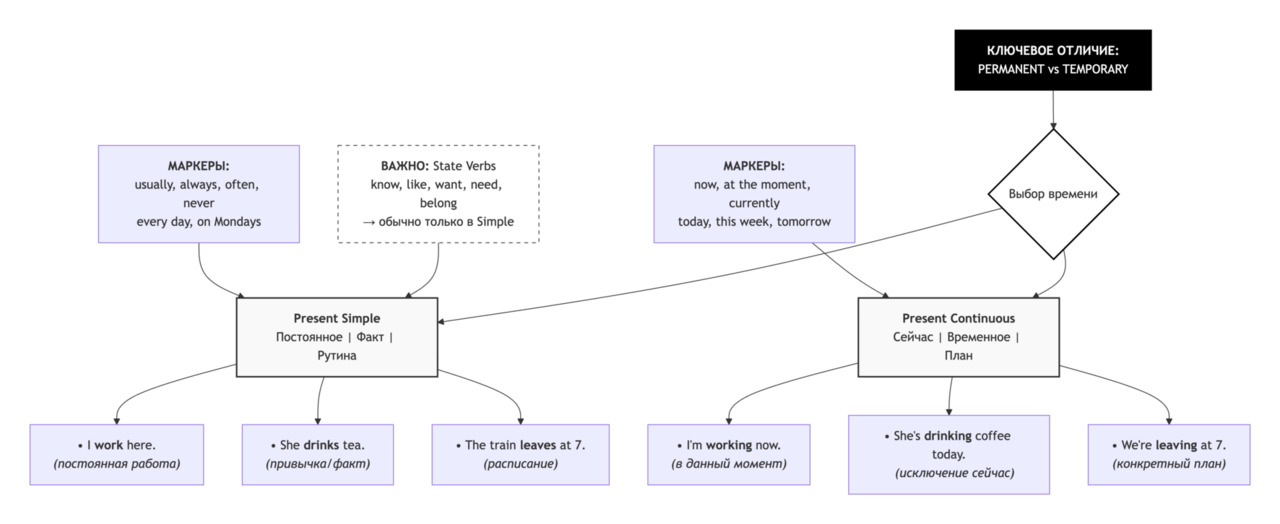
Когда использовать Present Simple:
Регулярные действия и привычки
I play football every day. — Я играю в футбол каждый день.
Общие факты и истины
The sun rises in the east. — Солнце встаёт на востоке.
Когда использовать Present Continuous:
Действия, происходящие прямо сейчас
I am playing football now. — Я сейчас играю в футбол.
Временные действия, происходящие вокруг момента речи
She is studying English this week. — Она учит английский на этой неделе.
Типичные ошибки:
Использование Present Simple вместо Continuous для действий сейчас:
Wrong: He plays football now.
Correct: He is playing football now.
Использование Continuous для привычек:
Wrong: I am reading books every evening.
Correct: I read books every evening.
Советы:
Ключевые слова для Present Simple: always, usually, often, sometimes, never, every day/week.
Ключевые слова для Present Continuous: now, at the moment, currently, today.
Сравнивайте действия и привычки, чтобы выбрать правильное время.
Story
Two Days in Emma’s Life
Emma lives in a quiet town. Every morning, she wakes up at 7:00, brushes her teeth, and eats breakfast. She usually drinks tea and reads the newspaper. After breakfast, she goes to work by bus.
Today is Monday, and she is feeling energetic. At this moment, she is sitting in the park near her office, drinking coffee, and watching people. Some children are playing on the swings, and a dog is running across the grass. Emma notices that the flowers are blooming and the sun is shining brightly.
After a short break, Emma returns to her office. She usually answers emails in the morning, but today she is preparing a report for her manager. Everyone is busy, but Emma enjoys observing life outside while she works.
Useful Words and Expressions
wake up — просыпаться
brush teeth — чистить зубы
eat breakfast — завтракать
drink tea/coffee — пить чай/кофе
read newspaper — читать газету
go to work — идти на работу
take the bus — ехать на автобусе
sit in the park — сидеть в парке
watch people — наблюдать за людьми
play on swings — качаться на качелях
run — бегать
bloom — цвести
shine — светить
prepare a report — готовить отчет
answer emails — отвечать на письма
energetic — энергичный
observe — наблюдать
at this moment — в данный момент
usually — обычно
today — сегодня
Exercises
Exercise 1: Fill in the blanks
Emma ___ (wake) up at 7:00 every morning.
She ___ (drink) coffee in the park at this moment.
The children ___ (play) on the swings.
Emma usually ___ (answer) emails in the morning.
Today she ___ (prepare) a report for her manager.
Exercise 2: Multiple Choice
Choose the correct form:
The dog ___ across the grass now.
a) runs
b) run
c) is running
She ___ tea every morning.
a) drinks
b) is drinking
c) drink
Emma ___ in the park at the moment.
a) sit
b) is sitting
c) sits
Exercise 3: Questions about the story
Answer 2–3 sentences each:
What does Emma do every morning?
What is Emma doing in the park today?
What are the children and the dog doing?
What does Emma usually do in the morning?
How is Emma feeling today?
Answer Key
Exercise 1:
wakes
is drinking
are playing
answers
is preparing
Exercise 2:
c) is running
a) drinks
b) is sitting
Exercise 3:
Every morning, Emma wakes up, brushes her teeth, eats breakfast, and usually drinks tea and reads the newspaper.
Today, she is sitting in the park, drinking coffee, and watching people.
The children are playing on the swings, and the dog is running across the grass.
Emma usually answers emails in the morning.
Today Emma is feeling energetic and enjoys observing life outside.
Mini tips:
Сравнивайте привычки (Present Simple) и действия сейчас (Present Continuous).
Используйте ключевые слова для проверки: usually, every day → Simple; now, at this moment → Continuous.
Читайте истории, подчеркивая глаголы и определяя время.
There is / There are — Existence and Presence
Grammar Focus
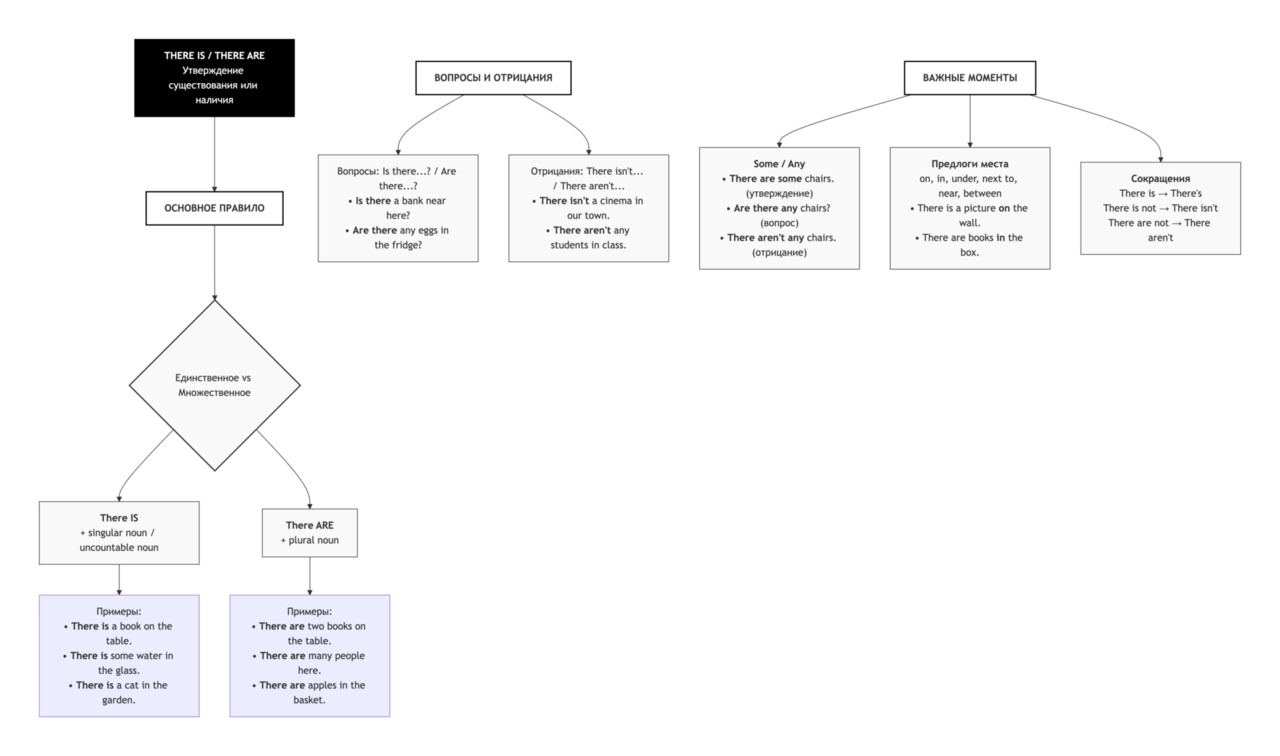
There is / There are используются для указания на существование или наличие чего-либо в определённом месте.
Образование:
There is + singular noun / uncountable noun
There is a book on the table. — На столе есть книга.
There is milk in the fridge. — В холодильнике есть молоко.
There are + plural noun
There are two chairs in the room. — В комнате есть два стула.
Отрицание:
There isn’t + singular / uncountable
There isn’t any sugar. — Сахара нет.
There aren’t + plural
There aren’t any apples. — Яблок нет.
Вопрос:
Is there …? / Are there …?
Is there a pen on the desk? — Есть ли ручка на столе?
Are there any students in the classroom? — Есть ли студенты в классе?
Советы:
Используйте a / an для единственного числа.
Для отрицания используйте any с существительными в множественном числе и неисчисляемыми.
Старайтесь сначала представить, что вы описываете место, а потом строить предложение.
Story
A New Classroom
Today, a new teacher arrives at Greenfield School. She opens the door and looks inside. There is a big whiteboard at the front of the classroom. There are twenty desks and twenty chairs.
In the corner, there is a bookshelf with many books. On the walls, there are colorful posters and maps. There isn’t a clock on the wall, so the teacher will bring one later.
Near the window, there is a small plant. There are also two computers on a table. Some students are already in the room. There are ten students sitting quietly and reading. Others are talking softly near the door.
The teacher smiles and says, «It’s a nice classroom. There is everything we need for learning.» Everyone agrees, and the day begins happily.
Useful Words and Expressions
there is — есть (единственное число, неисчисляемое)
there are — есть (множественное число)
desk — стол
chair — стул
whiteboard — белая доска
bookshelf — книжная полка
book — книга
wall — стена
poster — плакат
map — карта
clock — часы
plant — растение
computer — компьютер
student — ученик
corner — угол
window — окно
big — большой
small — маленький
colorful — красочный
quietly — тихо
Exercises
Exercise 1: Fill in the blanks
There ___ (be) a big whiteboard at the front of the classroom.
There ___ (be) twenty desks and chairs.
There ___ (not / be) a clock on the wall.
There ___ (be) two computers on the table.
There ___ (be) ten students sitting quietly.
Exercise 2: Multiple Choice
Choose the correct answer:
___ there a bookshelf in the corner?
a) Are
b) Is
c) Be
There ___ many colorful posters on the walls.
a) is
b) are
c) be
There ___ a small plant near the window.
a) are
b) is
c) isn’t
Exercise 3: Questions about the story
Answer 2–3 sentences each:
What is at the front of the classroom?
How many desks and chairs are there?
What is missing on the wall?
Where are the computers?
How do the students behave when the teacher arrives?
Answer Key
Exercise 1:
is
are
isn’t
are
are
Exercise 2:
b) Is
b) are
b) is
Exercise 3:
At the front of the classroom, there is a big whiteboard.
There are twenty desks and twenty chairs in the classroom.
There isn’t a clock on the wall, so the teacher will bring one later.
The computers are on a table near the window.
Some students are sitting quietly and reading, while others are talking softly near the door.
Mini tips:
Чтобы быстрее запомнить: there is = 1 / uncountable, there are = 2+.
Для отрицаний всегда добавляйте not + any (если множественное число или неисчисляемое).
Используйте истории о комнатах, домах или классах, чтобы практиковать «there is / there are» в разных местах.
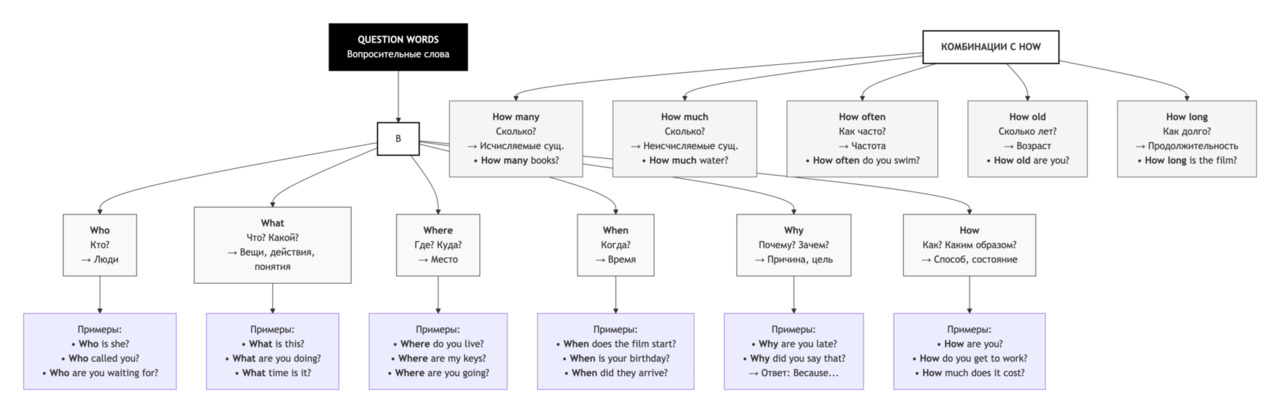
Question Words — Who, What, Where, When, Why, How
Grammar Focus
Question words используются для вопросов о людях, предметах, местах, времени, причинах и способах действий.
Who — спрашиваем о человеке.
Who is your teacher? — Кто твой учитель?
What — спрашиваем о вещах или действиях.
What do you like to eat? — Что тебе нравится есть?
Where — спрашиваем о месте.
Where do you live? — Где ты живёшь?
When — спрашиваем о времени.
When do you wake up? — Когда ты просыпаешься?
Why — спрашиваем о причине.
Why are you tired? — Почему ты устал?
How — спрашиваем о способе или состоянии.
How do you go to school? — Как ты добираешься до школы?
Типичные ошибки:
Неправильный порядок слов. После вопросительного слова всегда идёт вспомогательный глагол (do/does/did для Present/Past Simple).
Wrong: What you like?
Correct: What do you like?
Использование вопросительного слова с лишними словами.
Wrong: Where you do live?
Correct: Where do you live?
Советы:
Сначала определите, что вы хотите узнать: человек, вещь, место, время, причина или способ.
Для Present Simple используйте do/does. Для Past Simple — did.
Для некоторых вопросов (Who, How) вспомогательный глагол может быть не нужен, если дальше идёт глагол to be.
Story
A Morning Conversation
It is Monday morning, and John is at home. He is drinking coffee in the kitchen. His sister, Maria, comes in and asks, «Who is calling you on the phone?» John answers, «It is my friend, Alex.»
Maria is curious and asks, «What are you doing today?» John replies, «I am going to the library to study English.»
Then Maria asks, «Where is the library?» John explains, «It is near the park, next to the school.»
Maria continues, «When do you start your class?» John says, «My class starts at ten o’clock.»
Finally, Maria wants to know, «Why are you going there so early?» John answers, «Because I want to finish my homework first.»
Maria smiles and asks, «How do you go to the library?» John replies, «I usually walk, but sometimes I take the bus if it is raining.»
Useful Words and Expressions
who — кто
what — что
where — где
when — когда
why — почему
how — как
call on the phone — звонить по телефону
drink coffee — пить кофе
go to the library — идти в библиотеку
study English — изучать английский
near — рядом
next to — рядом с
class — урок, занятие
start — начинать
finish — заканчивать
homework — домашняя работа
usually — обычно
sometimes — иногда
early — рано
rain — дождь
Exercises
Exercise 1: Fill in the blanks
___ is calling John on the phone?
___ is John doing today?
___ is the library?
___ does John start his class?
___ is John going to the library so early?
Exercise 2: Multiple Choice
Choose the correct question word:
___ do you usually eat breakfast?
a) Where
b) When
c) Who
___ is sitting at the table?
a) Who
b) What
c) Why
___ do you go to school?
a) How
b) When
c) Where
Exercise 3: Questions about the story
Answer 2–3 sentences each:
Who is calling John?
What is John doing today?
Where is the library?
When does John’s class start?
How does John usually go to the library?
Answer Key
Exercise 1:
Who
What
Where
When
Why
Exercise 2:
b) When
a) Who
a) How
Exercise 3:
John’s friend, Alex, is calling him on the phone.
John is going to the library to study English.
The library is near the park, next to the school.
John’s class starts at ten o’clock.
John usually walks to the library, but sometimes he takes the bus if it is raining.
Mini tips:
Чтобы не путаться, сначала подумайте, что вы хотите узнать: человек, место, время, причина или способ.
Запоминайте, что для Present Simple после вопросительных слов нужен do/does, кроме вопросов с «to be».
Практикуйтесь, задавая себе вопросы о своём дне и отвечая на них.
Can / Can’t — Ability and Possibility
Grammar Focus
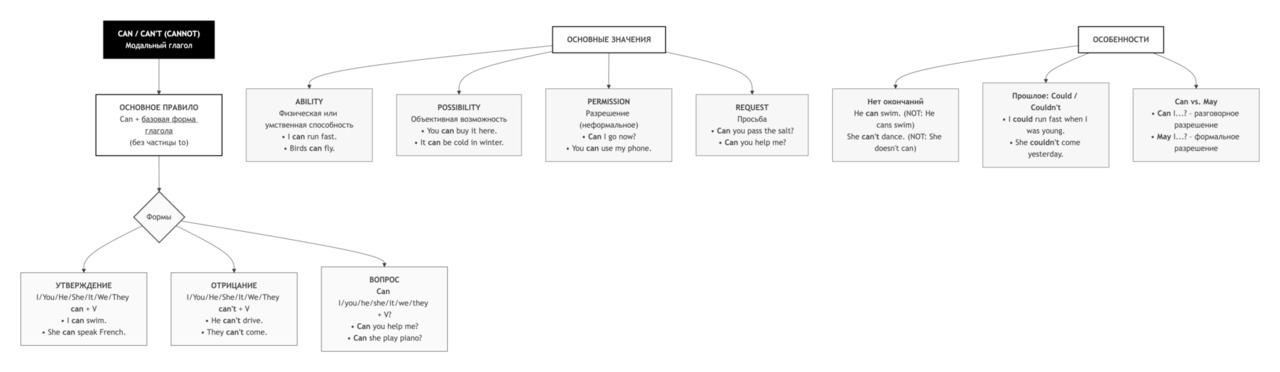
Can используется для выражения:
Умения
I can swim. — Я умею плавать.
Возможности
We can meet tomorrow. — Мы можем встретиться завтра.
Can’t используется для отрицания:
I can’t play the piano. — Я не умею играть на пианино.
She can’t come today. — Она не может прийти сегодня.
Вопросы с can:
Can I help you? — Могу я помочь вам?
Can he speak English? — Он умеет говорить по-английски?
Советы и типичные ошибки:
После can / can’t глагол идёт в инфинитиве без to.
Wrong: I can to swim.
Correct: I can swim.
Can используется для настоящего и будущего, не для прошедшего. Для прошлого обычно используем could.
Story
A Weekend of Abilities
Tom is excited. It is Saturday morning, and he has many plans. He can ride his bicycle very fast. Today, he is riding in the park near his house.
His sister, Anna, can draw beautiful pictures. She is drawing a large landscape with mountains and trees. Tom looks at her work and says, «I can’t draw like that!»
In the kitchen, their mother can cook delicious pancakes. Tom tries to help, but he can’t flip the pancakes correctly.
Later, Tom and Anna plan to play football. Tom can kick the ball far, but Anna can’t run very fast. Still, they enjoy the game and laugh together.
Tom thinks about the day and says, «I can ride, Anna can draw, and Mom can cook. We all have special skills!»
Useful Words and Expressions
can — мочь, уметь
can’t — не мочь, не уметь
ride a bicycle — кататься на велосипеде
fast — быстро
draw — рисовать
picture — рисунок
landscape — пейзаж
mountain — гора
tree — дерево
look at — смотреть на
cook — готовить
pancake — блин
flip — переворачивать
football — футбол
kick — пинать
run — бегать
skill — навык
enjoy — наслаждаться
laugh — смеяться
plan — планировать
Exercises
Exercise 1: Fill in the blanks
Tom ___ (ride) his bicycle very fast.
Anna ___ (draw) a beautiful landscape.
Tom ___ (not / draw) like Anna.
Their mother ___ (cook) delicious pancakes.
Anna ___ (not / run) very fast in football.
Exercise 2: Multiple Choice
Choose the correct form:
I ___ swim very well.
a) can
b) can’t
c) do
She ___ come to the party today.
a) can
b) can’t
c) is
We ___ play football together this afternoon.
a) can
b) can’t
c) are
Exercise 3: Questions about the story
Answer 2–3 sentences each:
What can Tom do very well?
What is Anna doing in the story?
Can Tom draw as well as Anna?
What can their mother do in the kitchen?
Who can run fast, and who can’t?
Answer Key
Exercise 1:
can
can
can’t
can
can’t
Exercise 2:
a) can
b) can’t
a) can
Exercise 3:
Tom can ride his bicycle very fast.
Anna is drawing a beautiful landscape with mountains and trees.
No, Tom can’t draw as well as Anna.
Their mother can cook delicious pancakes in the kitchen.
Tom can run fast, but Anna can’t run very fast.
Mini tips:
После can / can’t всегда используйте глагол без to.
Попробуйте описывать себя и членов семьи: что вы можете делать, а что нет.
Составляйте списки навыков и возможностей, чтобы лучше запомнить конструкции.
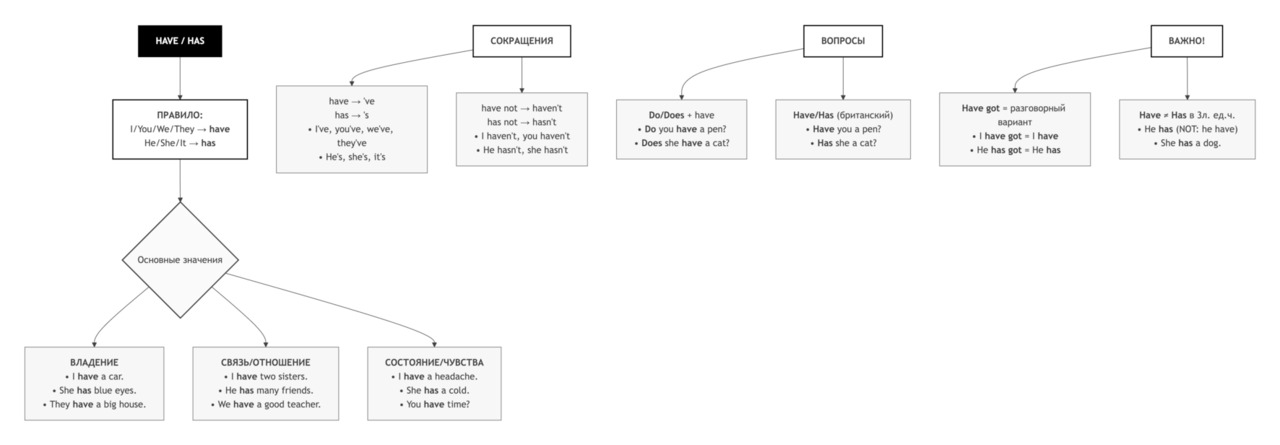
Have / Has — Possession and States
Grammar Focus
Have / Has используются для выражения владения, отношений, состояния или наличия чего-либо.
Have используется с I, You, We, They.
I have a dog. — У меня есть собака.
We have many friends. — У нас много друзей.
Has используется с He, She, It.
She has a new bike. — У неё новый велосипед.
It has four wheels. — У него четыре колеса.
Отрицание:
I / We / You / They don’t have…
We don’t have a car. — У нас нет машины.
He / She / It doesn’t have…
He doesn’t have a pen. — У него нет ручки.
Вопросы:
Do I / you / we / they have …?
Do you have a pet? — У тебя есть питомец?
Does he / she / it have …?
Does she have a bicycle? — У неё есть велосипед?
Советы и типичные ошибки:
Не путайте have / has с глаголом to be.
После don’t / doesn’t всегда have без «s».
Для вопросов используйте вспомогательные do / does, а не переставляйте have.
Story
A Family of Pets
The Roberts family loves animals. They have a dog named Bruno and a cat named Lucy. Bruno is big and brown, and Lucy is small and white.
John, the father, has a parrot. The parrot can speak a few words, and it always surprises the children. The mother, Anna, has many plants in the garden. She takes care of them every morning.
The children also have their own pets. Emma has a hamster, and Peter has a goldfish. They enjoy feeding and playing with their pets every day.
Sometimes, the children notice that Bruno has a favorite toy and Lucy has a cozy bed in the living room. The Roberts family says, «We are happy because we have so many wonderful friends — our pets!»
Useful Words and Expressions
have — иметь, владеть
has — имеет
don’t have — не иметь
doesn’t have — не имеет
dog — собака
cat — кошка
parrot — попугай
hamster — хомяк
goldfish — золотая рыбка
pet — домашнее животное
big — большой
small — маленький
brown — коричневый
white — белый
plant — растение
garden — сад
toy — игрушка
bed — кровать
take care — заботиться
surprise — удивлять
Exercises
Exercise 1: Fill in the blanks
The family ___ (have) a dog named Bruno.
Lucy ___ (be) small and white, and she ___ (have) a cozy bed.
John ___ (have) a parrot.
Emma ___ (have) a hamster.
The family ___ (not / have) any rabbits.
Exercise 2: Multiple Choice
Choose the correct form:
She ___ a bicycle.
a) have
b) has
c) don’t have
They ___ a big garden.
a) doesn’t have
b) has
c) have
Does he ___ a goldfish?
a) has
b) have
c) is
Exercise 3: Questions about the story
Answer 2–3 sentences each:
What pets do the Roberts family have?
What does John have in addition to Bruno and Lucy?
What pets do Emma and Peter have?
What does Lucy have in the living room?
Why is the Roberts family happy?
Answer Key
Exercise 1:
have
is, has
has
has
don’t have
Exercise 2:
b) has
c) have
b) have
Exercise 3:
The Roberts family has a dog named Bruno and a cat named Lucy.
John has a parrot that can speak a few words.
Emma has a hamster, and Peter has a goldfish.
Lucy has a cozy bed in the living room.
The Roberts family is happy because they have many wonderful friends — their pets.
Mini tips:
Помните, что have используется для I/You/We/They, а has — для He/She/It.
Отрицания строятся с don’t/doesn’t + have, не добавляя «s».
Практикуйтесь, описывая свою семью, друзей и домашних животных с помощью have / has.
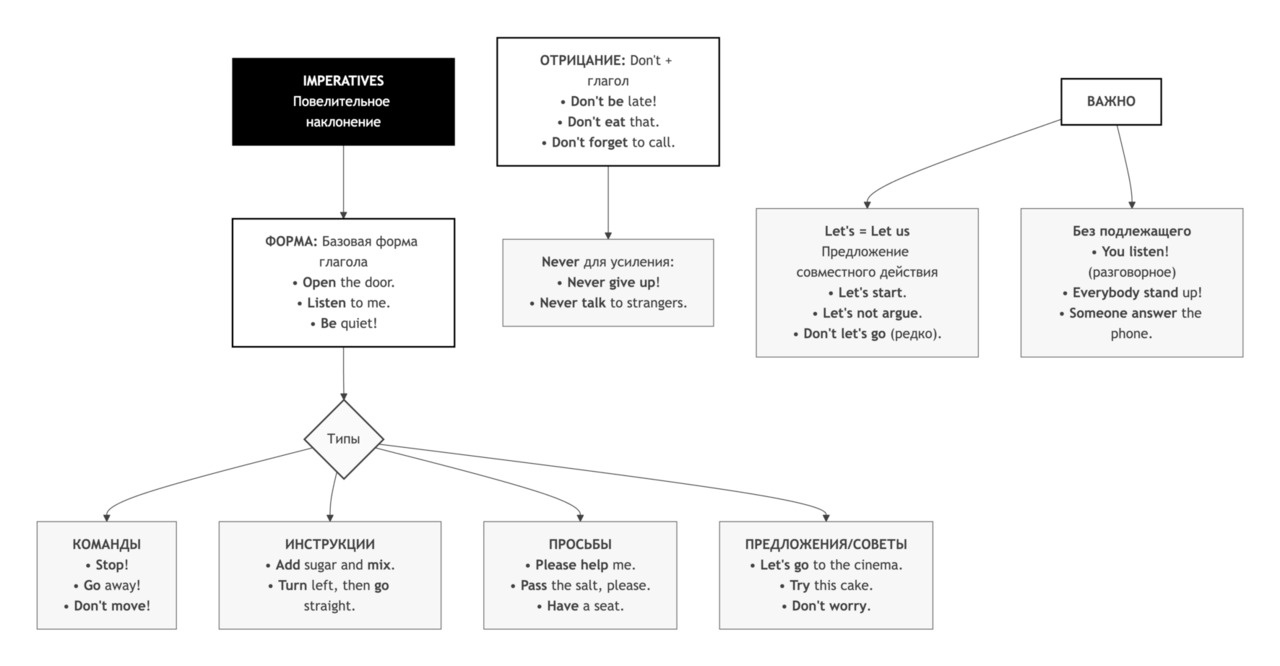
Imperatives — Commands and Instructions
Grammar Focus
Imperatives используются для:
Команд — что кто-то должен сделать.
Sit down. — Садись.
Open the window. — Открой окно.
Инструкций и советов
Turn left at the corner. — Поверни налево на углу.
Don’t touch the hot pan. — Не трогай горячую сковороду.
Особенности:
В предложении нет подлежащего, оно подразумевается (you).
Для отрицательных императивов добавляем don’t перед глаголом.
Don’t run in the corridor. — Не бегай по коридору.
Императив может быть мягким, если добавлены слова please / kindly.
Please close the door. — Пожалуйста, закрой дверь.
Советы:
Используйте простую форму глагола без «to».
В инструкциях говорите кратко и понятно.
Для вежливости добавляйте «please», особенно взрослым.
Story
A Day in the Kitchen
Lisa is helping her mother in the kitchen. Her mother gives her several instructions.
«Wash your hands first,» she says. Lisa washes her hands carefully. «Now, cut the vegetables,» her mother continues. Lisa takes a knife and cuts the carrots and tomatoes.
«Don’t forget to peel the potatoes,» her mother adds. Lisa peels the potatoes and puts them in a bowl. «Boil the water and add the pasta,» her mother says. Lisa follows all the steps carefully.
Finally, her mother tells her, «Stir the soup and taste it. If it needs salt, add some.» Lisa tastes the soup and adds a little salt. The meal is ready, and both of them are happy.
Useful Words and Expressions
wash hands — мыть руки
cut — резать
vegetables — овощи
carrot — морковь
tomato — помидор
peel — чистить
potato — картофель
bowl — миска
boil — кипятить
water — вода
pasta — макароны
stir — помешивать
taste — пробовать
add — добавлять
salt — соль
knife — нож
carefully — осторожно
first — сначала
finally — наконец
ready — готово
Exercises
Exercise 1: Fill in the blanks
___ your hands before cooking.
___ the vegetables carefully.
___ the potatoes before boiling them.
___ the water and add the pasta.
___ the soup and taste it.
Exercise 2: Multiple Choice
Choose the correct imperative:
___ the door, please.
a) Open
b) Opens
c) Opening
___ run in the kitchen.
a) Don’t
b) Does
c) Do
___ the mixture carefully.
a) Stir
b) Stirs
c) Stirring
Exercise 3: Questions about the story
Answer 2–3 sentences each:
What does Lisa do first in the kitchen?
What vegetables does she cut?
What should Lisa do with the potatoes?
How does she prepare the pasta?
How do Lisa and her mother feel at the end?
Answer Key
Exercise 1:
Wash
Cut
Peel
Boil
Stir
Exercise 2:
a) Open
a) Don’t
a) Stir
Exercise 3:
Lisa washes her hands first, as her mother instructed.
She cuts carrots and tomatoes carefully.
She peels the potatoes before putting them in the bowl.
She boils the water and adds the pasta.
Lisa and her mother are happy because the meal is ready.
Mini tips:
В командах и инструкциях всегда используйте глагол в простой форме без «to».
Для отрицаний добавляйте don’t перед глаголом.
Практикуйтесь, составляя короткие инструкции для повседневных действий: уборка, готовка, игры.
Adverbs of Frequency — Always, Often, Sometimes, Never
Grammar Focus
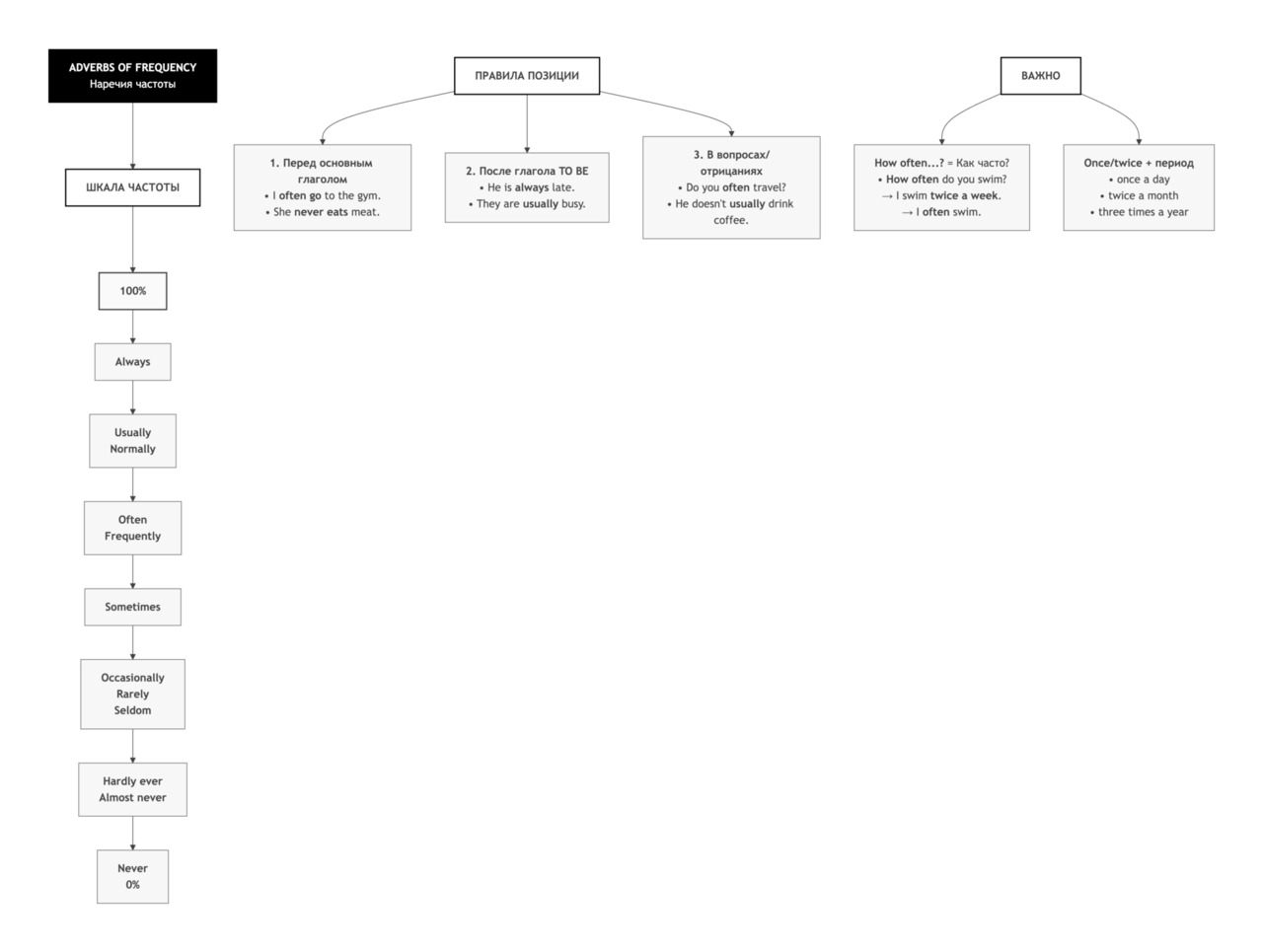
Adverbs of frequency используются для указания, как часто происходит действие. Они помогают описывать привычки и регулярные действия.
Always — всегда (100% случаев)
I always brush my teeth in the morning. — Я всегда чищу зубы утром.
Often — часто (примерно 70–80%)
She often goes for a walk after school. — Она часто гуляет после школы.
Sometimes — иногда (примерно 50%)
We sometimes watch movies on weekends. — Мы иногда смотрим фильмы по выходным.
Never — никогда (0%)
He never eats sweets. — Он никогда не ест сладкое.
Порядок слов:
Наречие ставится перед основным глаголом, но после глагола to be.
I often read books.
She is always happy.
Типичные ошибки:
Наречие не ставят в начале предложения для обычного времени.
Wrong: Always I brush my teeth.
Correct: I always brush my teeth.
С глаголом to be наречие идёт после него.
Correct: He is never late.
Советы:
Используйте наречия, чтобы говорить о привычках и распорядке дня.
Всегда повторяйте одни и те же наречия в разных предложениях, чтобы лучше закрепить их.
Story
A Typical Week for Anna
Anna has a busy week. She always wakes up at seven o’clock. After breakfast, she often walks to school. During lessons, she sometimes forgets to take notes, but she always listens carefully.
In the afternoon, Anna usually goes to the park. She sometimes meets her friends there and they play football together. In the evenings, she never watches TV before finishing her homework.
On Saturdays, she often visits her grandmother. She always helps her in the garden, watering plants and collecting vegetables. Sundays are special — Anna always reads her favorite books quietly in the living room.
Anna says, «I always try to be organized, and sometimes I succeed perfectly!»
Useful Words and Expressions
always — всегда
often — часто
sometimes — иногда
never — никогда
wake up — просыпаться
breakfast — завтрак
walk — гулять, идти пешком
school — школа
lesson — урок
forget — забывать
note — запись, конспект
listen — слушать
carefully — внимательно
afternoon — после полудня
park — парк
meet — встречать, встречаться
play football — играть в футбол
evening — вечер
homework — домашняя работа
garden — сад
Exercises
Exercise 1: Fill in the blanks
Anna ___ (always / never) wakes up at seven o’clock.
She ___ (often / sometimes) walks to school.
She ___ (never / always) forgets to take notes.
She ___ (sometimes / never) watches TV before finishing homework.
On Sundays, Anna ___ (always / often) reads books.
Exercise 2: Multiple Choice
Choose the correct adverb:
I ___ go to the gym after school.
a) always
b) never
c) sometimes
He is ___ late for lessons.
a) sometimes
b) always
c) often
We ___ visit our grandparents on weekends.
a) never
b) sometimes
c) always
Exercise 3: Questions about the story
Answer 2–3 sentences each:
What time does Anna always wake up?
How often does she walk to school?
What does she never do before finishing homework?
What does Anna often do on Saturdays?
What does she always do on Sundays?
Answer Key
Exercise 1:
always
often
sometimes
never
always
Exercise 2:
c) sometimes
b) always
c) always
Exercise 3:
Anna always wakes up at seven o’clock.
She often walks to school after breakfast.
She never watches TV before finishing her homework.
On Saturdays, Anna often visits her grandmother and helps in the garden.
On Sundays, she always reads her favorite books quietly in the living room.
Mini tips:
Наречия always, often, sometimes, never помогают описывать привычки.
С глаголами, кроме «to be», наречие идёт перед глаголом; с «to be» — после.
Попробуйте описывать свой день, используя эти наречия, чтобы закрепить их использование.
Like / Love / Enjoy — Expressing Preferences
Grammar Focus
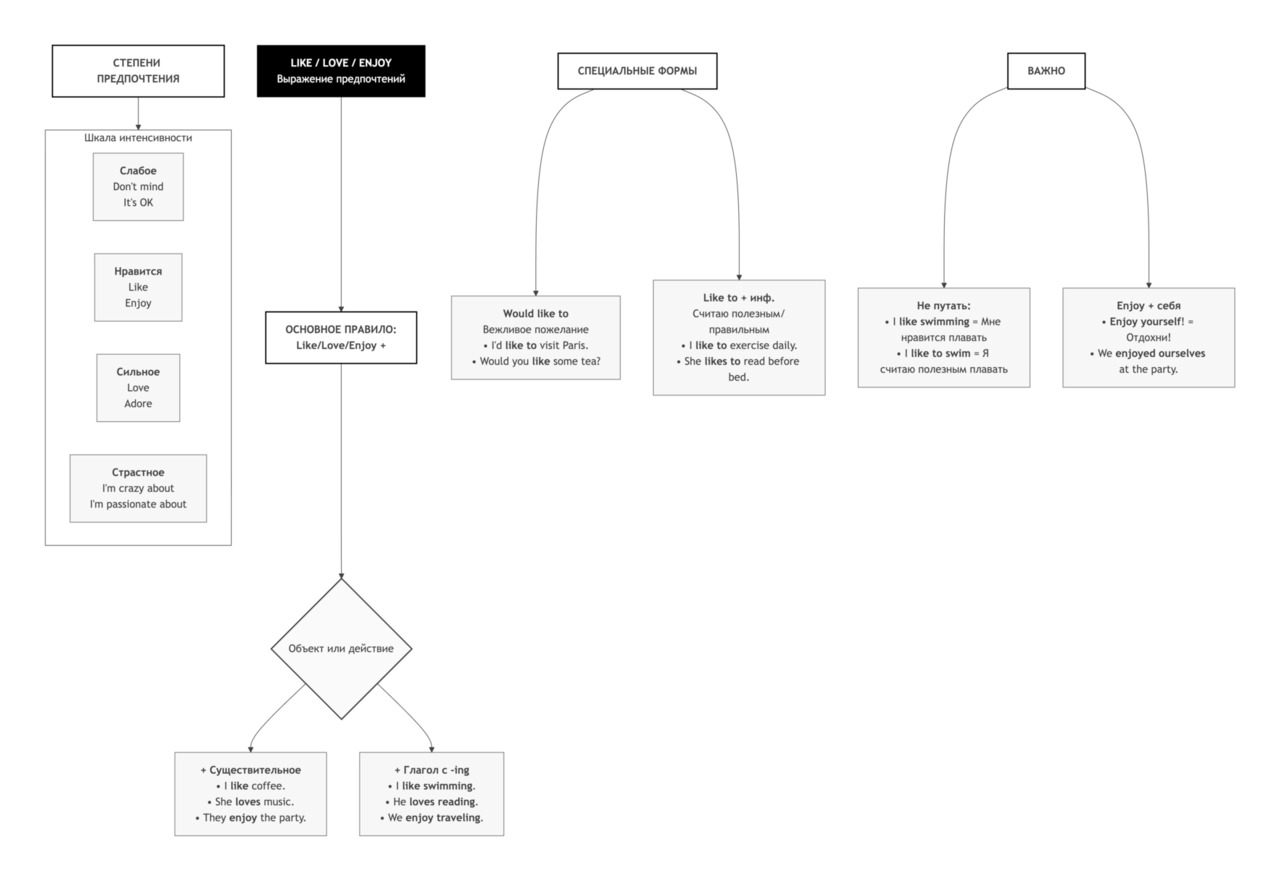
Like / Love / Enjoy используются, чтобы говорить о том, что нам нравится или чем мы увлечены.
Like — нравится, нейтральное предпочтение.
I like pizza. — Мне нравится пицца.
Love — очень нравится, сильная симпатия.
She loves reading books. — Она обожает читать книги.
Enjoy — получать удовольствие, наслаждаться чем-либо.
We enjoy playing football. — Нам нравится играть в футбол.
Порядок слов:
После like / love / enjoy всегда глагол с -ing, если говорим о действии.
I like swimming. — Мне нравится плавать.
Если речь о существительных, просто используем объект.
He loves chocolate. — Он любит шоколад.
Отрицание и вопросы:
I don’t like / love / enjoy…
I don’t like horror movies. — Мне не нравятся фильмы ужасов.
Do you like / love / enjoy …?
Do you enjoy reading? — Тебе нравится читать?
Советы:
Используйте like для обычных предпочтений, love — для сильной симпатии, enjoy — для действий, от которых получаете удовольствие.
Не забывайте ставить -ing после глаголов для описания действий.
Story
Weekend Fun
Emma has a busy weekend. She loves drawing, so on Saturday morning, she spends two hours drawing pictures of animals. She also enjoys listening to music while drawing.
Her brother, Tom, likes playing football. He goes to the park and plays with his friends. Sometimes Emma joins him, but she doesn’t enjoy running as much as Tom.
In the afternoon, the children enjoy baking cookies with their mother. Emma loves chocolate cookies, and Tom likes vanilla ones. They always have fun in the kitchen and enjoy spending time together.
In the evening, Emma reads a new book. She loves reading stories about adventures, while Tom enjoys playing computer games. They agree that weekends are the best time for doing what they like.
Useful Words and Expressions
like — нравиться
love — обожать
enjoy — наслаждаться
don’t like — не нравится
drawing — рисование
picture — рисунок
animal — животное
music — музыка
playing football — играть в футбол
run — бегать
bake — печь
cookie — печенье
chocolate — шоколад
vanilla — ваниль
kitchen — кухня
spend time — проводить время
story — история
adventure — приключение
weekend — выходные
friend — друг
Exercises
Exercise 1: Fill in the blanks
Emma ___ (love / like) drawing pictures.
Tom ___ (enjoy / love) playing football.
Emma sometimes ___ (enjoy / love) running.
They ___ (enjoy / like) baking cookies with their mother.
Tom ___ (like / love) vanilla cookies.
Exercise 2: Multiple Choice
Choose the correct verb:
I ___ reading adventure stories.
a) like
b) love
c) enjoy
She ___ listening to music while drawing.
a) enjoys
b) loves
c) likes
We ___ horror movies.
a) love
b) don’t like
c) enjoy
Exercise 3: Questions about the story
Answer 2–3 sentences each:
What does Emma love doing on Saturday morning?
What does Tom like doing in the park?
Do Emma and Tom enjoy baking cookies?
Which cookies does Emma love?
How do Emma and Tom spend their evenings?
Answer Key
Exercise 1:
love
enjoys
don’t enjoy
enjoy
likes
Exercise 2:
b) love
a) enjoys
b) don’t like
Exercise 3:
Emma loves drawing pictures of animals on Saturday morning.
Tom likes playing football in the park with his friends.
Yes, Emma and Tom enjoy baking cookies with their mother.
Emma loves chocolate cookies, while Tom likes vanilla ones.
In the evenings, Emma reads adventure stories, and Tom enjoys playing computer games.
Mini tips:
После like / love / enjoy добавляйте -ing, когда говорите о действиях.
Используйте like для обычных предпочтений, love для сильной симпатии, enjoy — для действий, которые доставляют удовольствие.
Практикуйтесь, описывая свои хобби и то, что вам нравится.
Past Simple (Regular Verbs) — Correct Verbs
Grammar Focus
Past Simple используется для описания действий, которые уже произошли.
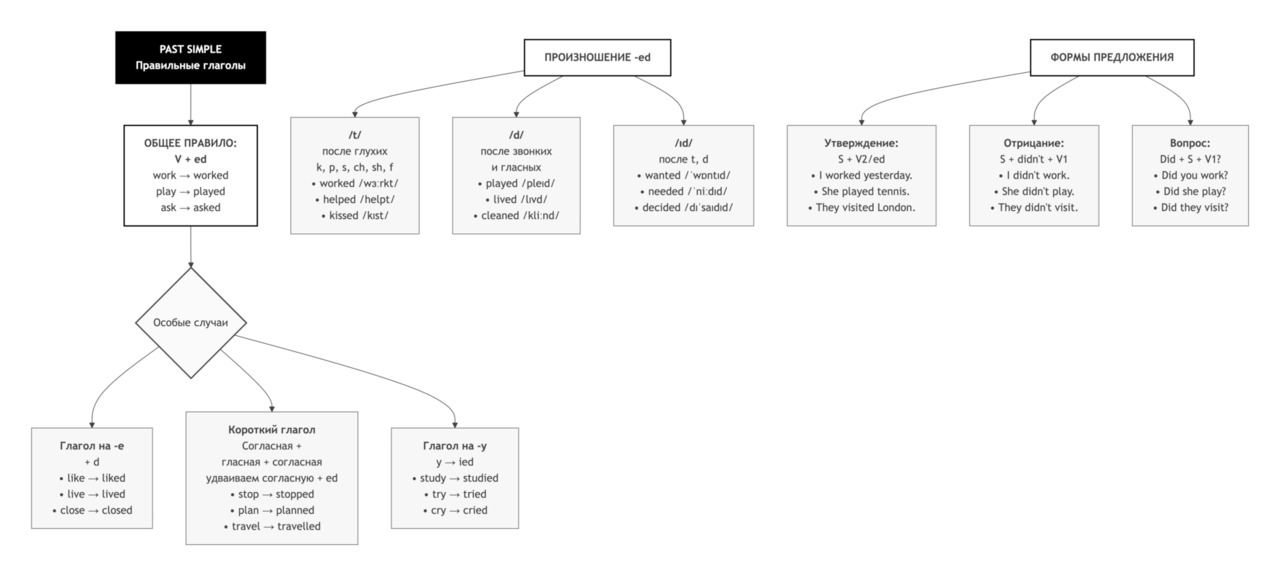
Правильные глаголы образуют форму прошедшего времени с добавлением -ed.
I watched a movie yesterday. — Я смотрел фильм вчера.
She visited her grandmother last weekend. — Она навещала бабушку в прошлые выходные.
Отрицания:
I / You / He / She / It / We / They didn’t + infinitive
I didn’t watch TV yesterday. — Я не смотрел телевизор вчера.
Вопросы:
Did + подлежащее + инфинитив?
Did you play football yesterday? — Ты играл в футбол вчера?
Типичные ошибки:
Не добавлять -ed к неправильным глаголам (нужна отдельная таблица неправильных глаголов для другой главы).
После did всегда используется инфинитив без -ed.
Wrong: Did you watched TV?
Correct: Did you watch TV?
Советы:
Для правильных глаголов просто добавляйте -ed для всех лиц.
Составьте список своих 10–15 часто используемых глаголов и регулярно тренируйтесь.
Story
A Day at School
Yesterday, Peter had a busy day at school. He started the day with math lessons. He watched the teacher carefully and wrote all the notes in his notebook.
During the break, he played football with his friends. They talked about their weekend plans and laughed a lot.
After the break, Peter visited the library. He borrowed a new book and read quietly in the corner.
In the afternoon, he helped his classmate with homework. They studied together and finished the exercises successfully.
Peter enjoyed his day and went home happily. He talked to his mother about everything he had done at school.
Useful Words and Expressions
start — начинать
watch — смотреть
write — писать
play — играть
talk — говорить, разговаривать
laugh — смеяться
visit — навещать, посещать
borrow — брать (книгу, вещь)
read — читать
help — помогать
study — учиться
finish — заканчивать
enjoy — наслаждаться
go — идти, ехать
home — домой
school — школа
notebook — тетрадь
lesson — урок
break — перемена
friend — друг
Exercises
Exercise 1: Fill in the blanks
Peter ___ (start) the day with math lessons.
He ___ (watch) the teacher carefully.
During the break, he ___ (play) football with friends.
Peter ___ (borrow) a book from the library.
They ___ (finish) the exercises successfully.
Exercise 2: Multiple Choice
Choose the correct past form of the verb:
Yesterday, I ___ a movie.
a) watched
b) watch
c) watching
She ___ her homework last night.
a) did
b) do
c) does
We ___ to the park on Saturday.
a) go
b) went
c) going
Exercise 3: Questions about the story
Answer 2–3 sentences each:
What did Peter do in the morning?
Who did he play football with?
What did Peter borrow from the library?
How did he help his classmate?
How did Peter feel at the end of the day?
Answer Key
Exercise 1:
started
watched
played
borrowed
finished
Exercise 2:
a) watched
a) did
b) went
Exercise 3:
In the morning, Peter started his math lessons, watched the teacher carefully, and wrote notes in his notebook.
He played football with his friends during the break.
Peter borrowed a new book from the library.
He helped his classmate with homework, and they studied together.
Peter enjoyed his day and went home happily, talking to his mother about everything he had done.
Mini tips:
Для правильных глаголов просто добавляйте -ed для всех лиц.
После did используйте инфинитив без -ed.
Попробуйте описывать свой вчерашний день, используя 5–10 правильных глаголов в Past Simple.
Irregular Verbs — неправильные глаголы
be — was / were — been (быть)
become — became — become (становиться)
begin — began — begun (начинать)
break — broke — broken (ломать)
bring — brought — brought (приносить)
build — built — built (строить)
buy — bought — bought (покупать)
catch — caught — caught (ловить)
choose — chose — chosen (выбирать)
come — came — come (приходить)
cost — cost — cost (стоить)
cut — cut — cut (резать)
do — did — done (делать)
draw — drew — drawn (рисовать)
Бесплатный фрагмент закончился.
Купите книгу, чтобы продолжить чтение.